Belt Tension Deflection Calculator
Compare span deflection force, belt type, pulley diameter, static tension, and correction factor using the standard force-deflection field method.
Belt Deflection Results
Calculation Breakdown
| Belt profile | Typical force range | Minimum small pulley | Common use |
|---|---|---|---|
| 3L fractional V-belt | 2.0-3.5 lb | 2.0 in | Small blowers, bench tools |
| A / 4L classical V-belt | 4.0-6.0 lb | 3.0 in | HVAC fans, pumps |
| B / 5L classical V-belt | 7.0-10.0 lb | 5.4 in | Compressors, conveyors |
| AX notched V-belt | 4.5-7.0 lb | 2.6 in | Compact high-flex drives |
| BX notched V-belt | 8.0-12.0 lb | 4.6 in | Higher torque V drives |
| 3VX wedge belt | 6.0-9.0 lb | 2.65 in | Industrial narrow belts |
| 5VX wedge belt | 12.0-18.0 lb | 4.4 in | Heavy industrial drives |
| PK multi-rib belt | 3.0-5.0 lb per rib | 2.4 in | Serpentine accessory drives |
| Free span | Target deflection | Metric deflection | Measurement note |
|---|---|---|---|
| 12 in | 0.188 in | 4.8 mm | Use a light spring gauge |
| 18 in | 0.281 in | 7.1 mm | Short fan or motor base |
| 24 in | 0.375 in | 9.5 mm | Common HVAC service span |
| 30 in | 0.469 in | 11.9 mm | Medium industrial span |
| 36 in | 0.563 in | 14.3 mm | Large compressor span |
| 48 in | 0.750 in | 19.1 mm | Long conveyor span |
| Condition | Correction factor | When to use | Result effect |
|---|---|---|---|
| Worn belt or small pulley | 0.85 | Known flex loss, marginal diameter | Lowers target force |
| Normal used belt | 1.00 | Routine inspection after run-in | Catalog range unchanged |
| New belt run-in | 1.15 | Fresh belt before first retest | Raises force range |
| Shock load or wet start | 1.25 | Frequent starts, damp load | Adds tension margin |
| High acceleration drive | 1.35 | Fast cycling or high inertia | Highest field allowance |
| Observed reading | Likely condition | Adjustment direction | Follow-up check |
|---|---|---|---|
| Below low force | Loose belt | Increase center distance | Retest after locking base |
| Inside force range | Acceptable tension | No change if no symptoms | Record reading and date |
| Above high force | Overtensioned belt | Reduce center distance | Check bearing temperature |
| Large force drift | Settling or wear | Inspect belt and sheaves | Repeat after run-in |
| Pulley below minimum | High flex stress | Verify belt profile | Use manufacturer rating |
When you start your vehicle in the early morning after a night in the cold and experience high pitched squeal, it’s the belt. And while this sound will be short lived and may take some tools to prove it, many mechanic and do-it-yourself types base their diagnosis on guess work rather different than measurement.
In truth, it’s not as complicated as it seems, although it can feel counterintuitive. Too tight? It causes overheating due to friction heat on motor bearings which wear them out prematurely. Too loose? It slips, decreasing the efficiency of power being transmitted through the belt. Finding the middle ground between these two conditions prevent an overuse diagnosis.
How to Check Belt Tension
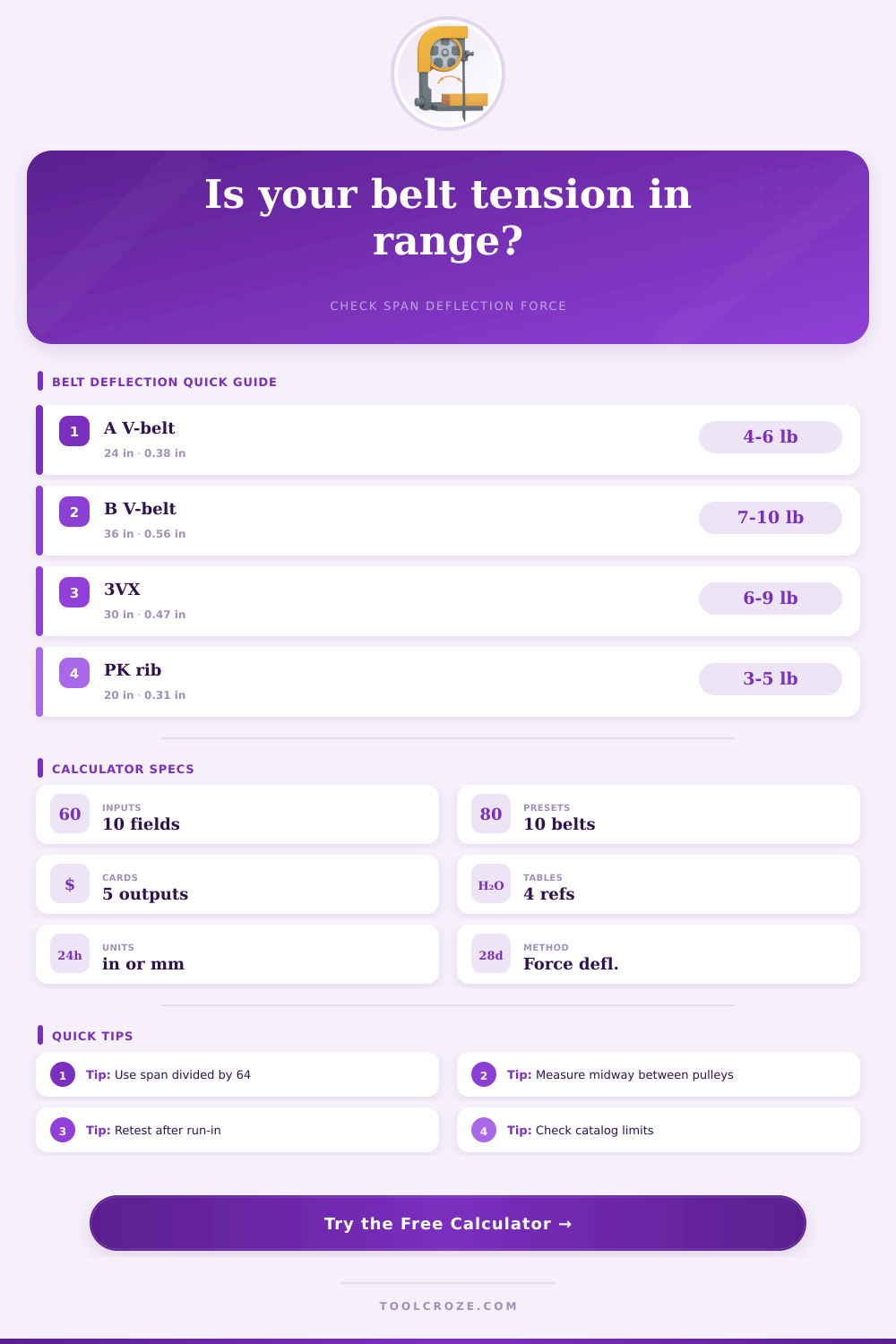
Deflection force is the balance point here. It measures how much pressure applied halfway between two pulley causes the longest section to move. That way the unseen force becomes a real distance you can see and write down. All you have to do in the field when making a call is figure out how far your force needs to go to make the belt move a certain distance; then input the span length and push force in calculator, and it will do the math for you. Just memorize the physical length of things plus the amount of force needed to move them a set distance.
Generally speaking, the free span length should of been divided by sixty-four to find the target deflection distance, accounting for each belt’s flexibility. The longer the span, the greater it need to bend to reflect equal tension. Conversely, a small span bends easily to indicate tension problems with minimal force. When you push on a long belt just a millimeter, that’s testing it structurally not in terms of tension. Standardizing the deflection distance mean that pushing down five pounds work the same way on different pieces of equipment.
There are two important correction factors that act as multipliers of reality, 1) new belts is tight and haven’t seated on their pulley grooves. If you tension a new belt to its final specs when new, it will stretches the first hour it’s run and become dangerously loose. This seating factor is included in a more aggressive initial force range setting with the tool.
Old belts or belts running on small pulleys wear out and becomes less flexible. In these situations, reducing the target force mean you’re never going to overtighten components beyond what they can take from normal stress loads.
“Getting the measurement off-center will give you an incorrect measurement; do not measure too close to where the belt wraps around the pulley. Near the pulley wrap area, the belt has a slight curve supporting it. That curve feel stiffer than the rest of the belt, so we wrongly think the belt needs more tension. It’s not. It just wants to be stretched out evenly all across the span.”
Don’t expect to get it perfect on your first try; just make small deliberate adjustments during this process step. How does it measure up? Compare that reading to what the manufacturers suggest. Is it too light? Crank up that center distance some more and try again. Too heavy? Back off the mount and don’t let ‘er get hot on those shaft mounts! There are handy tables to check your work quickly for popular belts so you know you’re within industry norms.
Getting the right tension isn’t something you do perfectly in one shot… It’s a series of small adjustments done with care. Respect the belt’s material limits. It’ll handle power effective while keeping wear on the supporting equipment to a minimum.