Beer Hose Length Calculator
Balance a draft beer line from keg pressure to faucet by combining hose resistance, vertical lift, faucet restriction, beer temperature, carbonation target, and serving speed.
⚙Draft System Presets
Choose a real draft setup, then adjust the numbers for your keg, faucet height, hose material, and preferred pour speed.
🍺Beer Line Inputs
Use actual pressure at the keg, after secondary regulators if installed.
Positive means faucet above keg; negative means faucet below keg.
Used to compare serving pressure with carbonation equilibrium.
A common clean draft target is about 1 US fluid ounce per second.
Balanced Draft Line Result
Recommended Hose Length
0.0
feet of beer lineLine Resistance Needed
0.0
psi absorbed by hoseEstimated Pour Rate
0.0
Carbonation Check
Good
pressure vs volumesFormula Breakdown
🧪Tubing and Material Spec Comparison
📊Draft Line Resistance Reference
| Inside Diameter | PVC Vinyl | Barrier Tubing | Polyethylene | Best Use |
|---|---|---|---|---|
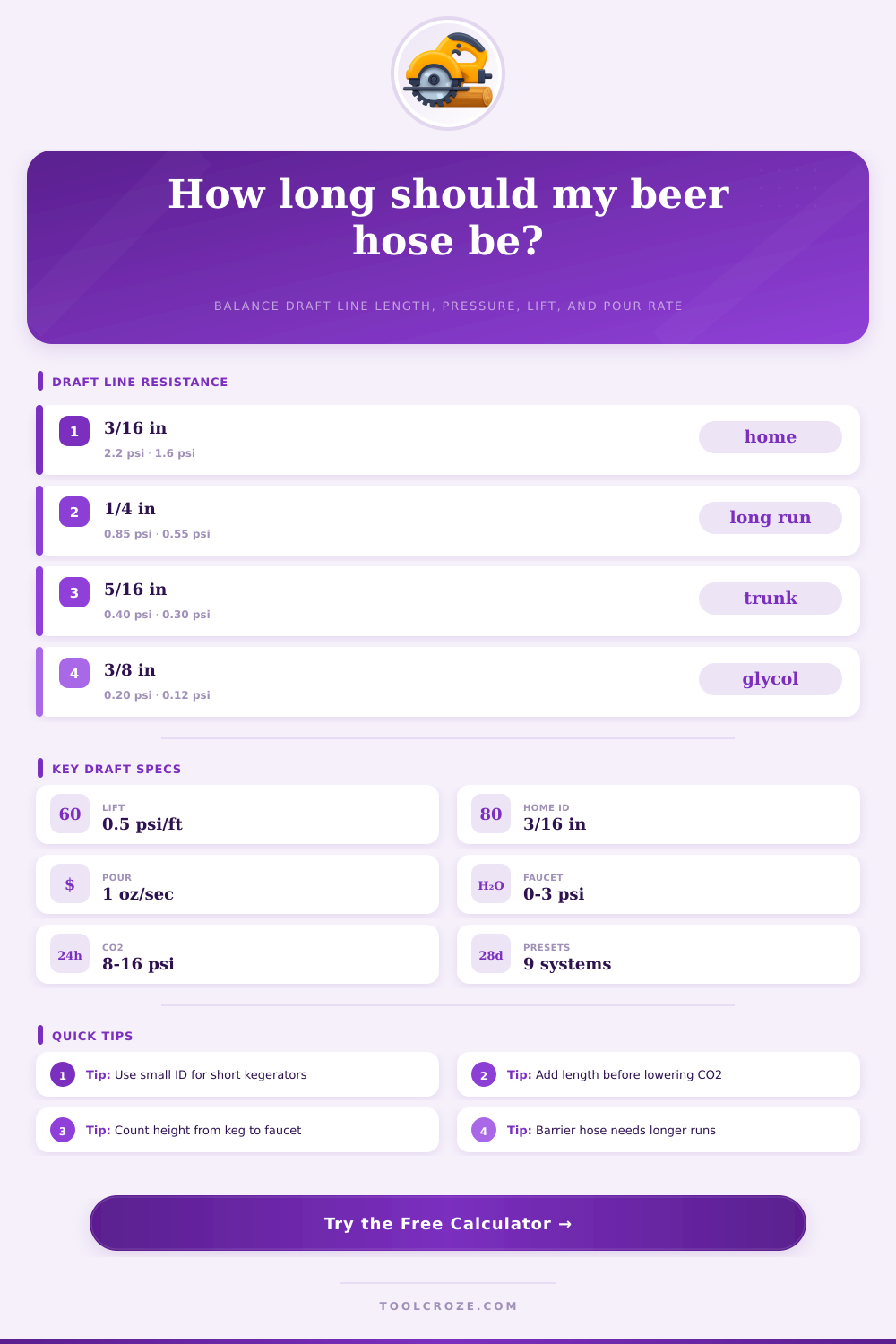
| 3/16 in - 4.8 mm | 2.0 to 3.0 psi/ft | 1.4 to 1.8 psi/ft | 1.2 to 1.6 psi/ft | Short kegerator and keezer lines |
| 1/4 in - 6.4 mm | 0.65 to 0.95 psi/ft | 0.45 to 0.65 psi/ft | 0.35 to 0.55 psi/ft | Medium back-bar runs |
| 5/16 in - 7.9 mm | 0.35 to 0.50 psi/ft | 0.25 to 0.35 psi/ft | 0.20 to 0.30 psi/ft | Long trunk lines and glycol systems |
| 3/8 in - 9.5 mm | 0.18 to 0.28 psi/ft | 0.10 to 0.18 psi/ft | 0.08 to 0.14 psi/ft | Main trunk with separate choker line |
🌡Temperature and Carbonation Pressure Guide
| Beer Temp | 2.2 Vol CO2 | 2.5 Vol CO2 | 2.8 Vol CO2 | Common Beer Fit |
|---|---|---|---|---|
| 36°F - 2°C | 8.0 psi | 11.7 psi | 15.7 psi | Lager, pale ale, wheat |
| 38°F - 3°C | 8.9 psi | 12.6 psi | 16.7 psi | All-purpose home draft |
| 42°F - 6°C | 10.7 psi | 14.6 psi | 18.8 psi | English ale, stout, amber |
| 46°F - 8°C | 12.6 psi | 16.7 psi | 21.0 psi | Warmer cellar dispense |
🔧Faucet, Shank, and Hardware Restriction
| Hardware | Typical Restriction | When to Use | Calculator Setting |
|---|---|---|---|
| Standard faucet and short shank | 0.8 to 1.2 psi | Most kegerators | Standard faucet |
| Forward seal faucet | 1.0 to 1.5 psi | Home bars with frequent use | Forward seal faucet |
| Flow-control faucet half open | 2.0 to 4.0 psi | Fine-tuning mixed beer styles | Flow control faucet |
| Stout restrictor plate | 6.0 to 10.0 psi | Nitrogen stout dispense | Stout restrictor |
📏Common Draft System Starting Points
| System Type | Starting Pressure | Suggested Hose | Typical Length | Notes |
|---|---|---|---|---|
| Single-tap kegerator | 10 to 12 psi | 3/16 in PVC | 5 to 7 ft | Simple short run with standard faucet |
| Home keezer collar | 11 to 14 psi | 3/16 in PVC or barrier | 6 to 10 ft | Extra coil length helps reduce foam |
| Back-bar remote keg | 14 to 18 psi | 1/4 in barrier | 18 to 35 ft | Often needs lift and hardware allowance |
| Glycol trunk system | 16 to 24 psi | 5/16 in trunk plus choker | 40 ft and up | Final balance usually happens in choker line |
💡Draft Line Calculation Tips
The length of the beer line are a critical factor in the way that the beer can pour into the glass. The length of the beer line will determine if the beer is poured clean into the glass, or if the beer foams over the rim of the glass. While many people may believe that the issue is with the length of the beer line or the pressure on a regulator, there are many factors to consider in order to achieve a succesful draft beer pour.
The factors to consider include the relationship between the pressure on the regulator, the height of the line, the diameter and material of the tubing, the type of faucet hardware, the temperature of the beer, the carbonation target for the line, the target pour speed, and any mistake that can be made in adjusting these variables. The regulator pressure must perform two main function within the system. The regulator pressure must be sufficient to provide the desired carbonation levels for the beer, yet the pressure must also be sufficient to overcome any resistance within the beer line itself.
What Affects a Draft Beer Pour
If the regulator is set to a pressure that is too low to provide the desired carbonation levels, the beer will lose carbonation over time. If the regulator pressure is too high relative to the resistance of the beer line, the beer will create too much foam when pour. Thus, the length of the beer line can help to absorb some of this excess pressure from the regulator.
Height is one of the factors that must be accounted for within the calculation of the proper length of the beer line. The height of the beer line will affect the amount of pressure that is delivered to the beer line. For every foot of height that the beer line must travel upwards towards the faucet, the beer will lose 0.5 pound of pressure.
For example, if the faucet is placed on a tower three feet above the keg, the beer will lose 1.5 pounds of pressure before it reach the pour vessel. Calculators can account for the height of the pour line so that the length of the beer line and the regulator pressure can be calculated without guessing at these variable. In cases where the faucet is positioned beneath the keg, the same mathematical calculations can be used since the drop in height will add to the pressure of the beer.
The diameter of the tubing and the material of the tubing will impact the amount of pressure that will be absorbed by the line. For instance, narrow tubing, such as 3/16 inch tubing, will allow for more friction than wider tubing. Because draft beer lines with 3/16 inch tubing are common within home kegerators, these narrow lines allow for enough resistance within the line even if the line is short in length.
In contrast, lines with a larger diameter, such as 1/4 inch or 5/16 inch tubing are better for longer lines since the wider lines will lose less pressure than narrow tubing. Furthermore, the material of the tubing will influence the resistance of the line; lines made with barrier tubing will have less restriction within the line than lines made from vinyl tubing. A calculator will allow a draft line designer to select the type of tubing they wish to use so that the variables reflect the actual tubing that will be construct.
The faucet hardware will restrict the line in a manner that can be accounted for within the draft beer line calculator. For instance, standard faucets and shanks will absorb around 1 pound of pressure. Flow control faucets that are only partly open may absorb 3 pounds of pressure, and stout restrictor plates may absorb as much as 8 pounds of pressure.
Each of these individual units can be accounted for when calculating the total length of the beer line since the total restriction of each of these component will impact the length of the line required to balance the system. In addition to the variables discussed above, two additional variables must be considered in the calculation of the proper length of the draft beer line: the temperature and carbonation target for the beer. The temperature of the draft beer will impact the amount of carbon dioxide that is dissolved into the beer.
If the temperature of the beer is changed without adjusting the regulator pressure for the system, the beer may become over-carbonated, or it may lose it carbonation entirely. The calculator can compare the serving pressure to the equilibrium pressure at that temperature so that the owner of the keg and the beer line can ensure that both are in agreement with one another. If the temperature and the pressure are not in agreement with one another, the draft line will produce either too slow or too fast pours of beer, and the length of the line will not fix this problem.
In addition to the variables discussed above, pour speed is a variable that may be considered when designing a draft beer line. For instance, a target pour speed of one ounce of beer per second will allow a person to fill a pint glass (16 ounces) in 16 second. Pours that are too fast may hide issues within the system, such as insufficient pressure or too much friction within the system; however, pours that are too fast may lead to a rough tasting draft beer.
Pour speeds that are slower than one ounce per second are more easily controlled when pouring beer, but may be tedious to serve large amounts of beer quickly. The draft beer line calculator has a setting that allows the individual to set their preference for pouring the beer faster or slower to match the preferences of those who will be drinking the beer. Common mistake can be made when adjusting the draft beer line.
For instance, one of the most common mistakes is to lower the regulator pressure to reduce the formation of foam at the outpour of the draft beer line. Yet, lowering the regulator pressure will also reduce the carbonation of the beer. Another common mistake is to increase the length of the draft beer line in an attempt to slow the rate at which the beer is pour.
Yet, increasing the length of the draft beer line will also increase the resistance within the line, causing the beer to pour too slow. Each of these individual mistakes can be accounted for within the draft beer line calculator so that an individual can avoid making these mistakes when creating their draft system. It should be understood that no mathematical calculation will account for every single variable within the draft beer line system.
For instance, slight changes in the temperature of the environment in which the draft line is created will impact the length of the draft beer line. Additionally, the placement of the draft line can change the outcome; lines that are exposed to direct sunlight may experience slight shifts in the length of the line that is required to achieve even the most consistent draft beer line. Thus, these calculations will only provide a starting point for creating a draft beer line.
After constructing the draft line according to the calculations, the draft line may need to be trimmed or additional tubing may need to be added to account for environmental factors. The draft beer line calculator will provide a starting point, but not guarantee a perfect pour of beer on the first attempt. Yet, the goal of creating a draft beer line is to be able to provide a steady pour of beer that maintains the same head and flavor every time the beer is pour.
This goal will be met when the length of the draft beer line, the regulator pressure, and the faucet hardware are all in balance with one another.