Bearing Tolerance Calculator
Check bearing bore and OD limits, shaft and housing fit classes, measured min/max dimensions, ISO fit allowance, temperature expansion, and stack-up before assembly.
⚙ Presets
📏 Inputs
Calculated Bearing Fit
📊 Tolerance Spec Grid
📘 Bearing Tolerance Classes
| Class | Typical use | Bore window | OD window | Notes |
|---|---|---|---|---|
| P0 | General machinery | normal | normal | Good default for motors, pumps, rollers, and shop repairs. |
| P6 | Improved runout | about 65% of P0 | about 65% of P0 | Use when alignment and speed matter more than general fit. |
| P5 | Precision spindle | about 45% of P0 | about 45% of P0 | Measure carefully; small thermal shifts can consume the fit. |
| P4 | High precision | about 30% of P0 | about 30% of P0 | Confirm the bearing maker table before release. |
⚖ Shaft and Housing Fit Reference
| Fit class | Approx range | Ring behavior | Best match | Caution |
|---|---|---|---|---|
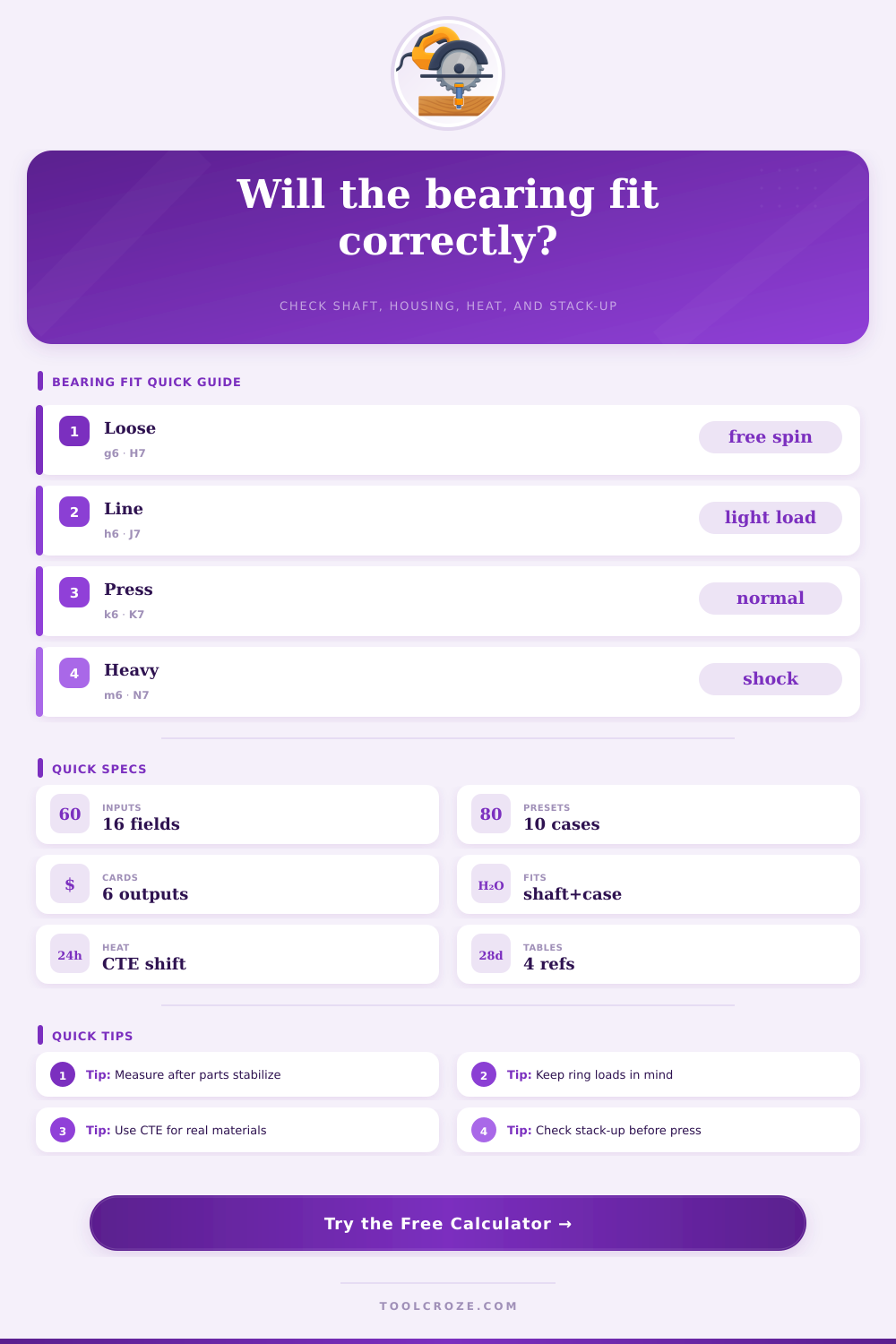
| g6 / H7 | clearance | easy slip | light load, fixed ring | May creep under rotating load. |
| h6 / J7 | line to transition | light hold | serviceable assemblies | Measure roundness before final fit. |
| j6 / K7 | transition | selective fit | normal bearing seats | Small heat changes alter the feel. |
| k6 / M7 | light press | positive location | rotating ring loads | Can reduce internal clearance. |
| m6 / N7 | press | firm location | shock or vibration | Check mounting force and shoulders. |
| p6 / P7 | heavy press | locked ring | high load seats | High preload risk if clearance is low. |
🌡 Thermal Expansion Reference
| Material | CTE um/m/C | Common part | Fit effect | Shop note |
|---|---|---|---|---|
| Bearing steel | 11.5 | rings and balls | baseline | Use maker data for hybrid bearings. |
| Carbon steel | 11.5 | shaft | tracks bearing | Usually small heat shift. |
| Stainless steel | 17.0 | shaft or sleeve | adds growth | Can tighten hot inner fits. |
| Cast iron | 10.5 | housing | slower growth | May hold OD fit as temperature rises. |
| Aluminum | 23.0 | housing | adds clearance | Hot housings can loosen the outer ring. |
| Bronze | 18.0 | bushing carrier | moderate growth | Check retained clearance hot. |
🔧 Stack-Up Planning Table
| Stack item | Typical tolerance | Effect on bearing | Check method | Action |
|---|---|---|---|---|
| Shaft shoulder | 0.005-0.020 mm | axial location | indicator sweep | Face before assembly if tilted. |
| Spacer sleeve | 0.005-0.030 mm | preload stack | micrometer pair | Sort or grind as matched set. |
| Housing step | 0.010-0.050 mm | outer ring support | bore gauge and square | Confirm contact before pressing. |
| Shim pack | 0.005-0.025 mm | endplay control | total pack height | Use measured thickness, not label. |
| Retainer plate | 0.010-0.040 mm | clamp force | blueing or feeler | Avoid side loading the ring. |
💡 Tips
This bearing tolerance calculator compares measured shaft and housing limits with bearing tolerances, fit classes, temperature growth, ISO allowance, and stack-up so assemblies can be checked before pressing.
A bearing must have the correct fit with a shaft or a housing for the machine to operate smooth without making any noises. A bearing must have enough grip to stay in place with the rotating components. However, the grip must not be so much that it remove the internal clearance of the bearing.
The difference between the correct and incorrect fit for a bearing are quite small. Hence, you can use a calculator to determine the correct fit. To use the calculator, the user has to enter the bore and outside diameter of the bearing.
How to Use the Bearing Fit Calculator
The user must also enter the bearing tolerance class, the shaft fit class, and a housing fit class. The user should also enter the minimum and maximum dimension for the bearing and the housing. The actual dimension of the components are different than those on the print.
The dimensions on the print drawings may not reflect the actual components when they is manufactured. When the user enters the minimum and maximum dimensions of the components into the calculator, it shows whether the interference or the clearance for the components falls within the range of the bearing manufacturers. The fit of the bearing to the shaft or the housing can also be affected by the change in the temperature of the components.
For example, aluminum housings expand at a faster rate than steel bearings. A rise in the temperature of the housing can loosen the outer ring of the bearing. The calculator allows the user to enter the temperature rise of the components and the expansion rate of three materials involved in the assembly.
By doing so, the calculator shows how this rise in the temperature will affect the fit of the components. A motor that produce alot of heat or that is housed next to a heat source will alter the temperature of the bearing. Such an alteration can occur in cold environments as well.
In cold environments, a contraction in the materials will make the bearing components fit tight together. The bearing fit classes depends on the application. For example, if the load on the wheel is very light, the outer ring of the bearing should have enough clearance to be able to slide in and out of the housing.
However, if the shaft on which the gear is mounted experience a shock load, the inner ring should have a press fit with the shaft so that the gear does not move on the shaft. The tables provided on the page provides fit classes and the behavior of the rings of the bearing. However, the bearing fit calculator performs these calculations using the dimension of the components that you will use.
Hence, you will not have to memorize these fit classes and the behaviors of the rings of the bearing. The fit of the bearing to the components can also be affected by the number of component in the assembly. For example, if there is a shoulder on one of the components, a spacer sleeve, and the housing, all of these may affect the fit of the bearing.
The calculator asks for the number of components in the assembly and the tolerance of each component. By entering these dimension, the calculator will give the statistical stack of the components as well as the worst-case total stack. Knowing the difference between the statistical and the worst-case total stack will help you determine whether to tighten the tolerance of the components or to use shimming in the assembly to achieve the desired fit.
Even though the bearing catalog will provide you with fit recommendations for your application, you should not solely use this information. The catalog does not know the roundness of your shaft, the size of your bearing, or the temperature of the housing. Using the real measurements of your components in the calculator will give you a more better idea of whether there is going to be too much interference between the components when they reach the operating temperature.
You can also use the real measurements of the components to determine whether there is a risk of having a clearance fit for the components. The retained internal clearance for the bearing must also be considered. When you press the inner ring of the bearing on the shaft, some of the internal clearance of the bearing are lost.
Furthermore, the thermal growth of the bearing will also lead to a loss of internal clearance of the bearing. If the calculator shows a heavy press fit on the inner ring with the shaft and there is going to be a heat shift between these two components, you must ensure that the bearing has enough internal clearance to accommodate the rotational speed of the component and the lubrication between the components. It is far easy to check the internal clearance of the bearing before pressing in the components than after the assembly is running.
The same logic apply to the outer ring of the bearing. For instance, if the housing has a clearance fit for the outer ring of the bearing, there will be a clearance between these two components. However, if your application require the outer ring of the bearing to be able to rotate on its axis relative to the housing, the calculator will show you this mismatch.
You will then be able to decide whether to change the fit class of the outer ring of the bearing or to add a locating feature to ensure that it does not rotate on its axis. Using the bearing fit calculator will allow you to make a documented decision on the fit of the bearing to the shaft and the housing. By entering the dimensions of the components, the fit classes, the temperature, and the component stack into the calculator, you will get the information that you need to adjust the tolerance of the components or to change the material that you are using for the components in the assembly.