
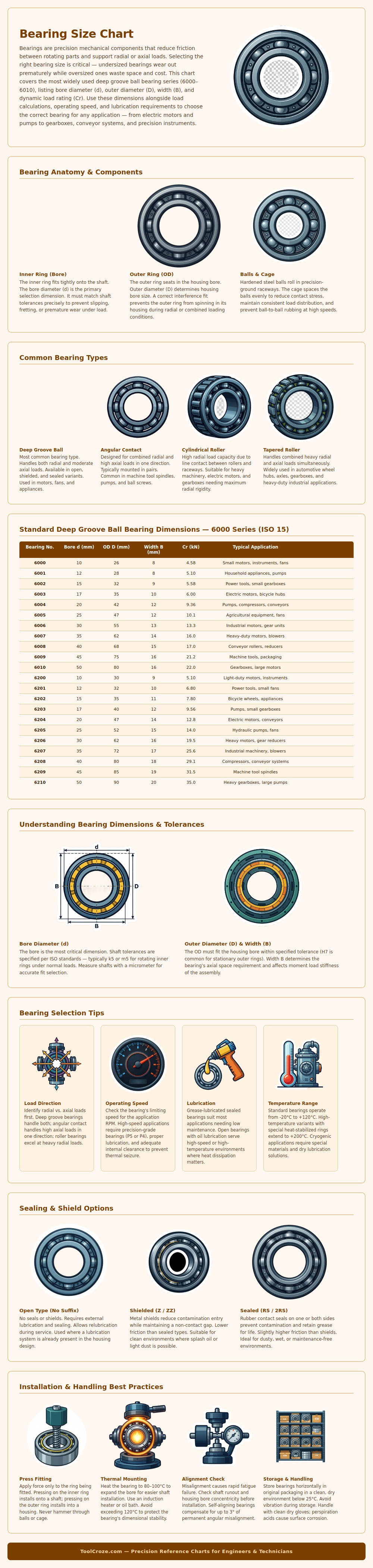
Almost all rotary machines has bearings. They’re the parts inside of them that make something turn smooth rather then seize up or grind. If you get the wrong size into a bearing, that’s where it gets problematic. Too big and it just takes up space and weighs down your thing, too small and it’ll wear out quicky.
It isn’t so much about memorizing size numbers as it is understanding what each dimension actualy controls. You want your shaft size to be similar to your inner ring bore since it rests directly on the shaft. You also need to know how big an outer ring will be. This is what goes into the housing, and its size set the minimum diameter for your surrounding structure. And then there’s width, which controls stiffness during moment loads and axial space taken up by the bearing.
How to Choose the Right Bearing Size
That’s basically the language of bearings: three numbers plus a dynamic load rating that describes how hard the bearing can works before failing over time. The chart above plots those relations for typical sizes of deep groove bearings so you can visualize where capacity jumps around and where they is all bunched up.
Ball bearings deals with moderate axial (side-to-side) and radial (straight-up-and-down) loads and can be mounted without any special arrangement. Angular contact bearings: Can take more thrust on one axis and typically run in pairs. Cylindrical rollers carry heavy radial loads through line contact instead of point contact. They’re found anywhere where large amounts of weight are being carried by a wheel or gearbox. Tapered rollers handle combined loads (weight plus side force) at the same time. You’ll find these where gearboxes or wheels encounters both sides plus weight.
Bearing size isn’t everything. Speed is also a factor. A bearing might fit exactly on paper but not run well because it’s turning to fast for its tolerance. Lubrication is also key. Without proper grease reaching the contact areas, no bearing will work regardless of size. For most every day gear, sealed bearings retains lubricant while keeping contaminants out, period. This means they’ll last forever (well almost). Open bearings require protection from outside forces but can be relubed. The conditions might be dirty or hot, or clean and cool, that decides the best fit.
Good sizing can be undone by poor installation. Common causes of premature death include skipping an alignment check, pressing on the wrong ring, and leaving bearings where they could of get damp. Heating up the bearing slightly before seating will help prevent damage as it slide on, but going too far can cause other issues by overheating the bearing past its stability point. Proper handling is easy once you know to apply force only to the ring being seated.
You get the real reward when a bearing outlasts the machine in which it’s mounted. And that doesn’t happen by chance very often. It happens when someone takes the time to match inner diameter, outer diameter, width, load rating, speed and environment before something turn on.
