Bearing Press Fit Calculator
Estimate bearing inner-ring interference, equivalent contact pressure, assembly heat relief, and the press force needed to seat a bearing on a shaft.
Use measured shaft and bearing bore values when possible. The direct interference field can override the shaft-minus-bore result for tolerance-stack checks.
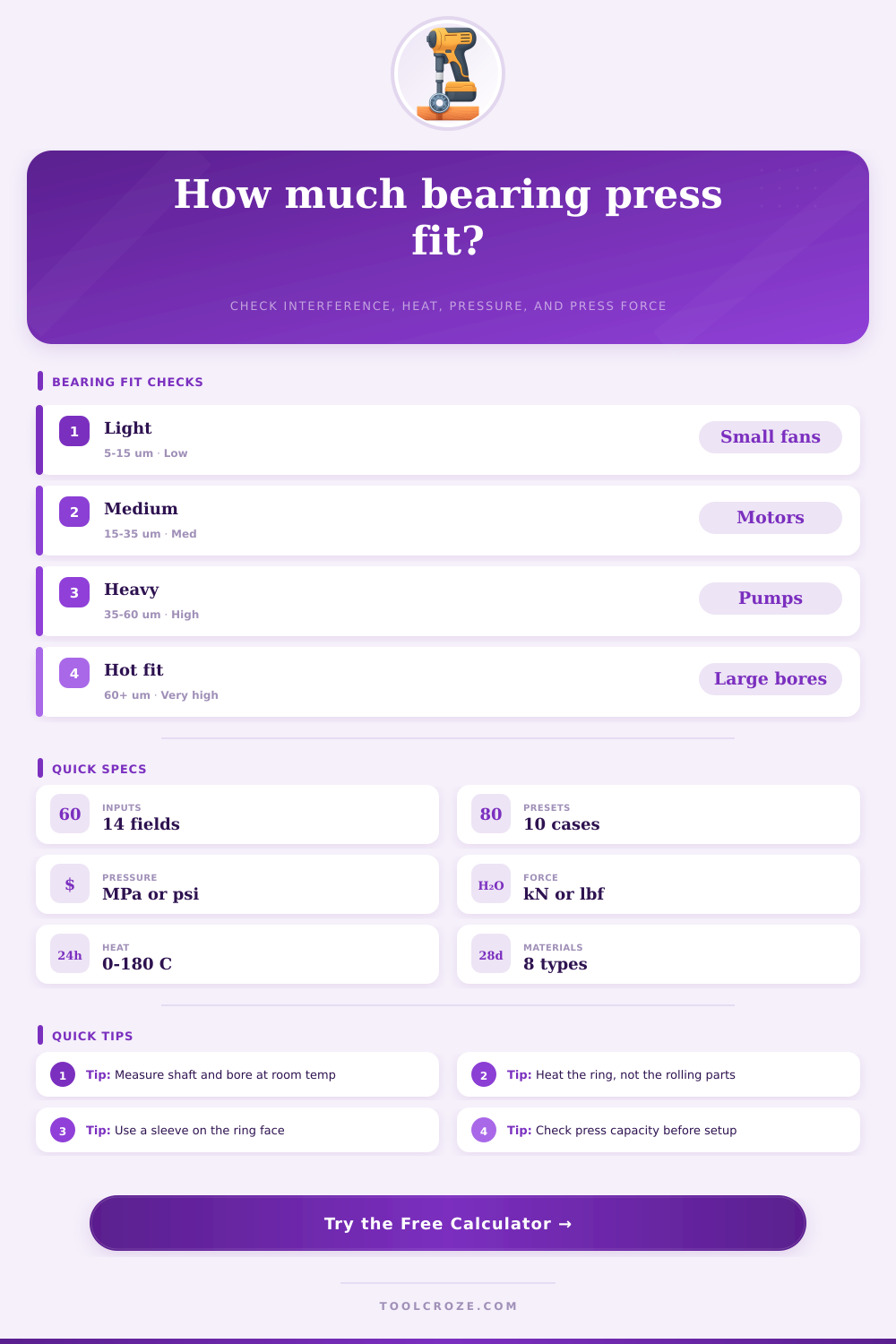
| Fit intensity | Interference per 100 mm | Typical contact pressure | Common bearing use |
|---|---|---|---|
| Location / light | 5 to 15 um | 20 to 70 MPa | Small fans, idlers, light duty inner rings |
| Normal motor fit | 15 to 35 um | 60 to 140 MPa | Electric motors, pumps, general rotating shafts |
| Heavy press | 35 to 60 um | 120 to 220 MPa | Gearboxes, shock loads, high torque shaft seats |
| Shrink or hot fit | 60+ um | 200+ MPa | Large bearings where heating controls assembly load |
| Material | Modulus | Expansion | Press fit note |
|---|---|---|---|
| Bearing steel ring | 205 to 210 GPa | 11 to 12 um/m-C | Default inner-ring material for most rolling bearings. |
| Carbon steel shaft | 200 to 210 GPa | 11 to 13 um/m-C | Stable baseline for most motor and pump shafts. |
| Stainless shaft | 190 to 200 GPa | 16 to 17 um/m-C | Watch thermal mismatch and galling during pressing. |
| Aluminum shaft | 68 to 72 GPa | 22 to 24 um/m-C | Lower stiffness and higher heat growth can reduce retention. |
| Ductile iron hub | 165 to 175 GPa | 10 to 12 um/m-C | Often acceptable with good support and chamfered seats. |
| Bearing bore | Typical heat rise | Bore growth estimate | Assembly note |
|---|---|---|---|
| 17 mm | 60 C rise | 0.012 mm | Often enough for light 6203 inner-ring fits. |
| 25 mm | 70 C rise | 0.020 mm | Useful for pump and motor bearings with moderate interference. |
| 40 mm | 80 C rise | 0.037 mm | Heating avoids high force on medium and heavy fits. |
| 80 mm | 100 C rise | 0.092 mm | Large bearings usually benefit from controlled heaters. |
| Setup detail | Preferred range | Why it matters | Check before pressing |
|---|---|---|---|
| Lead chamfer | 0.5 to 1.5 mm | Lowers peak force and prevents shaving the ring bore. | No burrs, nicks, or raised edges. |
| Surface finish | 0.4 to 1.6 Ra um | Rough seats increase force and reduce predictable pressure. | Clean, lightly oiled, and measured. |
| Press sleeve | Inner ring face | Keeps load out of balls, rollers, and cage. | Sleeve is square and contacts only the fitted ring. |
| Temperature limit | Below maker limit | Excess heat can damage seals, grease, or bearing metallurgy. | Confirm the bearing manufacturer's limit. |
Nominal bearing bore and shaft drawings are not enough for a press fit decision. Mic the shaft in several clock positions and confirm bore class, roundness, and temperature.
If hot clearance is negative, the bearing will still need force while hot. Add temperature margin or reduce interference before relying on a drop-on assembly.
Press only on the ring being fitted. Pressing through rolling elements can brinell races even when the calculated press force looks modest.
High contact pressure and ring hoop stress can reduce internal clearance. Check bearing class and internal clearance when moving from light to heavy fits.
This calculator uses simplified elastic estimates for planning and comparison. Final bearing fits should be checked against the bearing catalog, ISO/ANSI fit tables, operating temperature, internal clearance, shaft finish, and inspection data.
Installing a bearing onto a shaft require the correct amount of interference to ensure that the bearing will remain in place. If the interference between the bearing and the shaft is too low, the bearing might spin loose after a week of operating teh machine that has this bearing. If, on the other hand, the interference is too high, the bearing might seize up during installation.
In determining the proper interference between the bearing and the shaft, you need to consider three factors. These factors is the amount of interference between the bearing and the shaft, the temperature that will be used during installation, and the contact pressure that the ring material can stand. Using a calculator will allow you to determine these three factors.
How to Fit a Bearing to a Shaft
The calculator will remove the guesswork involved in calculating interference, contact pressure, and force to install the bearing. Many people will use the tables in the bearing catalog to determine the interference required between the bearing and the shaft. These tables features standard bearing and shaft sizes.
Both the shaft and the bearing might not match these dimension. If you use the calculator, you can enter the dimensions of your shaft and bearing. The calculator will show the diametrical interference between these two components.
The diametrical interference is the first step that you will take in installing the bearing onto the shaft. The diametrical interference determine the contact pressure between the shaft and the inner ring of the bearing. High contact pressure will allow the bearing to better transmit the torque that is being placed onto the rotating component.
It will also prevent slippage of the inner ring. The problem with high contact pressure is that the inner ring will stretch outward from the shaft. If too much contact pressure is applied, the inner ring might crack.
A calculator will estimate the contact pressure that will be created between the shaft and the ring. It will also calculate the hoop stress that results from contact pressure. The hoop stress indicates whether or not the contact pressure is within a safe zone for the materials of the shaft and the inner ring.
Another consideration when installing a bearing is temperature. Many individuals will heat medium and large size bearings to allow the bearing to be placed onto the shaft. As the bearing heats, the bore of the bearing will grow in diameter.
This will allow the bearing to be placed onto the shaft with light pressure. The bearing calculator will allow you to set a temperature for the bearing. It will calculate the growth of the bearing bore at this temperature.
If the clearance between the shaft and the bearing hot to the bearing is a negative number, it will indicate that the bearing will still require force to be placed onto the shaft. In this case, you must increase the temperature of the bearing or reduce the interference between the shaft and the bearing prior to installation of the bearing. The material for the shaft and the bearing will impact the contact pressure between those two components.
If both shaft and bearing are made of steel, the contact stiffness is similar for both components. A shaft made of aluminum will have less contact stiffness compared to the steel shaft. This will impact the contact pressure between the aluminum shaft and bearing ring.
The aluminum shaft will also feature less contact pressure than the steel shaft because it will relax more during installation and the aluminum material will react differently to heat than the steel material. The calculator will allow you to enter different moduli for both shaft and bearing to show the impact of material on contact pressure. You can use this information to determine if you need to increase the interference between the shaft and the bearing to overcome the difference in contact stiffness between aluminum and steel.
The coefficient of friction between the two components will impact the force required to install the bearing. The coefficient of friction will be low if the shaft features a lightly oiled and chamfered seat for the bearing. High friction will result if the surfaces between the shaft and the bearing are dry or rough.
The calculator will allow you to enter the coefficient of friction between the shaft and the bearing. The calculator will calculate the force required to install the bearing. This force will allow you to determine if the press that you have in your shop will be able to install the bearing.
If the force required to install the bearing is too high for your press, you will need to change your installation set up prior to loading the components into the press. A common mistake when installing bearings is to measure the wrong dimension or to ignore the impact of temperature on those dimensions. The diameter of the shaft will read larger at 30 degrees celsius than it will read at 20 degrees celsius.
The same is true of the bearing bore. The calculator will assume that you took both dimensions at the same temperature. For the most accuracy in determining interference, take both the shaft and the bearing bore measurements at room temperature.
When installing the bearing, avoid pressing on the wrong ring. Do not press through the rolling elements of the bearing. The calculator cannot see how you are setting up your press to install the bearing.
However, the force that you will feel when pushing on the proper ring using a sleeve will be similar to the force that the calculator calculated. If the forces are significantly different from one another, it means that you are either creating interference or the bearing and shaft are not clean. The tables found on the calculator page display the interference that should exist between the bearing and the shaft based on the level of duty of the bearing.
These tables can assist in providing a sanity check to your calculations. If your interference is outside of the range of interference values for the level of duty of the bearing, you should recheck your measurements or the materials of the shaft and bearing. By using the calculator, you can enter the dimensions of your shaft and bearing.
The calculator will determine the contact pressure between the two components. It will also calculate the force necessary to install the bearing. With these calculations, you can be certain that the installation of the bearing will be within a safe and effective range.