Bearing Load Calculator
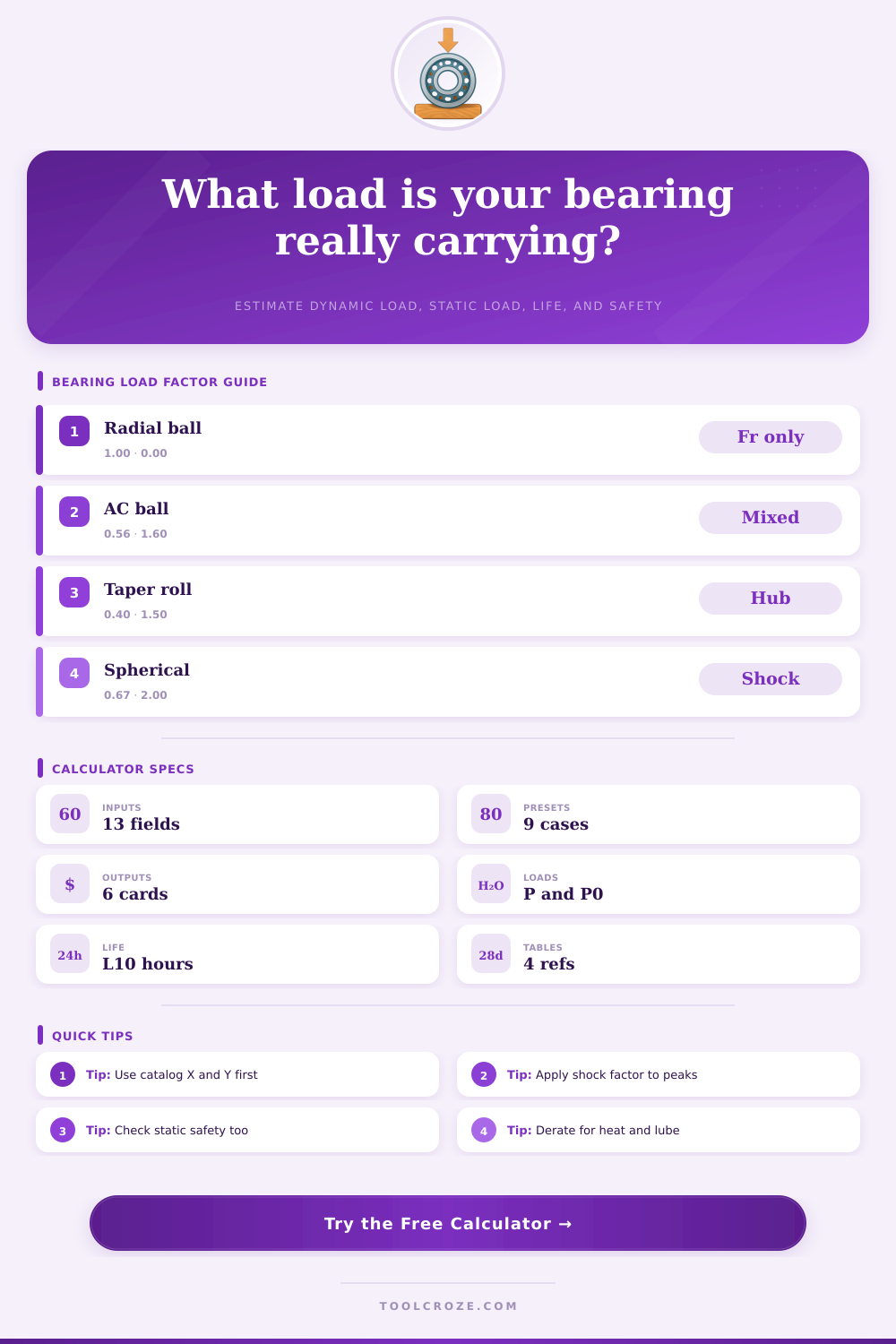
Estimate equivalent dynamic load, equivalent static load, L10 life, required dynamic rating, axial ratio, and static safety from radial load, axial load, X/Y factors, shock, distribution, and contact angle.
Choose a starting case, then replace the loads and catalog factors with the values from your bearing series, arrangement, and operating condition.
These tables are planning references. Always replace the example X/Y and X0/Y0 values with the exact catalog values for the bearing series, clearance, arrangement, and load ratio.
| Bearing type | Typical contact angle | Dynamic factor cue | Life exponent | Common load pattern |
|---|---|---|---|---|
| Deep groove ball | 0 to 12 deg | X near 1 for radial load, Y used when thrust rises | 3 | Motors, fans, light pumps |
| Angular contact ball | 15 to 40 deg | Lower X with higher Y for combined radial and thrust | 3 | Pumps, spindles, paired bearings |
| Tapered roller | 10 to 30 deg | Catalog factors depend strongly on load direction and pair layout | 10/3 | Hubs, gearboxes, thrust plus radial |
| Spherical roller | Low angle roller | Use heavier shock and distribution allowances | 10/3 | Conveyors, crushers, misaligned shafts |
| Cylindrical roller | Usually radial | X near 1 if no axial load is carried | 10/3 | High radial load machinery |
| Service condition | Shock factor | Distribution factor | What it represents | Watch item |
|---|---|---|---|---|
| Smooth electric motor | 1.0 to 1.2 | 1.0 to 1.1 | Steady radial load and good alignment | Belt tension and thermal growth |
| General gearbox | 1.2 to 1.5 | 1.1 to 1.3 | Gear mesh variation and housing deflection | Axial gear forces |
| Conveyor or fan shock | 1.4 to 1.8 | 1.2 to 1.5 | Start/stop load swings and uneven support | Peak starting load |
| Crusher or impact | 1.8 to 3.0 | 1.3 to 1.8 | Short peaks, vibration, and debris loading | Static safety and seals |
| Paired precision set | 1.0 to 1.3 | 1.05 to 1.25 | Preload and load sharing between bearings | Mounting stiffness |
| Check | Formula used | Good planning range | Warning range | Action |
|---|---|---|---|---|
| Equivalent dynamic load | P = fs fd (XFr + YFa) | C/P above target margin | C/P below required life | Increase bearing size or reduce load |
| Equivalent static load | P0 = fs fd (X0Fr + Y0Fa) | s0 above 1.5 for many machines | s0 near or below 1.0 | Check static rating and peak load |
| Basic rating life | L10 = (C/P)^p million rev | Meets duty target | Shorter than service interval | Revise rating, load, speed, or duty |
| Axial load ratio | Fa / Fr | Within bearing catalog range | High for radial-only bearing | Use thrust-capable arrangement |
| Application preset | Likely bearing style | Load character | Factor emphasis | Primary check |
|---|---|---|---|---|
| Fan or blower | Deep groove ball | Mostly radial | Low shock, belt pull | L10 hours |
| Vertical pump | Angular contact pair | High thrust plus radial | Y factor and static safety | P0 and s0 |
| Wheel hub | Tapered roller pair | Combined radial, thrust, shock | Direction and distribution | C/P and preload |
| Crusher support | Spherical roller | Impact and misalignment | Shock and distribution | Peak static load |
| Precision spindle | Angular contact set | Preload with speed | Contact angle and heat | Thermal/lube limits |
Bearings doesnt typically fail due to a single large overload; instead, the combination of radial and axial loads can cause bearing failures. Radial loads are applied to the bearing in a direction that is perpendicular to the shaft, and axial loads is applied in a direction that is along the length of the shaft. Many bearings has to handle both radial and axial loads simultaneously.
The lifespan of a bearing depends on the understanding of the combined loads that the bearing will experience. If the loads are understood corect, the bearing will last the intended amount of time. However, if the bearing and load are not understood correctly, the bearing will fails.
How Radial and Axial Loads Affect Bearings
The radial load will be the load applied perpendicular to the shaft and the axial load will be applied along the length of the shaft. Deep groove ball bearing can handle some axial loads, but deep groove ball bearings will fail if the axial load to radial load ratio becomes too high. The calculator can help determine the correct values of the loads that will be applied to the bearing.
In addition to the radial and axial loads that are applied to the bearing, the X and Y factors from the bearing catalog must also be entered into the calculator. The manufacturers of the bearing determine the X and Y factors to indicate how the bearing will respond to loads. Static load is different than dynamic load.
Static load refers to the force that is applied to the bearing when the machine that utilizes the bearing is not in motion. The machine may not operate for long periods of time, but when it is in operation, the bearing must be able to handle the static load that is placed upon it when the machine is not in operation. The static load may be from the weight of the machine or the belt that is placed upon the rolling elements of the bearing.
The equivalent static load must be calculated to ensure that the static load will not create dents in those rolling elements of the bearing. If the rolling elements of the bearing are permanently dented, the bearing will vibrate and create noise. These types of problems will occur before the bearing reaches its fatigue life.
The safety margin of the bearing can be calculated by dividing the catalog static rating of the bearing by the static load of the bearing being calculated. The safety margin should be calculated even if the dynamic load calculations of the bearing are within safe limits. For bearings that are used with axial loads, the contact angle of the bearing is important.
The higher the contact angle of the bearing, the more likely the rolling elements of the bearing will be tilted such that the bearing can handle axial loads. The higher the contact angle of the bearing, the lower the dynamic radial factor X of the bearing will be. Additionally, the axial factor Y will increase as the contact angle of the bearing increases.
If the user changes the contact angle of the bearing in the calculator, the X and Y factors will be updated within the calculation. The bearing type must be selected prior to entering any values into the bearing calculator. Shock and distribution factor are also incorporated into the bearing load calculations.
The shock factor is applied to bearings in machines that do not always operate smoothly. For instance, the motor that is mounted on a rigid stand will experience a much lower shock factor than a motor that is used to drive a crusher machine. The distribution factor takes into account the fact that each of the bearings mounted to a shaft will not necessarily have the same load.
The shaft will not be perfectly straight, and the housing for the bearings will not necessarily be perfectly stiff. Youll have to enter the shock factor and the distribution factor honestly into the calculator. The L10 life estimate for the bearing is a statistical median for the life of the bearing.
The L10 life estimate assumes that the lubricant is clean and that the fit between the bearing and the bearing housing is correct. Additionally, the L10 life estimate of the bearing assumes that the operating temperature of the bearing will not negatively impact the lubricant or the steel of the bearing. In many cases, the contamination of the lubricant and poor lubrication will reduce the life of the bearing by half before it reaches its fatigue limit.
The required dynamic load rating for the bearing is an estimate based on the planning of the manufacturer, but it isnt the final answer. If the dynamic load required for the bearing is higher than the rating of the bearing that is to be used, then the load calculations should of been performed again. There are reference tables within the bearing calculator to indicate which types of bearings are used for different types of load conditions.
The reference tables are not a replacement for the bearing catalog, however. The catalog will provide exact X and Y factor for the bearing that is to be used. The service-condition tables show the typical values of the shock and distribution factors for the types of machines that are indicated in the tables.
These tables provide engineers with an idea of the types of loads that are placed upon bearing by different types of machines. Engineers can use these tables to make certain that the loads calculated with the bearing calculator are appropriate. Calculating the loads of the bearing prior to purchase of the hardware is useful in that it will force the engineer or designer to think about the actual operation of the machine.
Machines can experience high loads during the startup period, or the machine may experience thermal growth of the components. Additionally, the tension of the belt that is used to transfer torque to another component may be increased at some point during the operation of the machine. While the bearing load calculator does not have the measuring devices required to measure these types of loads, it can be used to test the assumptions of the engineer or designer.
If the safety margin of the bearing is too low for the operation of the machine, the loads should be verified prior to the purchase of the bearing.