Bearing Grease Calculator
Estimate initial bearing grease fill, relubrication dose, adjusted interval, annual grease use, and speed-temperature risk from OD, bore, width, RPM, bearing type, fill percentage, interval, temperature, and grease density.
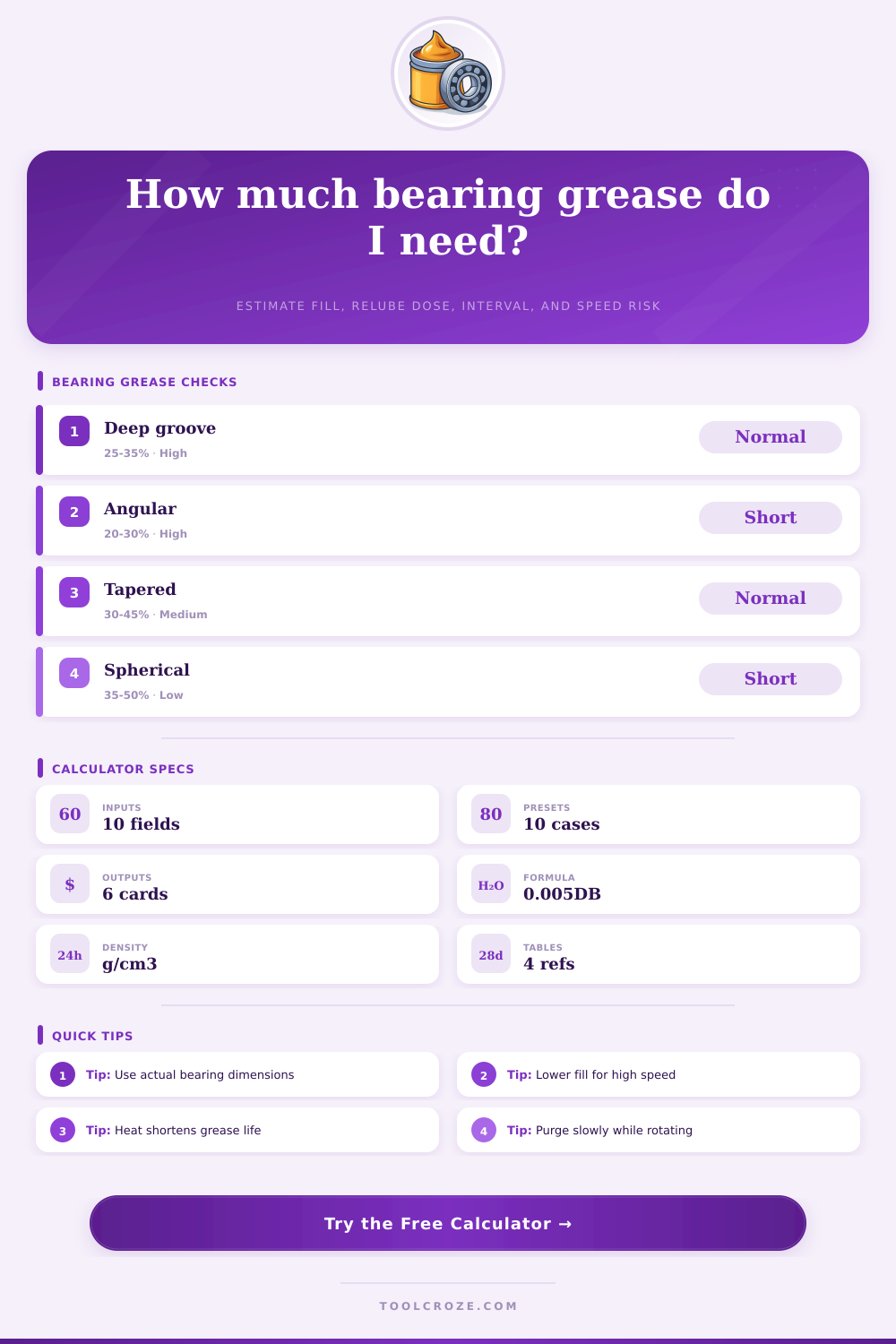
| Bearing type | Planning fill | Void factor | nDm planning limit |
|---|---|---|---|
| Deep groove ball | 25-35% | 0.24 of envelope volume | 650,000 |
| Angular contact ball | 20-30% | 0.22 of envelope volume | 800,000 |
| Cylindrical roller | 25-35% | 0.28 of envelope volume | 600,000 |
| Tapered roller | 30-45% | 0.30 of envelope volume | 450,000 |
| Spherical roller | 35-50% | 0.32 of envelope volume | 300,000 |
| Needle roller | 20-30% | 0.18 of envelope volume | 350,000 |
| Thrust bearing | 35-50% | 0.26 of envelope volume | 250,000 |
| Mounted insert | 40-60% | 0.34 of envelope volume | 200,000 |
| Fill range | Best use | Benefit | Watch for |
|---|---|---|---|
| 15-25% | Very high speed or low drag checks | Lower churning heat | Shorter grease reserve |
| 25-35% | Most greased motor and pump bearings | Balanced heat and reserve | Contamination control still matters |
| 35-50% | Slow roller bearings and rough duty | More grease reserve | Heat rise at higher speed |
| 50-70% | Low speed housed bearings | Extra sealing and purge capacity | Avoid on high-speed bearings |
| Operating temperature | Interval multiplier | Grease behavior | Planning note |
|---|---|---|---|
| Up to 70 C / 158 F | 1.0 | Normal oxidation rate | Use normal catalog interval |
| 80-95 C / 176-203 F | 1.3-1.8 | Oil separation accelerates | Shorten interval and trend temperature |
| 100-115 C / 212-239 F | 2.2-3.2 | Grease life drops quickly | Use high-temperature grease if suitable |
| 120 C+ / 248 F+ | 4.0+ | Rapid oxidation risk | Confirm grease, seals, fits, and bearing limit |
| Check | Formula or rule | Good result | Review trigger |
|---|---|---|---|
| Initial fill mass | Free space x fill x density | Within type fill guide | High fill at high nDm |
| Relube dose | 0.005 x OD x width | Small purge at each event | Seal damage or heavy overpurge |
| Adjusted interval | Entered interval divided by derates | Matches route schedule | Very hot or contaminated duty |
| Speed margin | nDm / type limit | Below 70% | Near or above 100% |
Applying grease to a bearing require precise amounts of grease. Using too little will result in wear on the bearing almost immediate. Using too much grease can result in the grease heating up from the churning motion of the grease inside the bearing and the breakdown of the grease faster than it should of break down.
The amount of grease that is required for a bearing can vary depending on the type of bearing, the speed at which the bearing will run, and the conditions under which the bearing will operate. For instance, the amount of grease required for a motor that is running at 1,750 RPM will be different than a bearing that is part of a slow conveyor belt roller. The speed at which the bearing will operate will have an impact on how long the grease will last within the bearing.
How to Use a Grease Calculator for Bearings
The grease calculator collect information on the dimensions and operating specifics of the bearing. The outer diameter, the bore of the bearing, and the width of the bearing all have to be entered into the calculator because these dimensions will help determine how much grease has to fill the bearing. Multiplying the area of the void created by the outer diameter and the bore by the width of the bearing will calculate the volume of grease that has to fill the bearing.
The result of this calculation will be multiplied by a void factor that takes into account the type of bearing. For instance, a deep groove ball bearing will contain more void space than a needle roller bearing of the same size. The nDm value of the bearing will determine the speed at which the bearing will be calculated.
The nDm value is the product of the speed of the bearing in RPMs multiplied by the pitch diameter of the bearing. This value can then be compared to the limits of the bearing in terms of how fast the bearing is allowed to operate. For instance, angular contact bearings can handle very high nDm values while spherical roller bearings may have different limit.
If the nDm value of the bearing reaches 75% of the limits for that type of bearing, the relubrication interval will be shortened because high speed cause the grease to work harder within the bearing and oxidize at a higher rate. The temperature at which the bearing will operate will also have an impact on the grease. If the temperature of the bearing rises to above 70 degrees Celsius, the oxidation rate of the grease within the bearing will increase.
To account for this, the relubrication interval will be multiplied by a factor that represents the rise in the grease oxidation rate at those high temperatures. The conditions in which a bearing operates will also affect the relubrication interval. If the conditions of the bearing are clean and steady, the relubrication interval will be longer because the grease will last longer.
However, if the bearing operates in wet or dusty environment, the grease will be exposed to more contamination, which will shorten the life of the grease. The base relubrication interval for a bearing will be calculated as a result of the speed of operation, the temperature of the bearing, the service conditions for the bearing, and the calculated volume of grease that must fill the bearing to ensure optimal operation. This base relubrication interval will be used to calculate the total amount of grease that will be used by the bearing each year.
The amount of grease that is used during the relubrication event will be determined by the outer diameter, the width of the bearing, and various other factors. The technician can adjust the fill percentage of the bearing. However, the percentage of the bearing that will be filled with grease has a significant effect on how the bearing will operate.
If the percentage of grease is too high for bearings that are running at high speeds, the grease will begin to froth, which will raise the temperature of the bearing and shorten the life of the grease. However, if the percentage of grease is too low for slow moving bearings, there may not be enough grease to provide a reserve amount of grease against contamination. The fill percentage can be adjusted within the calculator to ensure that the fill percentage is within the recommended range for that model of bearing.
However, the technician is still responsible for the fill percentage decision. The accuracy of the data entered into the calculator will have a direct impact on the calculated relubrication intervals. For instance, if the bearing is within a housing that does not permit the grease to purge out of the bearing, then there will be a failure in the delivery of grease to the bearing rolling surfaces.
Additionally, if the grease that is used within the bearing has a different base oil or thickener then the grease that is used to establish the relubrication limits for the bearing, the calculations for the relubrication intervals will be different. Additionally, the grease calculator makes calculations based on the assumptions of the manufacturers of the bearing and the grease. Therefore, it is up to the technician to make sure that the calculations made by the calculator are similar to the tables made by the manufacturer of the bearing and the grease used within the bearing.
Using the grease calculator will allow the technician to reduce the amount of downtime that the machine will have to experience. Additionally, using the grease calculator will reduce the instances of bearing failure. Setting the relubrication interval to be too long will lead to the bearings drying out and failing before their time.
However, if the relubrication interval is too short, the technician will spend too much time on lubrication routes and will use too much grease for the bearings. Based on the calculations made within the grease calculator, the technician will be able to establish an adjusted relubrication interval. This adjusted relubrication interval will be rounded to the nearest inspection cycle to determine the lubrication intervals that will be used.
Additionally, the temperature and vibration of the bearing will have to be monitored during these intervals. The grease calculator will also calculate the yearly total amount of grease that will be used by the bearing. It is easy for a technician to underestimate the total amount of grease that will be used by the machine that contains these bearings.
The amount of grease that will be used each year will be determined by multiplying the number of operating hours that the machine will experience each year by the adjusted relubrication interval and the calculated dose amount of grease. This value will help to purchase the amount of grease that will be needed for the year and to plan the amount of grease waste that will occur. If the total amount of grease that is used is high, then the seals for the bearing may need to be improved or the type of grease that is used for the bearing may need to be changed to one with a longer life.
A decision has to be made regarding the amount of grease that will fill the bearing and the relubrication interval for that machine bearing. If the percentage of the bearing that is filled with grease is too high, the temperature of the bearing will increase and the life of the grease will be shortened. However, if the percentage of grease within the bearing is too low for bearings with slow speeds, there is a possibility that the grease will become contaminated.
Shorter relubrication intervals will help protect the bearing from damage. However, the technician will work harder and will have to use more grease for the bearing. Using the grease calculator will help the technician make these decisions and ensure that the bearing and machine are running as efficiently as possible.