
When doing a home remodel, there’s often confusion around if your beam will be strong enough to hold a floor up. That is either because some pros rely on memory instead of calculations, or simply because DIYers is unsure. So how do you figure out how much wood are needed? And do you add reinforcement, or just start over? It’s part math, but even more part learned intuition, part experience. Beam span isn’t so much a table to memorize; it is more about the physics of how things bend.
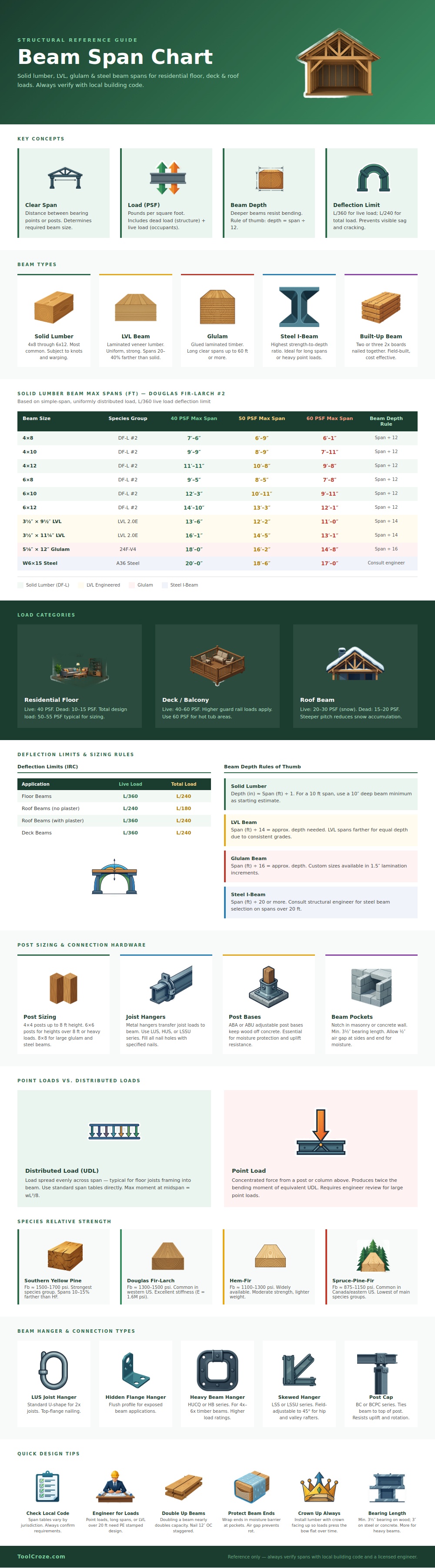
This chart (above) explain how various materials carry loads over length. That makes designing for structure much less guesswork. For example, with solid wood members, such as Douglas Fir, there are obvious boundaries on size. With a typical 4×8 member, they’ll carry a moderate load out to seven feet. Beyond that, they’ll get wobbly if you add more width or more load.
How to Choose the Right Beam for Your Home
The engineered-wood products provides a more reliable solution: LVL, laminated veneer lumber, is made to be consistent, not depending on nature’s grain variations. You can typically cross a greater space with an equal-depth LVL beam. This means it will clear a wider opening without significantly increasing the beam’s overall profile.
“People always worry about the beam breaking, and realy that’s not what happens most of the time in residential buildings. What happens is deflection, the technical word for sag. Even though your floors might be strong enough to support the weight, if they’re visible by eye or bouncing underfoot they’ll make you think they’re unsafe.” The code typically says that the deflection. The technical name for sag. Should never exceeds one three-hundred-sixtieth of the span for live loads. The reason: Human beings notice subtle differences in slope. Before you see a crack forming, you’ll feel a bouncy floor.
Beams resists bending better when they are deep rather than wide; doubling their depth makes them much stiffer, while doubling their width only increases their linear strength. If you’re dealing with good old-fashioned timber, material choice counts. Generally speaking, a slightly smaller piece of Hem-Fir will work because this species is actualy stronger per inch than Southern Yellow Pine. Of course, where you live determines available materials. Work with what’s at your local lumberyard and then tinker with the span accordingly.
The chart shows just how incredibly strong steel I-beams are given their skinny shape, but there are other considerations. For one thing, steel radiates temperature, which means it require more insulation and fire blocking than wood does. Different types of fasteners work better for steel, too, and spans greater than twenty feet typically require a professionally stamped engineer drawing.
Beams don’t stand alone: Connections has been known to kill a project in quiet but damaging ways. Even a stout beam will fail if its joist hangers is undersize or not nailed properly. Use metal connectors rated for the same load as the timber they’re supporting. The nail schedule provided by the manufacturer must be followed; otherwise the shear force don’t get distributed evenly at the connection points. Too-few nails transform the structural joint into a hinge just waiting to fold.
When installing lumber always crown it upwards. Over time, under load, gravity will pull that inherent bend flat, leaving you with a level floor instead of a bowed one. Don’t let moisture get into the end either. Moisture will accelerate rot, and wood rots from the bottom up. If possible leave a slight air gap on the sides so they can breathe. Rot happens. It happens fast in moist conditions. Beams are particularly vulnerable if set in a pocket with no air flow. So protect those ends!
And remember, verify your assumptions and never exceed the limits of your building materials. Know the local codes. For complicated projects, find an engineer. And know that your choice of materials determine the space between supports. The beam literally keeps house together.
