Base Aggregate Calculator
Estimate compacted base depth, loose order volume, tons, truck loads, lift passes, and geotextile coverage for road base, patio base, driveway base, and pad preparation.
⛏Project presets
⚙Base dimensions and material
Aggregate estimate
🧱Selected aggregate spec grid
📊Reference tables
| Aggregate type | Typical use | Loose density | Compaction shrink | Fines |
|---|---|---|---|---|
| Crusher run 3/4 minus | Patios, walks, pads | 1.40-1.55 tons/yd3 | 10-16% | 6-12% |
| CA6 road base | Driveways, aprons | 1.45-1.60 tons/yd3 | 12-18% | 8-15% |
| Class 5 limestone | Road base, parking | 1.35-1.50 tons/yd3 | 10-16% | 6-12% |
| Type 1 MOT | Sub-base layers | 1.55-1.75 tons/yd3 | 12-20% | 8-14% |
| Open graded 3/4 stone | Drainage base | 1.20-1.35 tons/yd3 | 4-8% | 0-3% |
| Project | Pedestrian depth | Vehicle depth | Preferred aggregate | Fabric note |
|---|---|---|---|---|
| Paver patio | 4-6 in | 6-8 in | 3/4 minus base | Use on clay |
| Gravel driveway | Not typical | 6-10 in | CA6 or crusher run | Use on soft soil |
| Private lane | Not typical | 8-12 in | 1.5 minus base | Overlap 12-18 in |
| Retaining wall trench | 4-6 in | 6-8 in | 3/4 minus base | Drain behind wall |
| Equipment pad | 4-6 in | 6-10 in | Dense graded base | Extend past edge |
| Compaction tool | Best lift | Moisture target | Passes per lift | Typical use |
|---|---|---|---|---|
| Hand tamper | 1-2 in | Damp, not wet | 6-10 | Small edges |
| Single plate | 2-4 in | Near optimum | 3-5 | Patios, walks |
| Reversible plate | 4-6 in | Near optimum | 3-6 | Driveways |
| Walk-behind roller | 6-8 in | Controlled water | 4-8 | Lanes, parking |
| Haul method | Common capacity | Best for | Rounding rule | Access note |
|---|---|---|---|---|
| Pickup bed | 0.5-1 ton | Small repairs | Round up whole trip | Check payload |
| Dump trailer | 3-7 tons | Pads, patios | Round up half load | Firm staging |
| Single axle dump | 8-12 tons | Driveway work | Round up full load | Overhead clear |
| Tandem dump | 14-18 tons | Large base areas | Round up full load | Plan turn radius |
💡Calculation notes
You might be thinking: Why did I not know about the aggregate calculator? For your next hardscape project, it’s easy to use and tells you precisely what amount of rock to buy. Unlike weight, volume is strange, often we dig out a hole, remove the weeds, then discover that the space we have cleared isnt quite as big as expected! Too much rock gets messy and expensive, while too little leaves you with a sinking surface that becomes increasingly unstable over time.
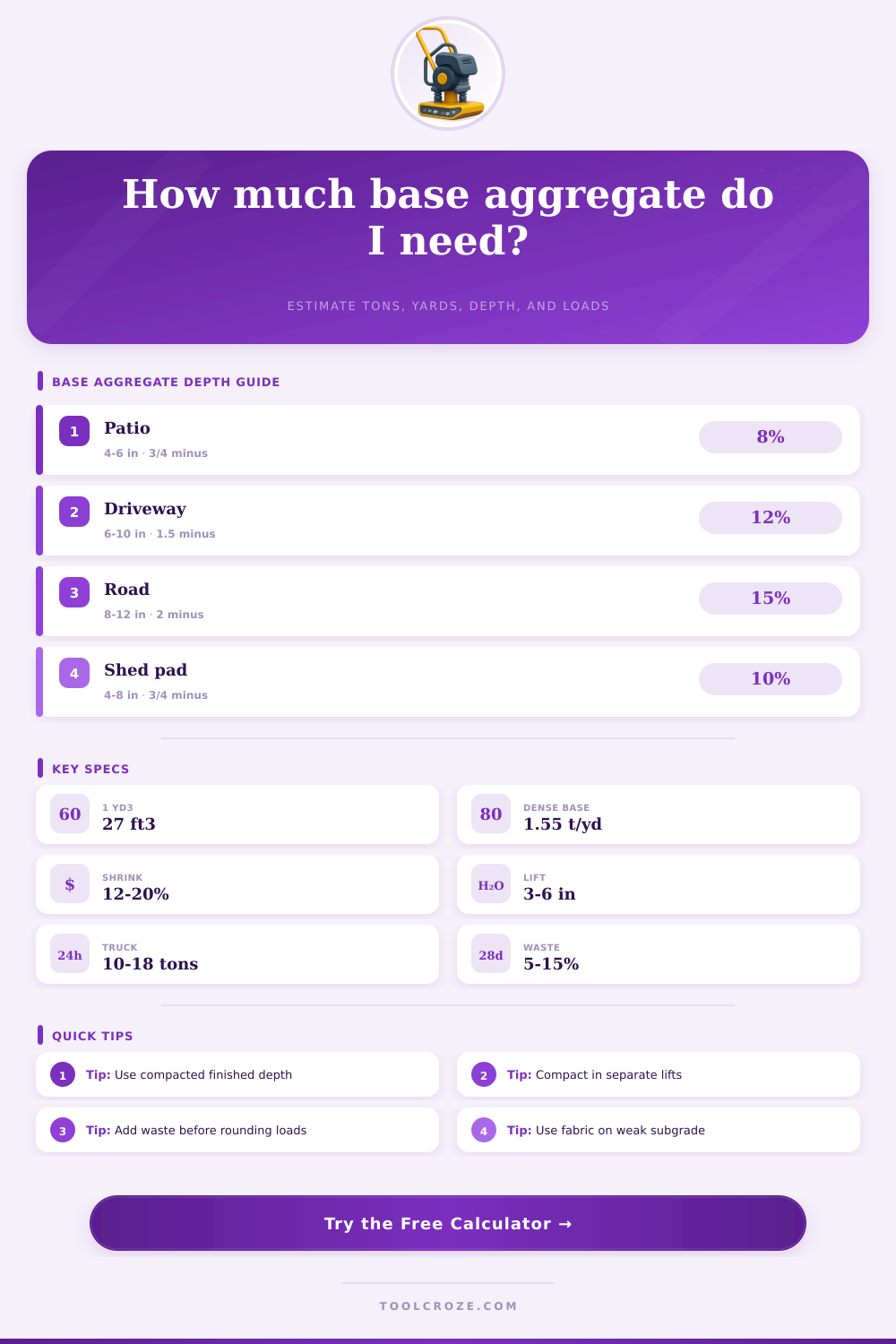
Even without an engineering background, you can use the tool to convert general shapes into specific amounts such as yards, tons, or truckloads. Where things get tricky is distinguishing between compacted material and loose material. When gravel is delivered, it come in fluffy form, full of air spaces, until you go over it with a plate compactor and knock it down, pushing out the air. That makes it take up less space; that’s what the compaction factor question is about. You want to know how much air has been pushed out, or else you’ll underorder by a lot. The shrink rate I use is 12 percent; that means you want roughly 40 percent more loose material then simple math says you’d need. And a bunch of folks miss this because they only do length x width x height.
How to Use the Aggregate Calculator for Your Project
Most people don’t think about this, but the type of material used does matter… A lot. Not all gravel are created equal; the calculator allows you to choose from various types such as open graded stone, Class 5 limestone, or even crusher run. Open graded doesn’t have any fines, so while great for drainage, it’s terrible at being load bearing. Crusher run, on the other hand, has fines in it that pack down tightly together when compacted and become kind of like a solid slab. If your driveway isn’t made out of something that can withstand weight of cars, you’ll end up with shifting and ruts.
The tables help explain which materials work well for heavy loads vs. They are just for pedestrians. That way you don’t buy cheap stuff for drainage and need dense aggregate. It’s logical, not conventional: “A decorative walkway may only require a 4-inch base, whereas a driveway should of be at least 6-10 inches thick to spread the weight of cars over the subgrade.” The more unstable your underlying soil is (wet sand or soft clay), the deeper you need to go. This helps you get above those layers and allows the stone to bridge the unstable surface below.
The calculator lets you account for this by entering condition of the subgrade into which you’re installing gravel. So if you have swampy soil, this way you don’t create a thin base on top of it (which sinks right away)…or a deep one on solid bedrock (when thin would do). Pro jobs also use lifts, unlike DIY attempts. For instance, when you dump all of that 18 inches of stone, you can’t compact it all at once… The compactor won’t even go deep enough. Instead, as they say “lay it down in lifts” of two to four inches and then compact each layer before starting again with the next. Depending on the maximum lift setting and the overall depth you’ll need, this tool figures out how much (how many layers, how many passes) it will take to get there. This ensures you don’t waste time and makes sure everything is dense through the whole profile.
These are edge and waste allowances. Spreading stone doesn’t always go exactly where you want, and neither does real excavation. A ten to fifteen percent waste factor will cover all those imperfections. This includes stone rolling away from the edges, spillage when loading trucks or wheelbarrows, and low spots that show up once youve compacted your area. Without waste, your last-minute trip to the supplier might have to be an emergency one to fix the flaws in your project.
The last logistics issue is how much will fit into your truck. Most suppliers will not sell you half a truck load. They always round it up to the next full truck load. So make sure you have enough material on hand to get the job done. It’s also important to plan for where the delivery truck will turn around and access the area where the materials need to be placed. A single axle dump truck has a smaller turning radius than a tandem axle one but can’t carry as much. These is things that should be checked before placing the order to avoid headaches down the road.
Preparing a good base goes unnoticed but rewards you with smooth driveways and patios for decades. Leveling requires the right material, volume and compaction; all tasks that can be handled accuratley by our calculator. It does all the coefficient- and conversion-heavy lifting so you can concentrate on correct placement. Accurate measurements begins with solid math instead of blind guessing.