
A high-quality bar clamp will help to separate a hobbyist woodworker from a person who can produce projects that are both tight and square. A person who dont have the correct type of bar clamps will struggle with there setup. You can have the best saw and the best joinery in your workshop, but if you cannot find a way to clamp the two pieces together even and until the glue sets, your project will fail.
The correct type of bar clamp will turn the act of clamping two parts of a project together into a calm and stress-free process. The best type of bar clamp for an individual will depend on the tasks that they performs within their workshop. A furniture maker that produces many tabletops each week will have different requirements for their bar clamp than an individual woodworker who create small boxes.
There is various types of bar clamps that can be purchased, and each type of clamp has specific reasons for needing to be acquired by woodworkers. In the list that follows, each type of clamp will be explained, why it deserve to be purchased, and in what situations one type of clamp may be better than another type of clamp. The first type of clamp to purchase for an individual woodworker is a pair of parallel jaw bar clamps.
The Best Types of Bar Clamps to Buy
1. Parallel Jaw Bar Clamps
These types of clamps have wide and flat jaws that will remain parallel to each other, no matter how much pressure is applied to the clamps. These types of bar clamps will ensure that the panels that are being glued together will remain flat, and the corners of the items will remain square. The size of the jaws on these clamps are approximately two inches in height, which will provide enough surface area for the clamp to distribute the pressure to the workpiece, and will prevent the clamp from denting the soft woods.
Additionally, because the jaw of these clamp is molded into the bar of the clamp, these clamps will resist racking. The resistance to racking will ensure that the items that are being glued together will remain in the position that they were set. They are not the cheapest bar clamp, but the time that they will save in the workshop will pay for their cost after a few projects are complete.
2. Pipe Clamps
Pipe clamps are the next type of clamp that an individual woodworker should purchase. Pipe clamps provide an individual with a solution to the problem of reach. The length of the pipe can be customized to fit the needs of an individual.
Pieces can be purchased that allow the clamp to be attached to one end of the pipe and the other end of the pipe. These clamps can be used to produce dining tables or other wooden items that require a large amount of clamping pressure. The downsides to pipe clamps are that they are very heavy, and the round jaws of the clamp will roll if they are not careful.
Often, people use wooden jaws with pipe clamps, or two pipe clamps can be utilized together. However, if an individual needs to clamp an item that is longer than there workbench, there is no other clamp that will offer the same flexibility or cost per foot of bar clamp flexibility.
3. Quick Release Clamps
Quick-release clamps are clamps that have a sliding jaw clamp that can be moved freely to the desired position until the brake is triggered with one or both hands.
These clamps are useful for quickly positioning two items to be glued together. Because quick-release bar clamps can be positioned with only one hand, the other hand can be used to hold the item that is to be glued. Quick-release bar clamps often have a small trigger plate that grips the bar of the clamp.
This trigger plate will not allow these clamps to provide the same amount of pressure as a clamp whose handle controls the pressure of the clamp. However, they are strong enough to be used in many cabinet projects. If an individual purchases six quick-release bar clamps of the three-foot size, they will be used very often.
4. Deep Throat Bar Clamps
Deep-throat bar clamps are similar to F-clamps but are manufactured in such a way that the throat of the clamp is deeper than four inches. This deep-throat allows for the clamp to be placed into areas that may be obstructed by an existing frame or side of a drawer. Cabinetmakers who glue face frames to carcases utilize deep-throat bar clamps so that the clamp does not interfere with the stile of the frame.
However, because the deep-throat of these clamps reduces the maximum amount of pressure that they can apply, they will not be the best clamp to purchase for gluing heavy panels. However, deep-throat bar clamps will prove helpful for applying precise pressure to the area of concern.
5. Aluminum Bar Clamps
Aluminum bar clamps will provide an individual with the same strength as there steel counterparts but will weigh half the amount.
Aluminum bar clamps that are manufactured to be four feet in length will weigh half as much as the steel clamp of the same length. The bars that are created by aluminum bar clamps are extruded with a T-track, which allows for other clamp accessories to be added to the clamp. These clamps are lighter but will flex more under heavy pressure.
They are best for medium projects that require a variety of bar clamps but not an individual who is required to hold many items with one or both hands.
6. Ratchet Bar Clamps
Ratchet bar clamps are generally less costly, and they are the best clamp for small projects. The ratchet clamp will be helpful in two situations.
The first is if the individual is producing small projects that require very little force from the clamp. The second is if the project requires the even application of pressure with the ratchet clamp. Ratchet clamps will click in small increments, allowing for an even placement of the parts.
Additionally, they are the most inexpensive type of clamp, so it is worth purchasing a set of the smaller sizes of ratchet bar clamps. They can be used to hold jigs or fences in place.
7. T-Bar Clamps
T-bar clamps may look old fashioned, but they were created for a specific reason.
Before the development of moddern bar clamp alloys, T-bar clamps were the best available clamp. The bar of a T-bar clamp is manufactured in a T-shape, which will provide resistance to the twisting of the clamp. Hence, the jaws of the clamp will stay square with the workpiece even with the application of high amount of pressure.
People who restore antique furniture prefer the old clamp design since it has stayed the same for one hundred years. The down sides of T-bar clamps are that the clamp is very heavy and the sliding jaw on the clamp must be threaded onto the bar from the end of the bar. This makes for slow movement of the clamp in the middle of a project.
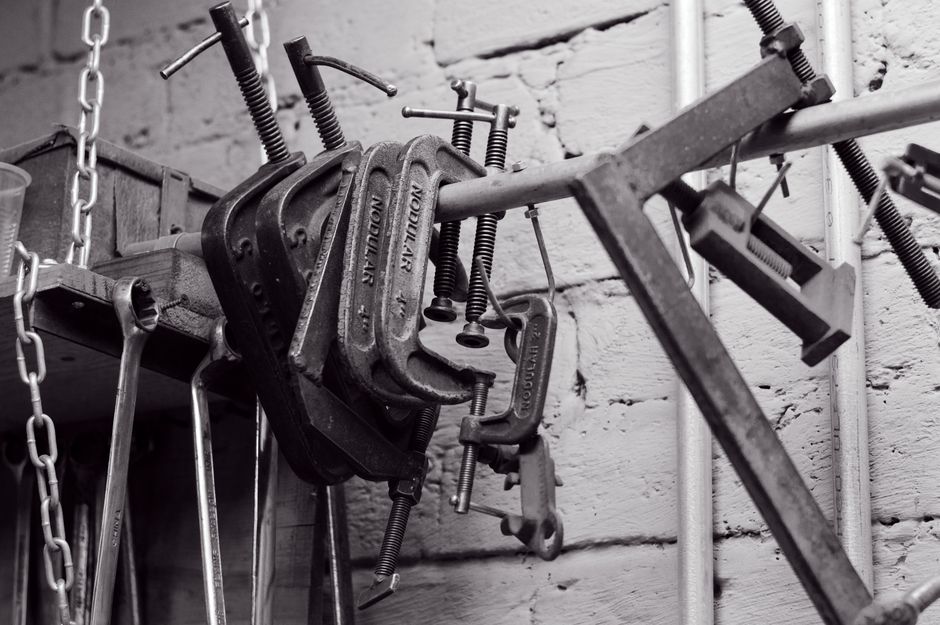
8. C-Clamps
C-clamps may not be the best type of bar clamp but should still be bought for any workshop. C-clamps are small and have the ability to reach into the tightest spots in a workbench. Hence, they are perfect for small projects and repairs, attaching hardware to wood pieces, or holding templates while routing.
The screw on a C clamp passes through the frame of the clamp. This makes the clamp capable of applying large amounts of pressure in a small area. These types of clamps are best used as specialty tools and are very helpful in the workshop.
Regardless of what type of bar clamp an individual purchases, they should have enough clamps to complete their projects. Most individuals will buy bar clamps and not purchase enough for a single project. For instance, a door panel will require eight to ten clamps of each size to hold the panel flat.
A dining table may require twenty clamps. The best solution is to purchase more bar clamps than an individual thinks they require. Buy some parallel-jaw bar clamps and pipe clamps first, then purchase the remaining clamps that will be needed for quick-release and deep-throat bar clamps.
The best clamps will eventually feel as if they are an extension of an individual’s hands. When they have mixed the glue and positioned the two workpieces that are to be glued, the weight of the bar clamp will be the last step before they step back to view the work. If they have properly used the bar clamps, the project will remain together for many generations.
