
A fuel line job, or even more so a brake job are made or broken by banjo washers. When you open the lines and reseal them, you install copper ring called a banjo washer on each side of the banjo fitting. If the seal holds, you’re done. Job’s over and all is clean and the bleeding went fine.
If the seal fails a few days later, then you’ve got yourself a slow leak situation. Use the proper diameter washer for the bolt size. Must crush just enough to get right seal under torque. Must hold up to pressure after system is in service. Use too small a size and you’ll have a seal failure. Use too hard a material and you will as well, though slowly.
How to Choose the Right Banjo Washer
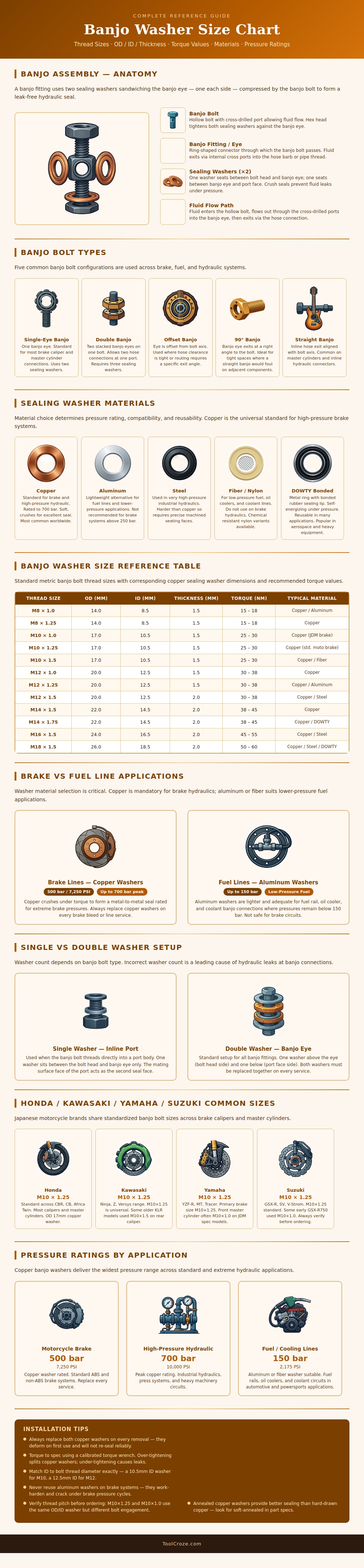
Here’s a simple metric screw size chart showing common sizes, both inside and outside diameter, along with thickness and range of torque to expect from that size. And it will do more than tell you what they are. It will show you why that M10-sized washer won’t seat properly on the M12 bolt. Why the larger bolt has a tighter torque window. How to know how big is right at the garage with bits in hand, but without your manual handy. A chart like this prevents you from having to guess at fitting right.
Almost as much as size are the material. By default, it’s still copper for brake systems. When you cinch that bolt, copper squeezes into those nooks and crannies on the surface. For oil coolers and fuel rails, pressures is kept manageable so aluminum does fine. But aluminum hardens from use during repeated braking and will eventually crack. Only put fiber or nylon washers on low pressure fuel or coolant lines. If you use one on a brake circuit, you risk having soft pedal when you need it most.
You should also consider how many washer are needed. For a single banjo bolt screwed into a port body there must be a washer between the eye and the head of the bolt. With a standard banjo fitting where the eye is sandwiched between two pieces of surface, two washers is required, one per side. Without the second washer in place, the eye will rock back and forth rather then seal to the copper. That’s what most slow leaks begin as.
A few sizes cover all the major motorcycle manufacturers, and they each has their own line of brakes. So having a little collection of washers that will span 99% of the street bike out there is possible. Once you learn the common thread pitches, you can carry a small assortment that covers most street bikes. That way you’ll know at a glance what size washers will be for the majority of master cylinders and calipers your likely to encounter.
The same applies to pressure ratings. When you apply pressure by pulling on the brake lever, copper is absorbing that spike in pressure. Fiber and aluminum stays in the lower-pressure lanes. Each size are paired with a realistic pressure ceiling in the chart. There’s no need to memorize different tables.
Before you grab the wrench, check what you’re working with. Both washers should of be new. The inside diameters of them must fit snugly over the shank of the bolt they sit on. Your torque wrench will be set within range specified. It all takes less than a minute and keeps you from having leaks when you button it up and get back out on road.
