

Your bandsaw might drift off the line while sawing on a piece of wood. When you start to cut on a piece of wood with your bandsaw, your cuts might start out good and straightly. However, your cut might slow wander to the left or it might slowly wander to the right.
If your cut wanders off of your sawn wood piece that you spent one hour laying out perfect, then you have ruined that piece of wood. When your wood is ruined, many woodworkers feel frustration. When they feel frustration, many woodworkers turn to the internet to find answers as to why there bandsaw is not making straight cut.
In almost all cases, however, the bandsaw is not the problem. The way in which your woodworker have set up the saw, prepared the wood, maintained the saw, or perhaps applied too much force when sawing causes the problem. Bandsaws that do not make straight cuts waste wood.
Additionally, bandsaws that do not make straight cuts tend to waste people’s patience. Furthermore, bandsaws that do not make straight cuts can also become a safety issue if the saw blade has to be force to make a cut. Fortunately, there are a few fix for bandsaws that do not make straight cuts.
The following paragraphs will list the fixes for bandsaws that do not make straight cuts, from the easiest fix to the fixes that will require more effort to fix the bandsaw.
Common Fixes For Wandering Bandsaw Cuts
1. Blade Tension
The first thing to check on a bandsaw that makes wandering cut is the tension of the blade. If the blade is too loose, it will flop from side to side even if you are using perfectly aligned wood.
A good rule of thumb for blade tension is to adjust the tension of the blade until the blade deflects about a quarter inch when you apply pressure to the blade. Applying too much pressure to the blade will snap the blades on your bandsaw. Additionally, applying too much pressure could also wear out the saw bearings.
Applying too little pressure can cause the blade to twist while cutting the wood. Try adjusting the tension of the blade and then saw a piece of scrap wood to test if the wandering has stop. Many people run their bandsaw blades with twenty percent less tension than required; thus, this simple adjustment will fix the problem.
2. Bandsaw Guides
The second thing to examine on a bandsaw that does not make straight cuts is the guide on the bandsaw. A bandsaw will wander even if the blade is of perfect tension if the thrust bearing, the side guides is worn or out of position. The thrust bearing should be even with one thirty-second of an inch behind the saw blade.
Additionally, the thrust bearing should only touch the bandsaw blade when you are applying pressure to the wood. The side guides for a bandsaw should be set even closer to the blade; perhaps to one sixty-fourth of an inch away from each side of the blade. The side guides should only lightly touch the saw blade when the blade is in motion.
If the side guides have grooves on them from years of contact with the saw blade, the side guides will never be able to hold the bandsaw blade to the correct position. In this case, you need to replace the side guides on the saw. The third thing that many people do not consider when their bandsaw is not making straight cuts is the blade itself.
3. Saw Blade Condition
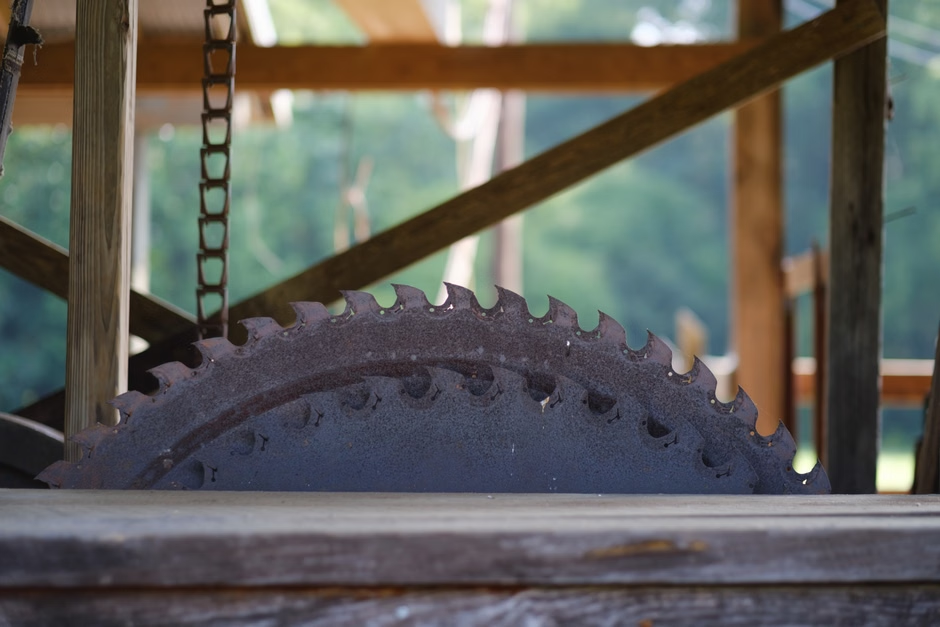
Many people just buy a saw blade and install it on their saw without considering that the blade is dull or does not have any teeth left on it for cutting the wood. Wide blades are more likely to remain steady when cutting thick pieces of wood; however, they will not be able to make tight curves with the wood. For even cutting, use a half-inch blade with three to four teeth in one inch.
Before you replace the blade on your saw, take the blade off of the saw and look at the saw blade with a flashlight. The blade that is replaced will likely fix the problem with the saw so complete that the woodworker feels embarrassed at having taken so long to find the solution. The next cause of bad cuts from a bandsaw that many people do not consider is alignment of the saw’s wheels.
4. Wheel Alignment
If the top saw wheel is even slightly out of the same plane as the bottom saw wheel, the bandsaw blade will track towards the high side; it will fight the wood as it is sawn. Performing a coplanar adjustment on the saw fixes this problem. Every bandsaw will have provisions for adjusting the tilt of the top wheel.
By rotating the saw’s wheels by hand while the blade is under tension, the saw blade should remain centered on each wheel. It will take fifteen minutes the first time to perform this adjustment. After the first time, it will only take five minutes.
Once the alignment problem is fixed, it will seem as if the sawmaker only ever had problems with one side of the saw table; however, the saw will now produce even cuts on both sides of the table. The next thing to consider is the fence on the bandsaw. Even if all else on the bandsaw is in perfect order, a problem with the fence can still cause bad sawn wood.
5. Fence Position
Place the fence on the saw in a position that is parallel to the blade. Use a pencil to draw a line on a piece of wood. Cut the line without the fence.
Now, place the fence on the cut line and cut the wood again. You might find that the fence must be adjusted to match the slight angle in which the saw blade naturaly wanders. Many woodworkers who use fences will notch the fence so it can be quickly and easily adjusted in small amount whenever installing a new blade.
This adjustment might seem fussy; however, the results will feature very smooth sawn wood. The next cause of bad cuts from a bandsaw is the buildup of sawdust inside the saw. The resin on the saw’s tires will lose its grip on the saw table.
6. Saw Dust Buildup
The tires will not grip the saw table well, and the blade will slip sideways while it is sawing the wood. Additionally, sawdust that gets into the guide saw bearings will create friction that makes the bandsaw blade move off of it path. Take five minutes to vacuum the saw.
Additionally, wipe the saw tires with isopropyl alcohol and clean the guide assembly. After vacuuming the saw and cleaning the guide bearings, the saw will act as if it had a tune-up. If your workshop mostly uses softwoods that contain more pitch in their structure, you will have to clean the saw every two weeks.
Otherwise, you will need to perform this five-minute routine twice each year. The next cause of bad sawn wood with a bandsaw is table flatness and table squareness. These two factors might seem unrelated to the bandsaw and its blade path.
If the saw table rocks or if the saw table is out of square with the saw blade, the table will create uneven pressure on the sawn wood. The pressure on the sawn wood will be even if the wood is perfectly flat on the saw table. However, if the wood is even slightly twisted while on the table, it will produce wandering cuts.
A precision square and straightedge can test the flatness and squareness of the table. You can place shims under the saws trunnions to even the table. Or, you can quickly file down the high spots on the saw table.
This is a carpentry solution to a bandsawing problem; however, it will fix the problem. The next cause of bandsaw problems is the feed rate at which you push the wood through the saw. This is perhaps the hardest habit to change when using a bandsaw.
7. Feed Rate
Push the wood through the saw too fast and the teeth of the blade will not be able to clear the sawn wood chips fast enough. If the blade cannot clear the sawn wood chips, the blade will bow backwards and not remain straight. Slowly reduce the feed rate at which you push the workpiece through the saw.
The saw will likely sound better with a more even feed rate and you will be able to let the saw blade do most of the work. If you find yourself leaning into the saw while sawing the wood, you are pushing the board to fast. The feed rate should be almost lazy; however, the bandsaw blade will remain perfectly straight.
8. Machine Stability
Bandsaws will never make straight cuts if they are dancing on an uneven floor or if the stand on which the bandsaw rests flexes when a workpiece is placed on the table. You should bolt bandsaws to the floor and place additional mass on the bandsaw to improve its stability. You can place mass on the bandsaw in the form of sandbags or concrete blocks.
Additionally, ensure that the saw’s wheels spin smoothly. If the saw’s wheels flex when spun, a saw blade will never cut straight; therefore it should be fixed. Bandsaws that do not allow wood to be cut straight might have a variety of causes; however, the solution is to return to the fundamentals of bandsaw use.
When the blade tracks true and the fence is appropriately adjusted to the sawn wood, the bandsaw becomes a meditative tool for woodworkers. When a woodworker pushes wood through the saws the wood parts as if that wood was never meant to be one long piece. This feeling of satisfaction is worth the thirty minutes that it will take to go over each of the causes of wandering sawn wood.
Thus, the next time wood parts while a bandsaw is running and the saw blade wanders off of the sawn wood, the woodworker should take a few minutes to breathe, to consider the causes of wandering wood, and to work through the list beginning at the top. The answer will be found in one of these causes; thus, the answer is almost always waiting to be found for woodworkers struggling with bandsaws that do not make straight sawn wood cut.
