
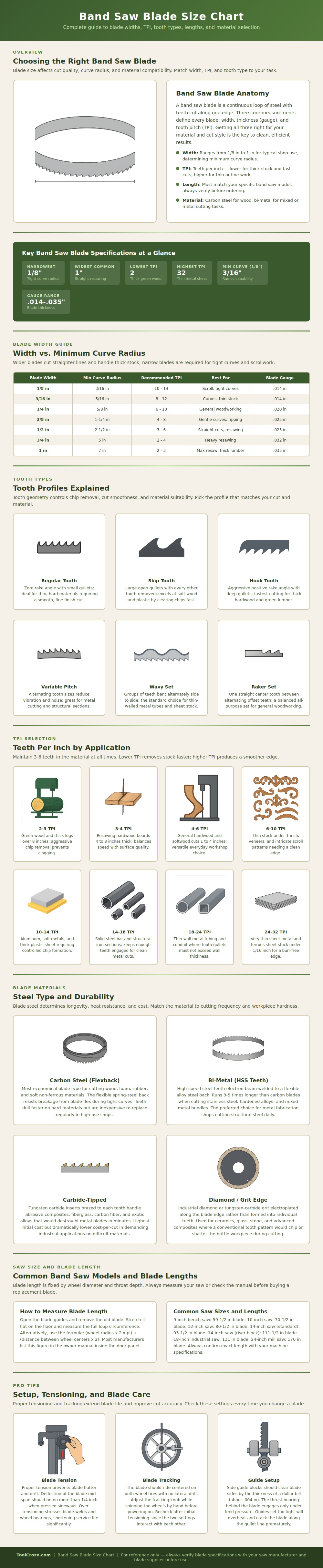
When you use a band saw, the performance of the band saw depends on the specific band saw blade that you use. Many saw operations depends upon the band saw machine to perform there operations. However, poor cut may be caused not by the band saw itself, but by the fact that the band saw blade that is used isnt the correct blade for the project.
The band saw blade that is chosen determines the versatility of the band saw. Thus, using the wrong band saw blade for a specific project will cause individual to waste their lumber, and it will also be frustrating to encounter these issues when cutting lumber. The width of the band saw blade is one of the factor that will impact the performance of that blade.
How to Choose the Right Band Saw Blade
The width of the band saw blade will determine how much that blade can bend. The relationship between the width of the band saw blade and the tightness of the curve that the blade must cut has a direct relationship to the performance of the band saw. For instance, if an attempt is made to cut a tight curve in the wood using a wide band saw blade, the blade will resist the resistance that is provided by attempting to make that tight curve.
As a result, the blade may create a jagged edge in the cut wood, or it could potentially result in the breaking of the band saw blade. Narrow band saw blades is used in situations where intricate curve are to be made in the wood, as the narrow saw blades are more flexible. In contrast, wide band saw blades are used for creating straight cuts in the wood.
The tooth pitch (also known as the teeth per inch, or TPI) of the band saw blade is another factor that impact the performance of the blade. The tooth pitch will impact the amount of sawdust that the band saw blade removes from the cut. Using a band saw blade that has high TPI rating will cause the gullet (the spaces between the teeth of the band saw blade) to become filled with sawdust quickly.
As a result, the band saw blade will rub against the wood that is being cut, which create the friction and heat in the blade that can damage it. To avoid these issues, a low TPI band saw blade should be used when cutting thick wood. Using a low TPI band saw blade on thin metal will cause the fine teeth of the blade to snag the thin metal material.
For this reason, high TPI band saw blades should be used on thin metal materials. The third factor that impacts the performance of the band saw blade is the tooth geometry. Different types of tooth geometry are made for different types of saw operations.
For instance, some types of saw teeth are created to allow for deep cuts into the materials to be cut by the band saw, while other type of teeth are made to create a smooth finish in the wood that is being cut. Hook shaped teeth is useful for cutting thick hardwoods, as the teeth are aggressive in their cut. However, the same type of teeth may be too aggressive for cutting delicate wood materials.
Another factor of importance is the material of the band saw blade. Band saw blades are typically made of carbon steel. Carbon steel is a cost effective material for the band saw blades, as well as flexible.
Carbon steel is suitable for cutting soft woods, such as pine. However, carbon steel will dull quickly if it is used to cut metals like stainless steel. In these instance, bi-metal or carbide tipped band saw blades should be used.
Though bi-metal and carbide tipped band saw blades cost more money up front, they last longer during the life of the blade. Lastly, the saw machine must be set up in the proper manner for the band saw blade to perform its cutting operation efficient. The tension of the band saw blade must be set to the correct level.
Too low a tension will cause the band saw blade to flutter. Too high a tension to the band saw blade may damage the weld of the band saw. In addition to tension, the tracking of the band saw must be correctly set up.
Otherwise, the band saw blade will drift off the tire of the saw, and the blade may rub against the frame of the saw or snap. Finally, the guides for the band saw blade must be set up in the saw. The guides must be set up in a manner that both support the blade, but does not squeeze the band saw blade.
If the guides are too tight for the band saw blade, the friction and heat created between the guide and the blade will damage the band saw blade. Thus, if the correct band saw blade width, TPI, tooth geometry, tension, and guides are set up for the saw, the band saw will perform the work that it is to perform efficient.
