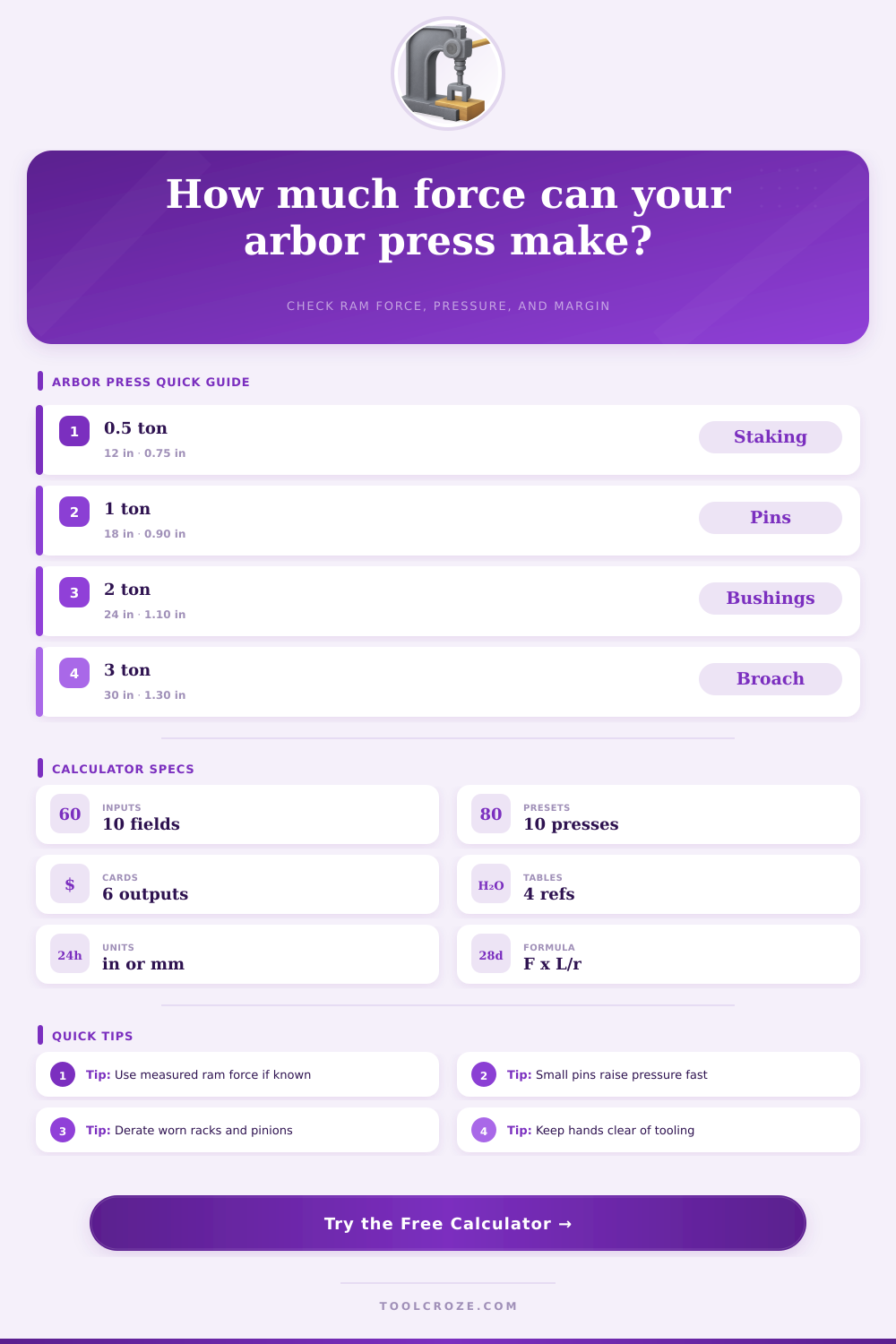
Arbor Press Force Calculator
Estimate rack-and-pinion ram force, workpiece pressure, required force, rating use, and remaining safety margin for pin pressing, staking, broaching, and bearing work.
Arbor press force results
Calculation breakdown
| Nominal press | Rated force | Common handle | Typical pinion radius | Common work |
|---|---|---|---|---|
| 0.5 ton bench arbor | 1000 lbf / 4.4 kN | 10 to 14 in | 0.65 to 0.80 in | Staking, small roll pins, light riveting |
| 1 ton hand arbor | 2000 lbf / 8.9 kN | 16 to 20 in | 0.80 to 1.00 in | Dowel pins, eyelets, small bearing starts |
| 2 ton shop arbor | 4000 lbf / 17.8 kN | 22 to 26 in | 1.00 to 1.20 in | Bushings, bearings, press tooling |
| 3 ton ratcheting arbor | 6000 lbf / 26.7 kN | 28 to 32 in | 1.20 to 1.40 in | Broaches, mandrels, larger assemblies |
| 5 ton floor arbor | 10000 lbf / 44.5 kN | 34 to 40 in | 1.40 to 1.70 in | Heavy gears, collars, thick fixtures |
| Operation | Typical pressure input | Fit factor | What limits the job | Watch closely for |
|---|---|---|---|---|
| Light staking or marking | 3000 to 10000 psi | 0.85 to 1.00 | Tool nose area and surface hardness | Part denting or uneven impressions |
| Dowel pin or roll pin | 8000 to 25000 psi | 1.00 to 1.15 | Lead chamfer, hole condition, pin material | Sudden slip after starting load |
| Bearing or bushing seating | 5000 to 20000 psi | 0.85 to 1.15 | Alignment, fixture support, fit length | Pressing through the wrong ring |
| Keyway broaching | 25000 to 70000 psi | 1.15 to 1.35 | Broach tooth load and bushing support | Chips packing or broach tilt |
| Mandrel straightening | 10000 to 40000 psi | 1.00 to 1.35 | Span, contact pad, and elastic springback | Frame flex and stored energy |
| Diameter | Area | Force at 10000 psi | Force at 25000 psi | Practical note |
|---|---|---|---|---|
| 0.125 in / 3.2 mm | 0.0123 in2 | 123 lbf | 307 lbf | Small pins reach high pressure with light handle pull. |
| 0.250 in / 6.4 mm | 0.0491 in2 | 491 lbf | 1227 lbf | Common pin and punch size for bench presses. |
| 0.500 in / 12.7 mm | 0.1963 in2 | 1963 lbf | 4909 lbf | Often near a 1 to 3 ton arbor press limit. |
| 1.000 in / 25.4 mm | 0.7854 in2 | 7854 lbf | 19635 lbf | Large flat work can exceed hand arbor capacity. |
| Quantity | Formula | Imperial unit | Metric unit | Notes |
|---|---|---|---|---|
| Handle torque | Handle force x lever length | in-lb | N-mm | Longer handles multiply torque but still need frame capacity. |
| Ram force | Torque / pinion radius x efficiency | lbf | N | Rack efficiency usually falls with dirt, wear, or side load. |
| Work pressure | Ram force / circular area | psi | MPa | Use the actual contact diameter, not the entire part size. |
| Required force | Pressure x area x severity x margin | lbf | N | Margin accounts for variation in fit, tooling, and readings. |
Arbor presses appear easy until pin refuses to seat or the broach binds. Then it’s time to learn that force isn’t just a figure stamped into frame; it depends on leverage of pinion and your pull, contact area and real world variables. The manual doesn’t always accurately predict those, so what does matter is knowing math of the press… which few shops are willing to admit.
An arbor press use some kind of rack-and-pinion system for its core. As you apply pressure to handle, it create torque. To find true force delivered to ram, divide that torque by pitch radius of pinion and then multiply by gear and rack efficiency. Tightening the pinion and/or making the handle longer multiplies what you’re doing dramatically, but every additional inch of leverage also multiples the risk of overloading frame before you realize it.
How Arbor Presses Really Work
This equation is highly dependent off efficiency. New presses with fresh lubrication may be as high as eighty percent efficient. Misalignment of gears, worn out racks, or side loading can reduces that number down in the sixties. You won’t notice until you try to press in a tight dowel pin and ram doesn’t move.
Force is everything. But so’s contact area. For any given force, a punch half the diameter will exert four times the pressure. With just modest loads on a quarter-inch pin, it’s easy to reach twenty thousand psi at workpiece. Sharp corners and small pins require respect. The calculator do the circle-area math for you to show whether your desired pressure remains well-below the tooling material yield strength or the workpiece material yield strength.
In a practical sense, finding the right safety factor is also not difficult. For known jobs in good fixtures, twenty percent is fine. When fixture or the fit is uncertain, the press are old(er), or slippage has expensive consequences, thirty or fifty percent is wise.
The press load differently depending on what operation is being performed. Material flow spikes at bottom of stroke with staking or riveting. Broaching sends stepped peaks every time it catch a tooth. Seating bearings requires that they have square support, otherwise the load go into the balls instead of traveling outward via outer ring. Straightening parts stores spring energy in the frame itself. Even though arithmetic may be similar, each scenario require a little different mindset.
Experienced hands has one good habit that leads to headache-free operation. When it’s vital they don’t just trust calculated value; they also use load cell to measure actual ram force. With a gauge, you know precisely where you stand, removing guesswork regarding your level of efficiency.
For the rest of us, we need clear sight lines. We input conservative numbers. We avoid putting our hands in path of ram. Never expect press to hold a part that desires ejection to the side. Support workpiece squarely and keep those hands away from ram path.
A final word on an arbor press: Ultimately it’s just a quiet magnifier of man’s efforts. Leave a little margin for those things we could of anticipate in our formulas, but let’s be respectful of the leverage, and always mindful of contact patch. And it will continue to be one of the safest and most useful tools on your bench.