Angle Steel Weight Calculator
Estimate equal or unequal angle bar weight from leg size, thickness, length, steel grade, drilled holes, quantity, and ordering allowance.
⚙Angle Steel Presets
📏Calculator Inputs
Calculation Breakdown
🧱Material / Spec Grid
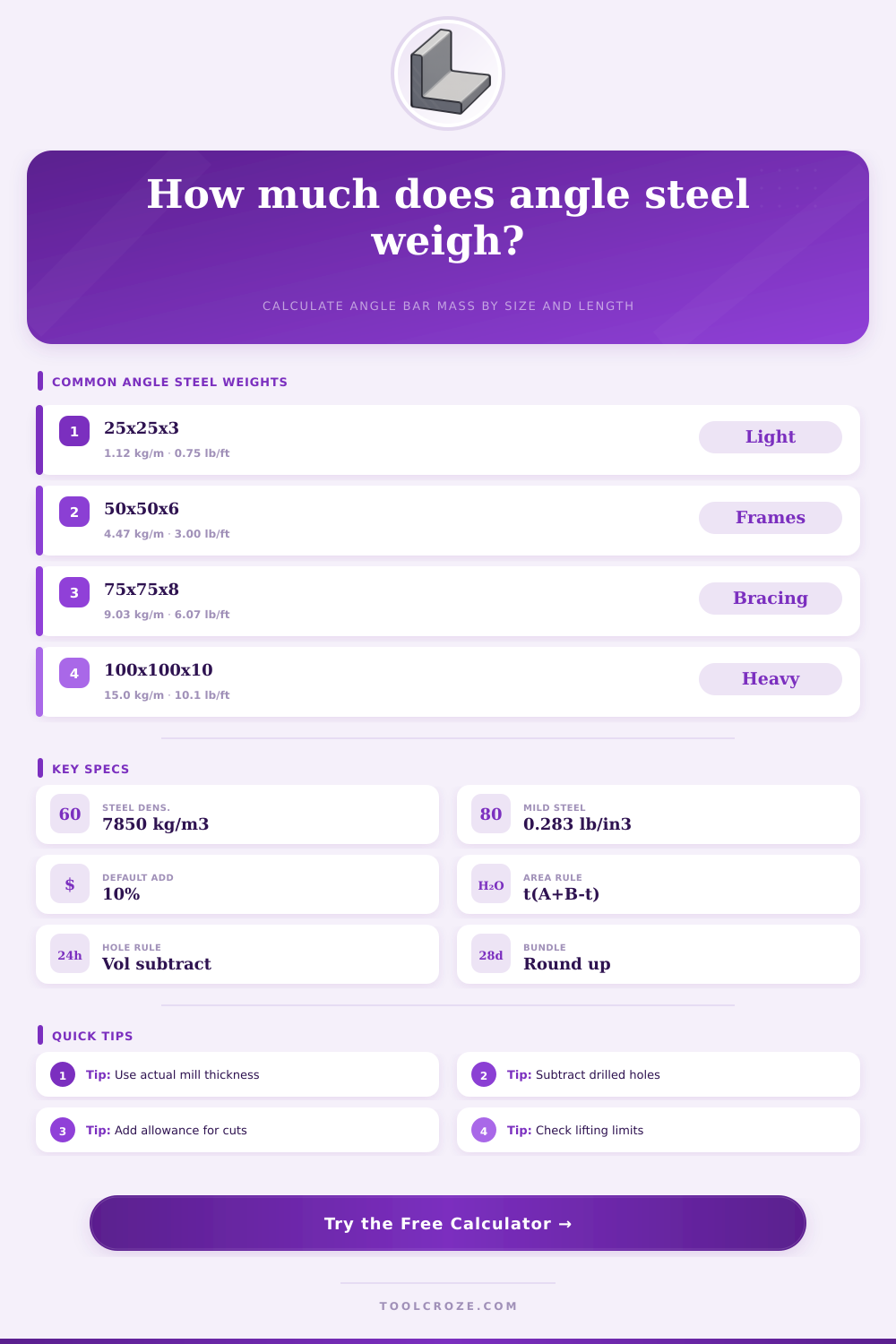
📋Common Equal Angle Weight Table
| Nominal angle | Area formula check | Approx kg/m | Approx lb/ft | Typical use |
|---|---|---|---|---|
| 25×25×3 mm | 3(25+25-3) | 1.11 | 0.75 | Light edging, small brackets |
| 40×40×5 mm | 5(40+40-5) | 2.94 | 1.98 | Frames, machine guards |
| 50×50×6 mm | 6(50+50-6) | 4.43 | 2.98 | General fabrication |
| 65×65×6 mm | 6(65+65-6) | 5.84 | 3.92 | Supports and rails |
| 75×75×8 mm | 8(75+75-8) | 8.92 | 5.99 | Platform edging |
| 100×100×10 mm | 10(100+100-10) | 14.92 | 10.03 | Heavy frames, lintels |
⚖Material Density Reference
| Material option | Density kg/m³ | Density lb/in³ | Relative weight | Notes |
|---|---|---|---|---|
| Mild steel A36 / S275 | 7850 | 0.2836 | 1.00× | Default structural steel density |
| Carbon steel S355 / A572 | 7850 | 0.2836 | 1.00× | Same density for weight planning |
| Galvanized steel angle | 7870 | 0.2843 | 1.00× | Includes light zinc coating allowance |
| Stainless steel 304 | 8000 | 0.2890 | 1.02× | Slightly heavier than carbon steel |
| Stainless steel 316 | 7990 | 0.2886 | 1.02× | Marine and chemical exposure |
| Weathering steel | 7850 | 0.2836 | 1.00× | Use same mass as mild steel |
| Aluminum 6061 angle | 2700 | 0.0975 | 0.34× | For aluminum angle comparison |
🔧Imperial Angle Reference
| Nominal angle | Area in² | Approx lb/ft | Approx kg/m | Metric equivalent |
|---|---|---|---|---|
| 1×1×1/8 in | 0.234 | 0.80 | 1.19 | 25.4×25.4×3.2 mm |
| 1-1/2×1-1/2×3/16 in | 0.527 | 1.79 | 2.66 | 38.1×38.1×4.8 mm |
| 2×2×1/4 in | 0.938 | 3.19 | 4.75 | 50.8×50.8×6.4 mm |
| 3×3×3/8 in | 2.109 | 7.18 | 10.68 | 76.2×76.2×9.5 mm |
| 4×4×1/2 in | 3.750 | 12.76 | 18.99 | 101.6×101.6×12.7 mm |
📐Angle Weight Formula Reference
| Calculation item | Metric formula | Imperial formula | Use in calculator |
|---|---|---|---|
| Nominal area | t(A+B-t) mm² | t(A+B-t) in² | Base L-section area |
| Weight per length | Area × density / 1,000,000 | Area × density × 12 | kg/m or lb/ft output |
| Piece volume | Area × length | Area × length × 12 | Gross piece mass |
| Hole deduction | n × πr²t | n × πr²t | Subtract drilled hole volume |
| Order allowance | Net weight × (1+%) | Net weight × (1+%) | Cutting and trim planning |
💡Practical Calculation Tips
Every fabrication project has a moment. It’s that moment where you realize something went wrong with your math and there you stand in front of a steel rack identical to drawing but now three hundred pounds heavier then what you’d accounted for. The crane operator looks at you and you know he’s seen this mistake before. No, you didn’t forget to measure the beams or order the bolts. You just miscalculated how much the angle iron holding everything together would weigh. Because that little L-shaped bar isn’t that bad, right? Until you multiply it by four piece and ten meters. At which point you realize your forklift won’t be able to handle lifting entire assembly safely.
But here’s the rub: Steel is surprisingly dense. A person sees a piece of metal that’s 50mm by 50mm and thinks, “oh, yeah, I could handle a little strip like that.” They don’t realize that inside that small piece of metal is hiding seven thousand eight hundred kilograms per cubic meter. Every millimeter of thickness add up fast when you’re cutting those leg to length. Once you enter the measurements for the dimensions you want, the calculator (above) do the rest of the work for you. It spares you from having to think about unit conversions or coefficients; it just takes raw numbers and turns them into something you can actualy lift.
Why Steel Angle Iron Weighs So Much
For this number most stores follows a basic area rule. Basically you multiply the thickness by the sum of the two legs minus that same thickness. Sounds like some sort of geometry homework problem, but honestly there’s no other way to come remotely near accurate without having to weigh each individual bar. The key here is knowing what exactly they are taking the measure based off of. Sharp corners is assumed in that equation. In reality, steel comes out of a mill with rounded edges and has rounded roots and fillets. That adds mass which basic equation completely ignores.
The Corner Allowance Setting is why knowing about radius of the roll is important. Every single time you ignore this setting on the roll, you’ll under quote your shipping costs. You can set the tool to accommodates smaller and larger radii of roots. It only adds a little bit to the overall cost but over a hundred times it pays for itself with accurate freight estimates. No need to know exactly what the radius of the bend is. Just admit that it’s there and it do contribute some weight.
Budgets get blown out with holes too. Bolts takes out material when they’re drilled through. You lose real steel by drilling 4 big hole through every piece. That reduces your overall weight. A small deduction per piece, sure, but if you’re trying to get really tight on the lift limit or shipping over internationally it all adds up. These voids is accounted for in the calculator and will give you a final number that’s closer to what you’ll have in your hand.
Also material makes a difference. If you substitute mild steel with stainless, there’s no change in dimensions but a little bump up in density. A drop down to aluminum will get you two thirds less weight. Now if you’re used to working with aluminum and think “thicker angle is OK since it’s light,” that’s true. But you must find its real mass first before designing anything structurally. The table on this page shows this comparison so you can quickly see how much heavier a stainless bar is than common carbon steel of the same size.
This is where theory meets reality: allowances. Even if you cut all your steel right on the money, it’s not gonna happen every time. When you weld metal together, it’ll warp. Every time you make a cut there is some length that gets eaten up by saw burrs and kerfs. Ten percent isn’t wasted; it’s a cushion for making it through the job site. Run out of steel because the first cut was off? That happens when you order exactly to the formula. The weight was a bore to get right, but once it saved your budget (or your back) it felt like genius. Let the tool do the heavy lifting by starting with the rough dimensions. Worry about the aesthetic later. First make sure you can actualy move the thing you built.