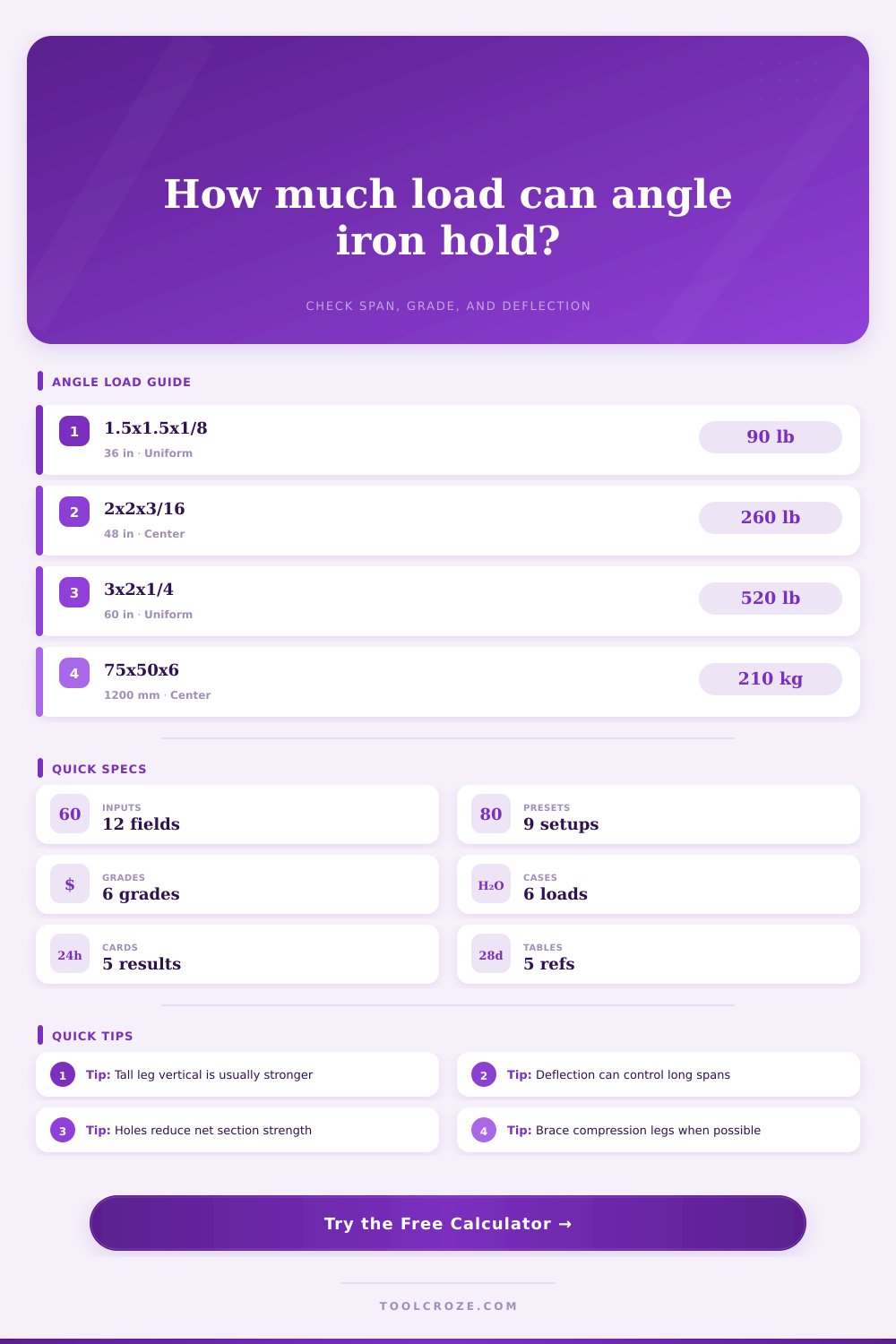
Angle Iron Load Capacity Calculator
Estimate safe load from angle leg size, thickness, span, steel grade, load case, bracing, holes, safety factor, and deflection limit.
Angle Iron Capacity Results
| Nominal Angle | Typical Thickness | Approx Weight | Best Orientation |
|---|---|---|---|
| 1 x 1 angle | 1/8 in | 0.8 lb/ft | Short brackets, light trim, small trays |
| 1-1/2 x 1-1/2 angle | 1/8 to 3/16 in | 1.2 to 1.8 lb/ft | Small shelf ledgers and perimeter frames |
| 2 x 2 angle | 3/16 to 1/4 in | 2.4 to 3.2 lb/ft | Machine stands, trailer tabs, rack rails |
| 3 x 2 unequal angle | 1/4 in | 4.1 lb/ft | Put the 3 in leg vertical for bending depth |
| 4 x 3 unequal angle | 3/8 in | 8.8 lb/ft | Heavy ledges, lintel seats, equipment frames |
| Material | Yield Strength | Elastic Modulus | Density Used |
|---|---|---|---|
| ASTM A36 carbon steel | 36 ksi | 29,000 ksi | 0.283 lb/in³ |
| ASTM A572 Grade 50 | 50 ksi | 29,000 ksi | 0.283 lb/in³ |
| ASTM A588 weathering steel | 50 ksi | 29,000 ksi | 0.283 lb/in³ |
| ASTM A500 Grade B | 46 ksi | 29,000 ksi | 0.283 lb/in³ |
| 304 stainless angle | 30 ksi | 28,000 ksi | 0.289 lb/in³ |
| 6061-T6 aluminum angle | 35 ksi | 10,000 ksi | 0.098 lb/in³ |
| Load Case | Maximum Moment | Maximum Shear | Deflection Form Used |
|---|---|---|---|
| Simple span, center point | P L / 4 | P / 2 | P L³ / 48 E I |
| Simple span, uniform load | W L / 8 | W / 2 | 5 W L³ / 384 E I |
| Simple span, offset point | P a b / L | larger reaction | P a² b² / 3 E I L |
| Simple span, two third-point loads | W L / 6 | W / 2 | 23 W L³ / 2592 E I |
| Cantilever, end point | P L | P | P L³ / 3 E I |
| Cantilever, uniform load | W L / 2 | W | W L³ / 8 E I |
| Check | Typical Limit | When It Matters | Calculator Treatment |
|---|---|---|---|
| Rough support | L/180 | Temporary rails, rough platforms | Higher allowed movement |
| General support | L/240 | Shelves, frames, utility ledgers | Default serviceability limit |
| Finish support | L/360 | Finish panels, tight door or drawer gaps | Lower allowed movement |
| Machine support | L/480 | Machinery, tile, vibration-sensitive loads | Stiffer serviceability limit |
| Lateral twist | project-specific | Single angles with unbraced compression legs | Bending capacity multiplier |
| Orientation | Capacity Effect | Deflection Effect | Practical Use |
|---|---|---|---|
| Long leg vertical | Usually highest bending capacity | Usually stiffest | Best for shelf rails, headers, ledges |
| Short leg vertical | Lower section modulus | More deflection | Useful when clearance limits depth |
| Equal angle vertical leg | Symmetric leg size, not symmetric section | Moderate stiffness | General brackets and frames |
| Unbraced single angle | Twist may reduce usable strength | Movement can look worse than beam math | Add gussets, weld plates, or bearing deck |
| Bolted critical section | Hole lowers net section | Stiffness mostly unchanged | Keep holes away from maximum moment zones |
This calculator uses simplified elastic beam formulas and an approximate built-up angle section model. It does not check weld capacity, bolt tear-out, bearing, local leg buckling, torsion, fatigue, or code load combinations.
This is angle iron. Build a shelf in half an hour. And when it’s time to set a TV on top of it, maybe for the first time, then you’ll know… well, maybe not. There is no sure way to tell with angle iron. Angle iron feel like solid stuff but being shaped as an L doesn’t work structurally exactly how you’d intuitively think.
Enter the calculator above. Feed it your dimensions, feed it your span, and it’ll do the math for you. Then translate those physical inputs into a safe load limit.
Why You Need an Angle Iron Calculator
But why does that number change? That’s where the magic happen beyond what you see before you. So it’s designed to be a compromise between strength and materials used. Using a tube would use much more material, but have more stiffness. And using an angle gives you twice the surface to bolt on which uses less material, but also makes it less stiff.
An angle that is bent out will tend to both flex, and twist. So the tool will ask how the part is braced. Does the compression leg has any lateral support? Without lateral support, the load capacity drop. It’s not just about how thick the steel is; material grade and shape play a big role too. It’s about how the shape hold up under load. Oftentimes, unbraced angles don’t just break, they simply twist until they do. Bracing becomes more important then thickness over greater span lengths.
Builders has another hurdle with orientation. If you make one side longer than the other and turn it on its end so the shorter leg is vertical, it will look fine at first, but it won’t look right once weight are added to the top. Now not only is your bending depth less due to this orientation, but you take away a bunch of strength. With the calculator, you can flip the long and short legs around and compare. In most cases, it’s better to use the longest leg vertical as it gives you more capacity since you increase the section modulus. It is a simple little change in geometry that has a big impact practically speaking. Most folks don’t do it because of preexisting holes or clearance issue, but that’s why you end up with wobbly frames and sagging shelves.
But what about the effect of material grade? Most people are surprised that this matter as much as it does. For example, a lighter A36 mild-steel will do the job for a lightweight rack, but bumping up to Grade 50 steel will raise load ratings with no change in angle size. Stainless steel provides corrosion protection with reduced yield strength; aluminum is light but not stiff (and therefore prone to sag). To help out here, the tool lets you compare grades and swap one factor for another (weight vs. Strength or vice versa). Will your application need maximum load bearing or rust durability?
The deflection is what makes the structure work (or not). Two hundred pounds of stuff might sit on an angle just fine without snapping, but a half-inch sag can cause finish work to crack and drawers to stick open. That’s where the deflection parameters in the tool tighten things up. Some bounce on a shelf storing rough storage rack, but no movement at all for heavy machinery or tile support. Failure to consider deflection yield structures that are strong enough to stay together, but still so flexible they won’t actualy do the job.
Drilling into the leg means local weakening of the cross-section from the hole needed to bolt it on. You have just reduced the effective net area supporting the load by drilling out some of the strongest section. You can include the hole size in your calculation. It’s an easily overlooked factor in ballpark calculations. Placing a bolt hole in the zone of greatest bending force is a potential weak spot. Keeping them nearer to the supports reduces bending forces and preserves your strength.
Angle iron is forgiving but not magic. Have confidence in its strengths and respect its weaknesses. Checking deflection, bracing, and span turns guesswork into knowledge. It is a thing built that appears solid and acts solid under true load. The TV sits on the shelf. And it stays level while doing so. It would of been worth every additional minute tinkering with the input settings just for that peace of mind.