🔧 Anchor Bolt Pullout Strength Calculator | Hold Check
Screen headed and hooked anchors with a fast concrete pullout estimate
| Type | Formula | Use | Note |
|---|
| Bolt | Area | Head / Hook | Embedment |
|---|
| f'c | Ratio | Screening note | Typical use |
|---|
| Case | Rule | Flag | Action |
|---|
The pullout strength of an anchor bolt is a measurement of the tension that a concrete foundation can resist before the anchor bolt pulls out of the foundation. If the foundation experience a failure in which the anchor bolt pulls out of the foundation, it can lead to instability in the structure and delays in the construction of the projects. Engineers must calculate the pullout strength of anchor bolts to determine if a steel column or a machines will remain attached to the concrete slab on which it is constructed.
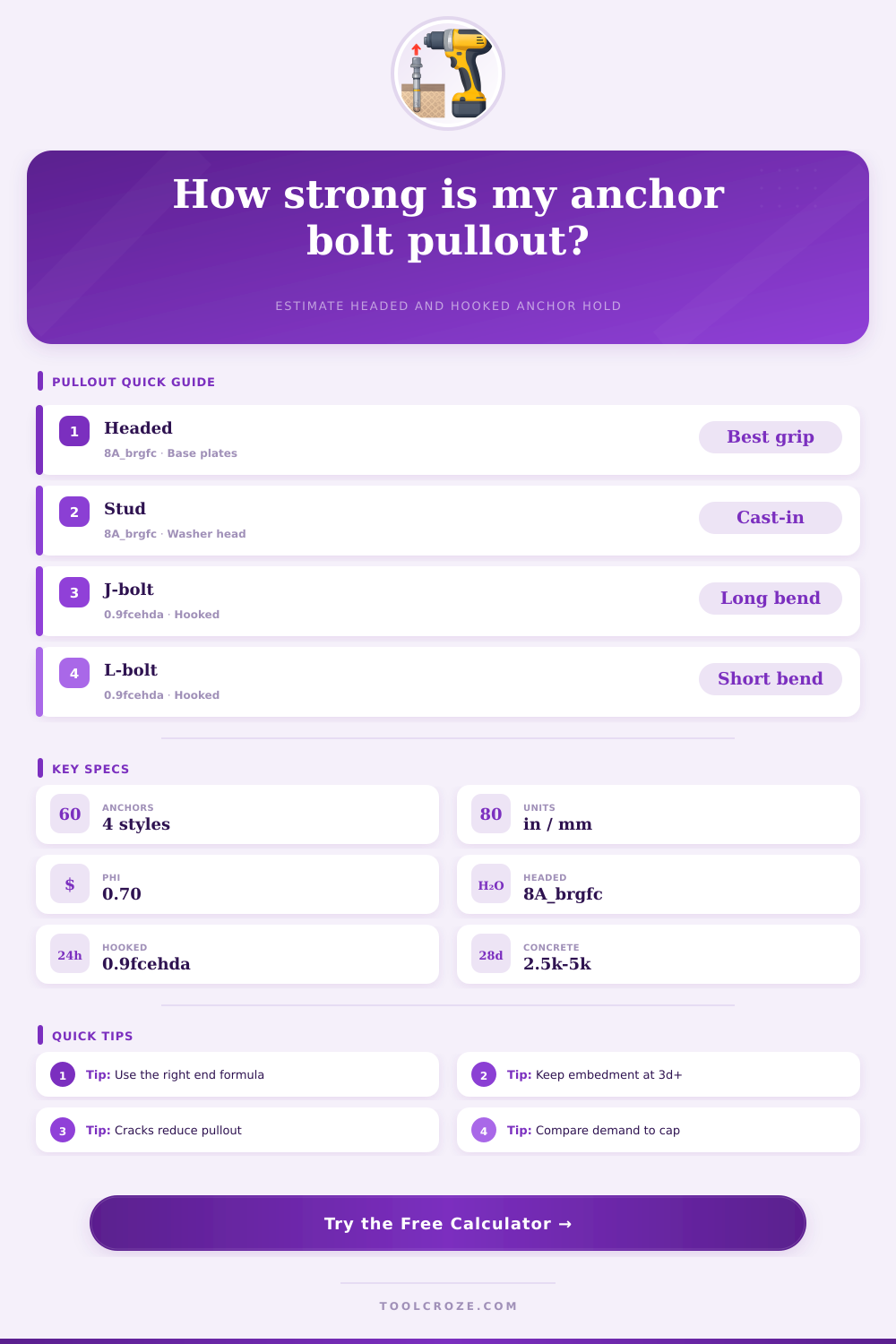
Tension loads is applied to the anchor bolt in such a way that pulls on the anchor bolt in a direction that is perpendicular to the surface of the concrete slab. There are different methods by which anchor bolts can resist these tension loads. Headed bolts and headed studs use the wide head of the bolt or the nut that secures the bolt to compress the cone of concrete beneath the head.
What Affects Anchor Bolt Pullout Strength
Hooked anchors, such as J-bolts and L-bolts, use the bend in the bottom portion of the bolt to create a shear mechanism along the length of the hook of the anchor bolt. Headed anchors are useful in environments in which there is ample space for the head of the anchor bolt, while hooked anchor bolts can be useful in environments in which space is limitedly. The diameter of the anchor bolt is not necessarily the factor that determines the pullout strength of that anchor bolt.
The area that is compressed under the head of the anchor bolt or the length of the hook of the bolt is one factor in determining the pullout strength of that bolt, and the compressive strength of the concrete multiplies the pullout strength. Therefore, an anchor bolt that has a smaller diameter but a very large head may have more pullout strength than an anchor bolt that has a large diameter but a small head. The compressive strength of the concrete is another critical factor in determining the strength of the anchor bolt.
The higher the compressive strength of the concrete, the more strength will be provided to the anchor bolt. For instance, increasing the compressive strength of the concrete from 3,000 psi to 5,000 psi will increase the pullout strength of that anchor bolt by 60 percent. Embedment depth is another critical factor in determining the pullout strength of the anchor bolt.
If the depth to which the anchor bolt is embedded into the concrete foundation is too shallow, the anchor bolt will not be able to develop the full strength of the foundation. For headed anchors, the embedment depth should be a minimum of four times the diameter of the anchor bolt. For hooked anchors, the embedment depth should be at least three times the diameter of the anchor bolt, but a depth of four and one-half times the diameter is recommended.
Using lightweight concrete for the foundation or if the foundation is cracked will reduce the pullout strength of the anchor bolt. The factors discussed to date are based off theoretical calculations of the strength of the foundation and the anchor bolt. For instance, if a headed stud is cast into a pour of concrete, the headed stud will develop the strength of the concrete beneath it.
If a person were to replace that headed stud with a J-bolt, the J-bolt would have to be embedded to a depth that allows it to develop the same sideways strength as the headed stud. If the depth of the embedment of the J-bolt is too shallow, the J-bolt will fail more easy than the headed stud. In addition, if the structure is subjected to loads that occur periodically, such as seismic activity, the anchor bolt will be subjected to increased tensions.
These increased tensions must be accounted for when calculating the strength and safety margin of the anchor bolt. A person should leave some reserve capacity in the strength of the foundation and anchor bolt system to ensure the safety of the structure. The reserve capacity is the difference between the design strength of the anchor bolt and the actual load that is applied to the anchor bolt.
If a person intends to use more than 85 percent of the strength of the anchor bolt, that anchor bolt will be operating with a low margin of safety. If a person intends to use 100 percent of the strength of the anchor bolt, the system will be at risk of being overload. In many instances, people makes mistakes when calculating the pullout strength of an anchor bolt.
One common mistake is to focus on the strength of the steel of which the anchor bolt is made and to forget to calculate the strength with which the concrete will breakout from beneath the anchor bolt. Another mistake is to forget to account for the distance of the anchor bolt from the edge of the slab of concrete. If the anchor bolt is too close to the edge of the slab, the concrete cone will break through the side of the slab of concrete.
If many anchor bolts is embedded in the same area of a foundation, the stress cones of the anchor bolts may overlap. This will reduce the total strength of the group of anchor bolts. Finally, the method with which the anchor bolt is installed can affect the strength of the anchor bolt.
If the anchor bolt is cast into place, the pullout strength will be higher than for an anchor bolt that is installed into a foundation after the foundation is constructed. Drilling into the foundation will weaken the concrete around the anchor bolt. The torque that is applied to the anchor bolt when it is installed should also be taken into consideration.
If the bolt is tightened unevenly, it may lead to failure of the anchor bolt. The geometry of the anchor bolt should be matched to the strength of the concrete and the loads that is placed on the foundation to ensure that the anchor bolt will not fail in a manner in which it is pulled out of the foundation.