🔧 Anchor Bolt Embedment Calculator | Required Depth and Length
Size effective embedment, hole depth, and rod length for concrete anchors
| Family | Min hef | Bias | Best use |
|---|
| Dia | Min hef | Hole slack | Rod stack |
|---|
| Layout | Ratio | Effect | Action |
|---|
| Condition | Factor | Note | Use |
|---|
Embedment depth are the measurement of how deep the anchor is placed into the concrete surface. Embedment depth is one of the critical factor in determining how much weight the anchor can support. If the embedment depth is too shallow for the weight to be supported, the concrete will fail in a tension breakout.
A tension breakout happens when a cone shaped portion of the concrete begins to pull out of the concrete along with the anchor. To avoid this type of failure, the embedment depth must be sufficient to ensure that the anchor does not pull out of the concrete under the design load. Due to the strength of the concrete in compression and its weakness in tension, the embedment depth must provide a large volume of concrete that surround the anchor.
How Deep to Place Anchors in Concrete
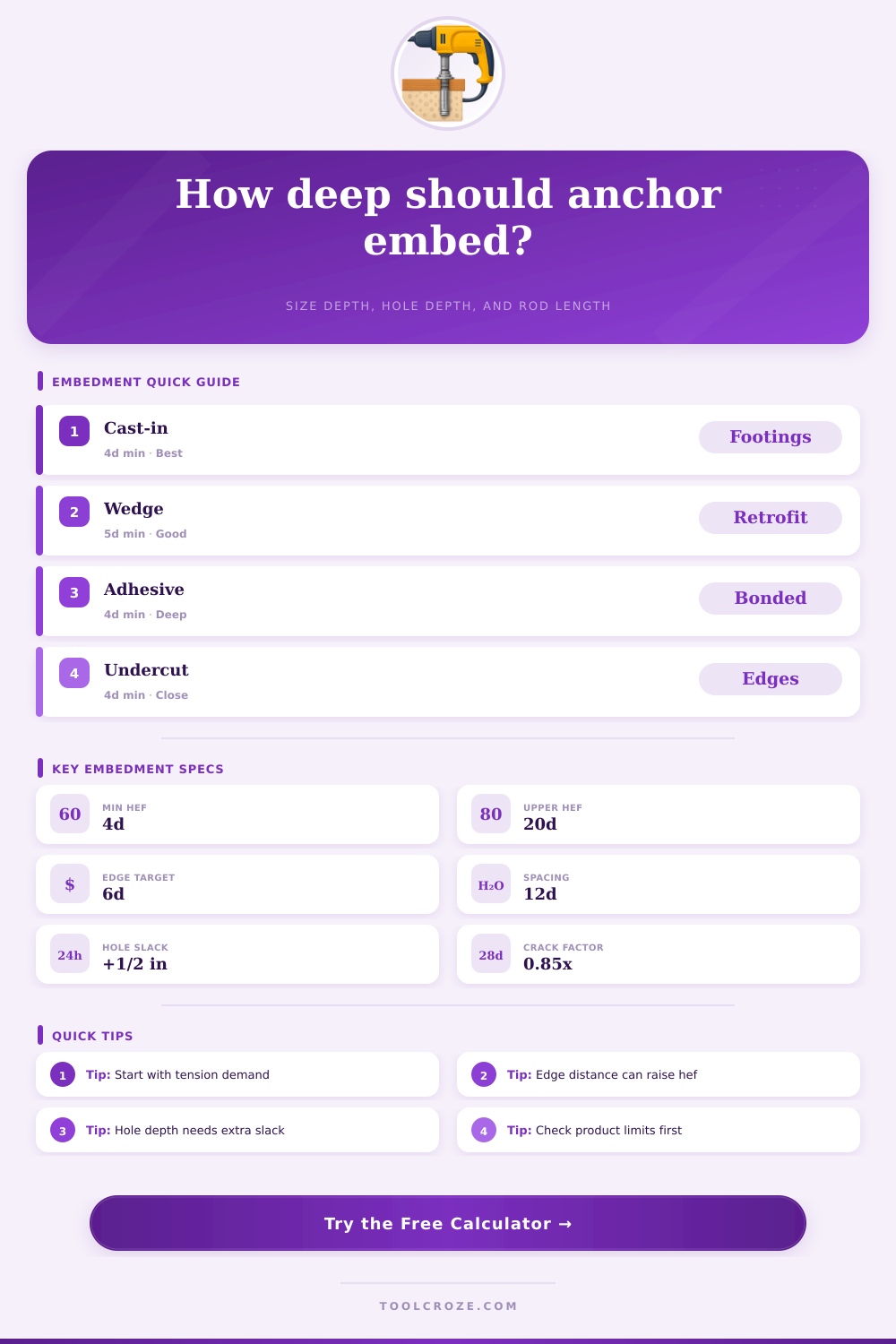
An increase in embedment depth increase the volume of the concrete cone, which increases the capacity of the anchor. Different types of anchors requires different embedment depths. For instance, workers place cast-in headed studs into the concrete while it is still setting.
Due to the concreting process, the anchor has high capacity within the poured concrete. Wedge anchors are used in existing poured concrete. Wedge anchors expand against existing concreting, so the depth must allow for this expansion.
Adhesive anchors requires a chemical to bond the rod to the concrete. Due to the fact that there is no need for mechanical expansion, adhesive anchors allow for deep embedment. Each type of anchor has a specific efficiency factor that modifies the embedment depth that are required to support the loads of the structure.
The loads that are applied to the anchor impact the embedment depth requirements for the anchor. Tension loads are those that pull the anchor away from the concrete. These loads are the primary consideration in the determination of embedment depth.
Shear loads are those that push the anchor sideways against the concrete. Shear loads contribute to the total load that the anchor can take. Most anchors will experience both types of load simultaneously.
The embedment depth must account for both types of load. Finally, the strength of the load has an impact on the embedment depth requirements for the anchor. The higher the strength of the concrete, the more resistantly that the concrete will exhibit against the embedment depth.
Due to this higher resistance, the embedment depth for high strength concrete can be less than for weaker concrete. The geometry in which the anchor is installed will impact the embedment depth requirements. For instance, the distance of the edge of the anchor to the edge of the poured concrete is referred to as the edge distance.
If this distance is small, it will limit the size of the concreting cone. Due to the smaller size of the cone, the capacity of the system will be less. In this situation, an increase in embedment depth may be required.
The spacing between multiple anchor will also impact embedment depth requirements. If the spacing between the individual anchors is too close together, the concreting cones created by each anchor will begin to overlap. This overlapping will reduce the total capacity of the system, so the spacing between the anchors may need to be increased or the embedment depth increased.
The condition of the poured concrete will also impact embedment depth. If the poured concrete is uncracked, it will have a higher embedment depth capacity than if it were cracked. The cracks will allow the concreting cone to slide out of the poured concrete more easy.
To account for the ease with which the poured concrete may slide out of the anchor, the embedment depth will need to be increased by approximately 15%. Finally, lightweight poured concrete will have a lower capacity than standard poured concrete. To account for this, an increase in embedment depth will be required.
When determining embedment depth, there are some mistakes that you should avoid. One mistake is to aim for the minimum embedment depth. Due to the nature of construction, it is possible for the depth of the drilled hole to be less than the calculated embedment depth.
To account for this, it is common to add a margin of safety to the embedment depth calculations. Adding ten percent to the embedment depth is a common method of providing a safety margin for construction errors. It is also important to ensure that the drilled hole is clean.
Any dust or debris within the drilled hole can reduce the capacity of mechanical anchors by half. If you are to use adhesive anchors, a blower and brushes will be necessary to remove any debris from the drilled hole. Finally, the total load that the anchor will experience cannot reach the maximum limit of the anchor product.
Any increase in load beyond the specifications of the manufacturer will damage the anchor.