
To get a snug fit, you only need to turn it one-sixth of a rotation. Tighten the fitting until you feel metal resistance, then back it off slightly. That’s it, and that precise turn ensures a tight seal on the high-pressure fluid within your landing gear system or engine bay. Back it off too much and the seal gets crushed out of use; go too little and there’s a big enough gap for hydraulic fluid to splash all over your work space.
Knowing how these connectors fit together isn’t as important than knowing that they actualy connect, instead of just forcing them together until they won’t turn any more. Today’s standard stems directly from military aircraft applications where reliable, lightweight connector are required that withstand great amounts of pressure and vibration cycles. The initial Army-Navy fittings used anodized aluminum bodies to achieve lightness but retain strength. This is what gives us those fittings in our high performance builds today as well as race cars.
How to Install AN Fittings Correctly
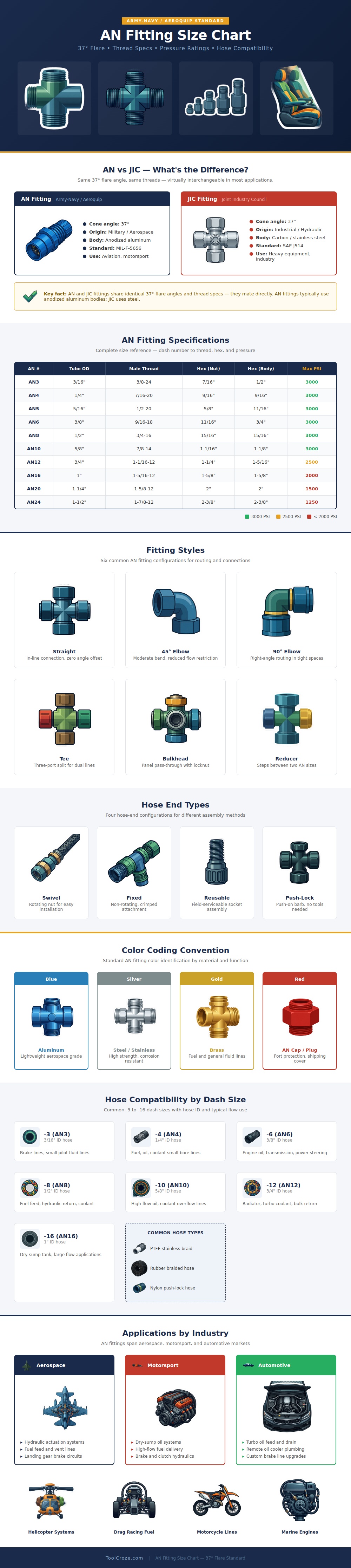
Each dash number represents a unique set of hex size and pitch. The chart above details these breakdowns so you don’t have to guess at your wrench size before you get going. Here’s something most people fail to realize. All AN fittings also share the same threading geometry as the JIC industrial fittings. Both use a 37 degree flare angle. Really the difference boils down to materials used and the context of the application. Understand the pressures involved and you can mix ’em up.
The other consideration that most folks new to this don’t think about is that larger tubes has lower pressure ratings. A dash size of AN-4 or an AN-6 handles three thousand psi no problem. Move up to a larger connection such as an AN-20 or even an AN-16 and it drops off considerably. Think about it in terms of stress spread across the flare seat and surface area… You are not simply purchasing a connector, but a pressure vessel component. So why would you use overly large fittings for low flow applications? They add bulk and weight unnecesarily with no improvement in performance. Match your required flow to the fitting size. Don’t just choose what’s easiest on the shelf.
Clearance and angling must be considered when routing lines through engine bay. Simple inline runs are no issue with straight connectors, but real-world scenarios don’t always feature identically lined-up ports. Exhaust headers, intake manifolds and other parts call for elbows. Remember: the smaller the angle change (a 45-degree bend vs. A hard right-angled 90), the less it impedes flow. This may seem inconsequential until you’re revving at high RPMs; turbulence can lead to cavitation.
Tee fittings allow you to split line runs without having to add extra adapters (and consequent leak points). The more connections you have, the more opportunity there is for something to fail. If you need to pass hoses through firewall panels, bulkhead fittings eliminate the guesswork involved in making sure they stay secure yet still look good on the outside. Locking nut clamps firmly against firewall/panel thickness so it doesn’t loosen over time due to vibration.
The inner diameters must match for the hose to fit. Three-eighth-inch hose matches a dash-6 fitting. Three-quarter-inch tubing matches a dash-12 fitting. If not, it won’t be secure; either the crimp will fail or you’ll have a loose connection that leaks when pressurized.
Stainless braided hose is chemically resistant, durable, and has a PTFE lining for use in fuel systems. Rubber braids are better for heat resistance in oil cooler lines. Push-lock fittings allow you to assemble quickly for test runs, but aren’t as secure as permanent fittings should be used in a final installation. Reusable hose ends let you take apart and reconnect systems as needed without using special crimping tools. This proves priceless during development stages.
This is about quality. Material quality affects not only appearance but also how it works. Low weight is important so blue anodized aluminum is a standout in an engine bay. For corrosive conditions like the marine environment, stainless steel offers better protection against salt compared to other metals. Brass fittings are very common in fuel systems because they do not degrade rubber seals and are compatible with multiple hydrocarbon fuels. Red caps protect ports when not installed and help keep debris from filling open ends until the last install step. These little touches save big bucks later.
Respecting the precision required for proper installation Clean threads matter; prep flares properly; apply torque correctly. The graphic does a good job of pointing you to matching parts visually. However, the actual work happens when you get your hands on things, and that requires doing it carefully. Go slow, ensure everything lines up, confirm each joint and don’t put fluid pressure on it until you’re certain it’s done right. If you take that extra time upfront, it will pay off when the engine is warm, fluids are flowing at full speed, and you can no longer fix mistakes.
One last thing: Don’t forget that one-sixth turn tweak. That’ll be the difference between a winner and a cleaning mess.
