⚡ Amperage to Wire Gauge Calculator
Find the correct AWG wire size for any electrical circuit — residential, automotive, or low-voltage DC
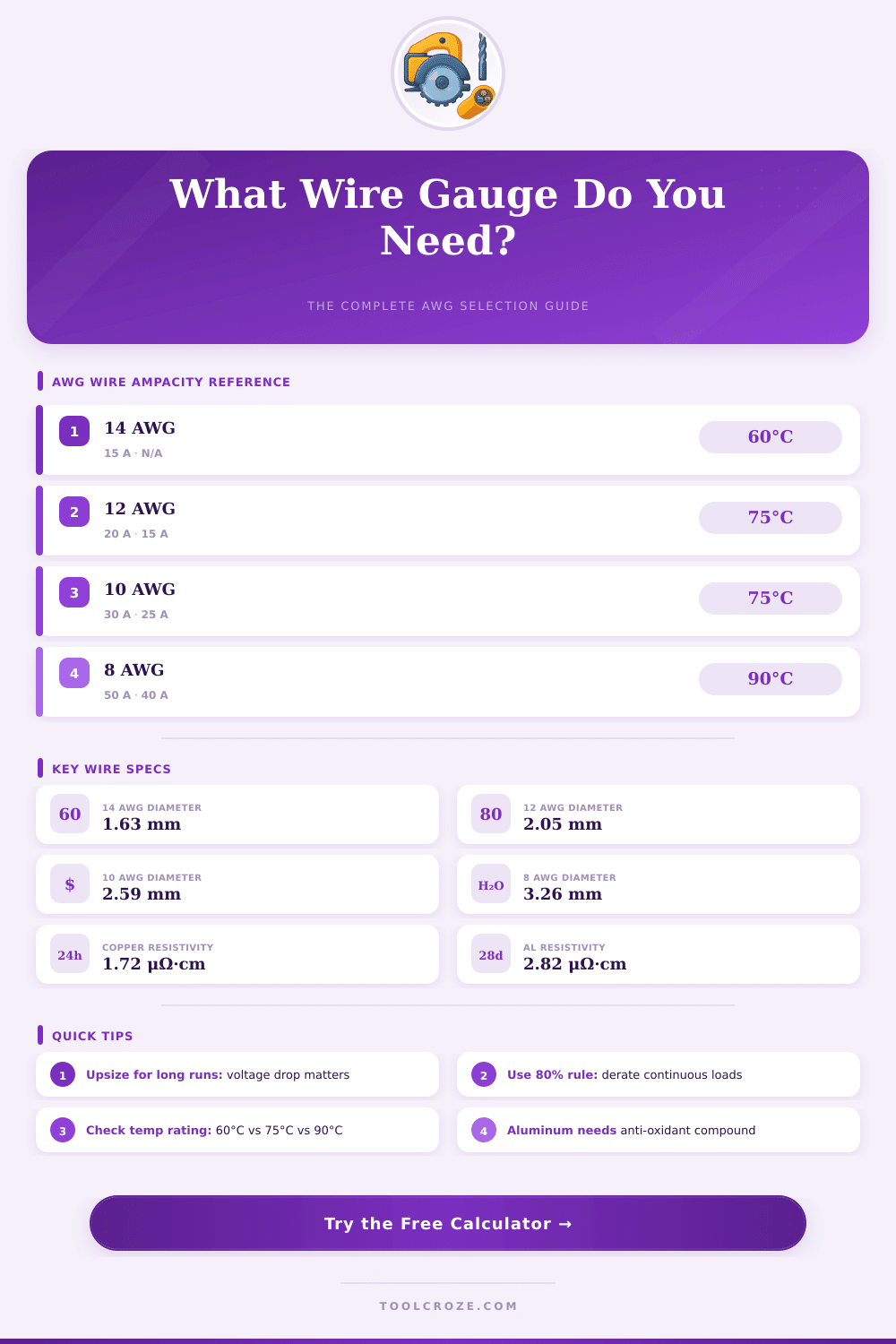
| AWG | Copper 60°C (A) | Copper 75°C (A) | Copper 90°C (A) | Aluminum 75°C (A) | Diameter (mm) | Resistance (Ω/1000ft) |
|---|---|---|---|---|---|---|
| 18 AWG | 7 | 7 | 7 | — | 1.02 | 6.385 |
| 16 AWG | 13 | 13 | 13 | — | 1.29 | 4.016 |
| 14 AWG | 15 | 20 | 25 | — | 1.63 | 2.525 |
| 12 AWG | 20 | 25 | 30 | 20 | 2.05 | 1.588 |
| 10 AWG | 30 | 35 | 40 | 30 | 2.59 | 0.999 |
| 8 AWG | 40 | 50 | 55 | 40 | 3.26 | 0.628 |
| 6 AWG | 55 | 65 | 75 | 50 | 4.11 | 0.395 |
| 4 AWG | 70 | 85 | 95 | 65 | 5.19 | 0.249 |
| 3 AWG | 85 | 100 | 110 | 75 | 5.83 | 0.197 |
| 2 AWG | 95 | 115 | 130 | 90 | 6.54 | 0.156 |
| 1 AWG | 110 | 130 | 150 | 100 | 7.35 | 0.124 |
| 1/0 AWG | 125 | 150 | 170 | 120 | 8.25 | 0.098 |
| 2/0 AWG | 145 | 175 | 195 | 135 | 9.27 | 0.0779 |
| 3/0 AWG | 165 | 200 | 225 | 155 | 10.40 | 0.0618 |
| 4/0 AWG | 195 | 230 | 260 | 180 | 11.68 | 0.0490 |
| 250 kcmil | 215 | 255 | 290 | 205 | 12.70 | 0.0431 |
| 300 kcmil | 240 | 285 | 320 | 230 | 13.91 | 0.0360 |
| 350 kcmil | 260 | 310 | 350 | 250 | 15.01 | 0.0308 |
| 400 kcmil | 280 | 335 | 380 | 270 | 16.00 | 0.0270 |
| 500 kcmil | 320 | 380 | 430 | 310 | 17.88 | 0.0216 |
| AWG | 15A / 25ft | 20A / 50ft | 30A / 50ft | 50A / 100ft | 100A / 150ft | Recommendation |
|---|---|---|---|---|---|---|
| 14 AWG | 1.1% | 6.0% | 9.1% | — | — | 15A branch circuits |
| 12 AWG | 0.7% | 3.8% | 5.7% | — | — | 20A branch circuits |
| 10 AWG | 0.4% | 2.4% | 3.6% | 4.0% | — | 30A circuits, long 20A runs |
| 8 AWG | 0.3% | 1.5% | 2.2% | 2.5% | — | 50A circuits |
| 6 AWG | — | — | 1.4% | 1.6% | — | 60A circuits |
| 4 AWG | — | — | — | 1.0% | 3.1% | 100A sub-panels (short) |
| 2 AWG | — | — | — | 0.6% | 1.9% | 100A circuits |
| 1/0 AWG | — | — | — | — | 1.2% | 150A service |
| 2/0 AWG | — | — | — | — | 0.9% | 150A or 200A short |
| Application | Typical Amps | Voltage | Recommended AWG | Breaker Size | Notes |
|---|---|---|---|---|---|
| General Outlet (15A) | 15A | 120V | 14 AWG Cu | 15A | Max 80% = 12A continuous |
| Kitchen Outlets (20A) | 20A | 120V | 12 AWG Cu | 20A | Requires GFCI |
| Electric Dryer | 30A | 240V | 10 AWG Cu | 30A | 4-wire NEMA 14-30 |
| Electric Range | 50A | 240V | 6 AWG Cu | 50A | 4-wire NEMA 14-50 |
| EV Charger (Level 2) | 48A | 240V | 6 AWG Cu | 60A | Continuous load rule |
| Hot Tub / Spa | 50–60A | 240V | 6 AWG Cu | 60A GFCI | Must be 60A GFCI breaker |
| AC Unit (5 ton) | 40A | 240V | 8 AWG Cu | 50A | Check nameplate MCA |
| Sub-Panel (100A) | 100A | 240V | 3 AWG Cu / 1 AWG Al | 100A | Aluminum saves cost |
| Main Service (200A) | 200A | 240V | 2/0 Cu / 4/0 Al | 200A | Utility service entrance |
| Car Audio Amp (1000W) | 83A | 12V | 4 AWG Cu | 90A fuse | Fuse near battery |
| Solar Panel Array | 30A | 12–48V | 10 AWG Cu | 40A | Derate 25% per NEC 690 |
| LED Strip Lighting | 5A | 12V DC | 18 AWG Cu | 6A fuse | Keep runs under 15ft |
For any load that operates continuously for 3 or more hours (NEC definition), size your wire and breaker to handle 125% of the actual load. A 20A continuous load requires a 25A breaker and appropriate wire. This is called the NEC 80% rule and applies to branch circuits, feeders, and service entrances.
On a 120V AC circuit, a 3% voltage drop is about 3.6V — usually acceptable. On a 12V DC system, 3% is only 0.36V, but that 3% drop causes the same proportional power loss and can affect device performance significantly. For 12V systems, limit voltage drop to 2% or less by upsizing wire, or reduce run length. Use the formula: V-drop = 2 x I x R x L / 1000 (where R is resistance per 1000ft for the selected AWG).
Choosing the right wire size for the circuit is one of those tasks that seems hard but actually comes down to matching the wire size with the flow that it must handle. To find the right size, one should match it to the rating of the circuit, and a chart about wire ratings can help find the exact value.
Rating is the biggest flow that a conductor can bear without passing its temperature limit. In thicker wire, the resistance drops so it handles more heat without overheating. Wires with smaller diameter has higher AWG numbers and hence lower rating, because their cross-section area does not spread heat as well.
How to Choose the Right Wire Size
The American system of wire ratings, or AWG, sets the size according to the diameter of the conductor. However the real rating depneds on the use of the wire. Charts of AWG ratings show typical rating ranges for every size in usual setups, what well serves as a starting point.
Here some general tips. Wire of 14th rating usually handles up to 15 amps. For 20 amps, 12th rated wire works.
If the circuit requires 30 amps, use 10th rating. For up to 10 amps, 16th rated wire works. Among devices that require around 10 amps, are toasters, hair dryers, vacuum cleaners, heaters, washing machines, dishwashers and refrigerators.
wire works as a conductor, but it does not have zero resistance, so it acts as a very low-ohm resistor. Charts of wire ratings commonly list the resistance in ohms four thousand feet. Longer wire brings more resistance, while thicker wire reduces it.
Resistance causes two problems: heat and voltage drop. Both of them one must balance, so that the resistance stays low enough for the usage.
For safety, if the wire must bear 20 amps over 12 feet, it is good to choose 10th AWG rating for up to 16 feet. Use 12th rating, when the breaker does not pass 20 amps. Even short wire can warm just as long one at a given rating, if the covering is the same.
Garages commonly get wired with 12th rating, so that 20-amp breakers can be used, what better works for heavy devices. For lighting circuits, 14th rated wire can save money. With LED lights, a 15-amp circuit does not overloadeasily.
Also the metal of the conductor and the kind of covering affect the choice of the rating.