Aluminium Plate Weight Calculator
Estimate the mass of aluminium sheet, tread plate, tooling plate, marine plate, and structural plate using alloy density, cutouts, trim allowance, and quantity.
Aluminium plate weight results
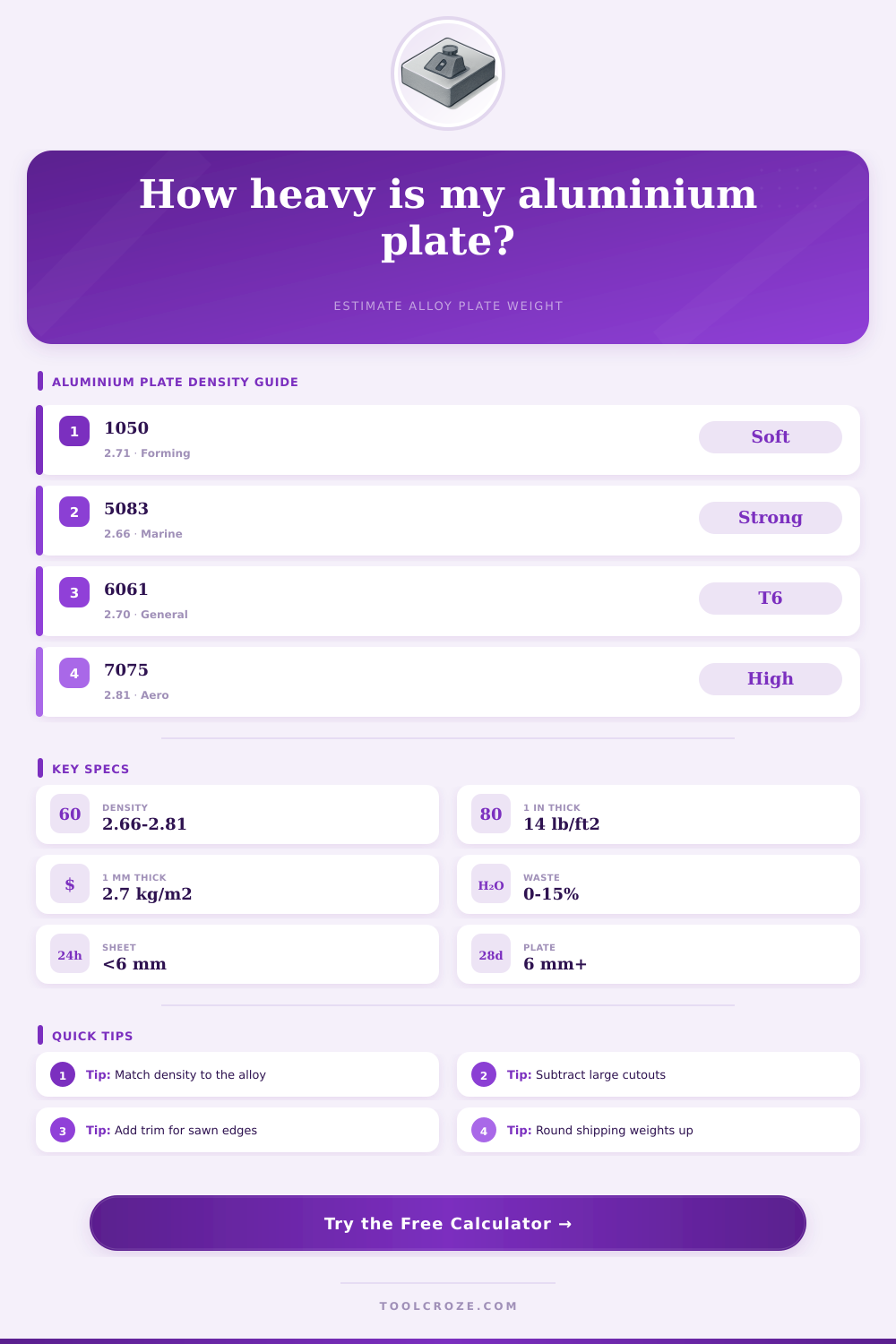
| Alloy | Density lb/in³ | Density g/cm³ | Typical plate use | Weight note |
|---|---|---|---|---|
| 1050-H14 | 0.0979 | 2.71 | Forming, signs, chemical sheet | Soft commercial purity alloy |
| 3003-H14 | 0.0980 | 2.72 | Tread plate, tanks, duct panels | Often sold as checker plate |
| 5052-H32 | 0.0968 | 2.68 | Enclosures, marine sheet, brackets | Good corrosion resistance |
| 5083-H116 | 0.0961 | 2.66 | Marine hulls, decks, cryogenic plate | Lighter than 6061 by density |
| 6061-T6 | 0.0975 | 2.70 | Base plates, fixtures, structural parts | Common default for plate weight |
| 7075-T6 | 0.1015 | 2.81 | Aircraft fittings, high strength blanks | Heavier and stronger alloy |
| Nominal size | Metric equivalent | Common thicknesses | 6061-T6 weight at 1/4 in | Handling note |
|---|---|---|---|---|
| 12 in × 12 in | 305 × 305 mm | 1/8, 1/4, 3/8 in | 3.5 lb | Bench handled |
| 24 in × 24 in | 610 × 610 mm | 1/8 to 1 in | 14.0 lb | One-person lift for thin plate |
| 24 in × 48 in | 610 × 1219 mm | 1/8 to 2 in | 28.1 lb | Watch sharp saw-cut corners |
| 48 in × 48 in | 1219 × 1219 mm | 1/4 to 2 in | 56.2 lb | Use two people or a cart |
| 48 in × 96 in | 1219 × 2438 mm | 1/8 to 3 in | 112.3 lb | Plan lifting before unloading |
| 60 in × 120 in | 1524 × 3048 mm | 1/4 to 4 in | 175.5 lb | Forklift or crane usually needed |
| Thickness | Metric thickness | 6061 weight lb/ft² | 6061 weight kg/m² | Typical category |
|---|---|---|---|---|
| 0.063 in | 1.6 mm | 0.88 | 4.29 | Sheet |
| 0.125 in | 3.2 mm | 1.76 | 8.56 | Sheet |
| 0.190 in | 4.8 mm | 2.67 | 13.02 | Heavy sheet |
| 0.250 in | 6.35 mm | 3.51 | 17.14 | Plate threshold |
| 0.500 in | 12.7 mm | 7.02 | 34.27 | Fixture plate |
| 1.000 in | 25.4 mm | 14.04 | 68.54 | Heavy plate |
| Total calculated weight | Likely handling class | Common check | Packaging allowance | Shop note |
|---|---|---|---|---|
| Under 25 lb | Small bench plate | Hand carry possible | Box or wrap | Protect corners |
| 25 to 75 lb | Awkward plate | Two-person lift | Edge guards | Use gloves |
| 75 to 150 lb | Large sheet or plate | Cart or lift table | Skid recommended | Check doorway width |
| 150 to 500 lb | Pallet freight | Fork pockets needed | Crated or banded | Plan unloading |
| 500 lb plus | Rigging load | Hoist rating required | Engineered skid | Use rated lifting gear |
When you’re a machinist standing in front of a rack of stock looking at a slab of metal that will take both hands to pick up, do you go with gut-instinct? Most times, no. Intuition do not work well with awkward shapes and heavy materials. Instead, you guess weight based off its thickness, but you pay for that guess when calculating freight for custom orders or planning a shop move. Before purchasing an aluminium plate, knowing precisely how much it weighs protect you against back strain and surprise fees.
Just enter your dimensions into the calculator and let it crunch the numbers. That’s one less thing to guess about when dealing with different units or converting densities. This little step eliminates big headaches further down the line. How does this work?
Why Knowing the Weight of Aluminum Is Important
The main point of the math is knowing that aluminum isn’t monolithic. While it’s frequently lumped into a single commodity with an average weight, its alloys vary enough in density to be significant at scale. For example, lower purity commercial grades like 1050 are a bit less dense than higher strength aerospace grade materials such as 7075. If that sounds inconsequential for a tiny bracket, take that same number across two dozen big plate, and now you’ve shifted your gross load a couple pounds. You’re changing the logistics around moving and storing that material.
The beauty of the tool is letting you choose your alloys based on what you really have in the bin. Because if you ship via freight, they charge based off weight. And a couple ounces per square foot can adds up quickly across a big order.
Most of these estimates fail at dimensional accuracy. Your plate may well have been one-inch thick when you measured it, but on paper, there’s some wiggle room in how things are made and how thick they end up. Before you even get around to cutting anything off the slab, however, you must consider how much you’re going to remove. Cutting complex shapes from a slab or making large window openings will result in much less weight than the total weight. And unless you can do the math yourself in geometry-land (which few folks desire on a Monday morning), you could of let the software model those removed areas for you. Have the software build a model of what remains so that you can have a more accurate representation of what you’re really lifting.
Abstract volume becomes real mass. There’s a bit more of the same going on with surface condition. That pattern on the checkered plate adds some surface area. Raising those patterns from the flat sheet changes both effective weight and the total amount of material added. Add another layer like anodizing or cladding material, and there’s just a little bit more to the whole thing. It is something easy to overlook when it comes time to balance your fixture machine exactly right.
The reference charts on the page make all this quite clear, pointing out the difference in base density depending on finish. No sense trying to remember them; just know what’s going into the equation so you have confidence in the answer. Knowing the inputs informs the outputs.
It is more than just raw strength that dictates how you approach planning logistics. Depending on the form of a piece of aluminium, it might handle different even when weighing one-hundred and fifty pounds. While a small rigid square block is solid and hard to get a good grip on; a long narrow sheet of metal bends and snaps like a noodle if supported just on the end. Knowing which class of weight you’re dealing with will clue you in to the proper tools for the job ahead of time. By working out your plan before the metal ever arrives, you eliminate the potential for an accident and save the finish from scratches from rushed modifications. Knowledge of what’s being moved is the beginning of safety in the machine shop.
The bottom line: Weight estimation ties together the world of theory with the world of practice. It converts a computer drawing into a piece of hardware with mass, inertia and shipping bills. It turns designing from guessing to plotting when you know the effect of cutouts, alloy density, and finish on surfaces. You’ll have a clear idea of how this thing is going to respond in your shop based off the numbers. Knowing its weight isn’t just about theory; it prepares you for the work ahead.