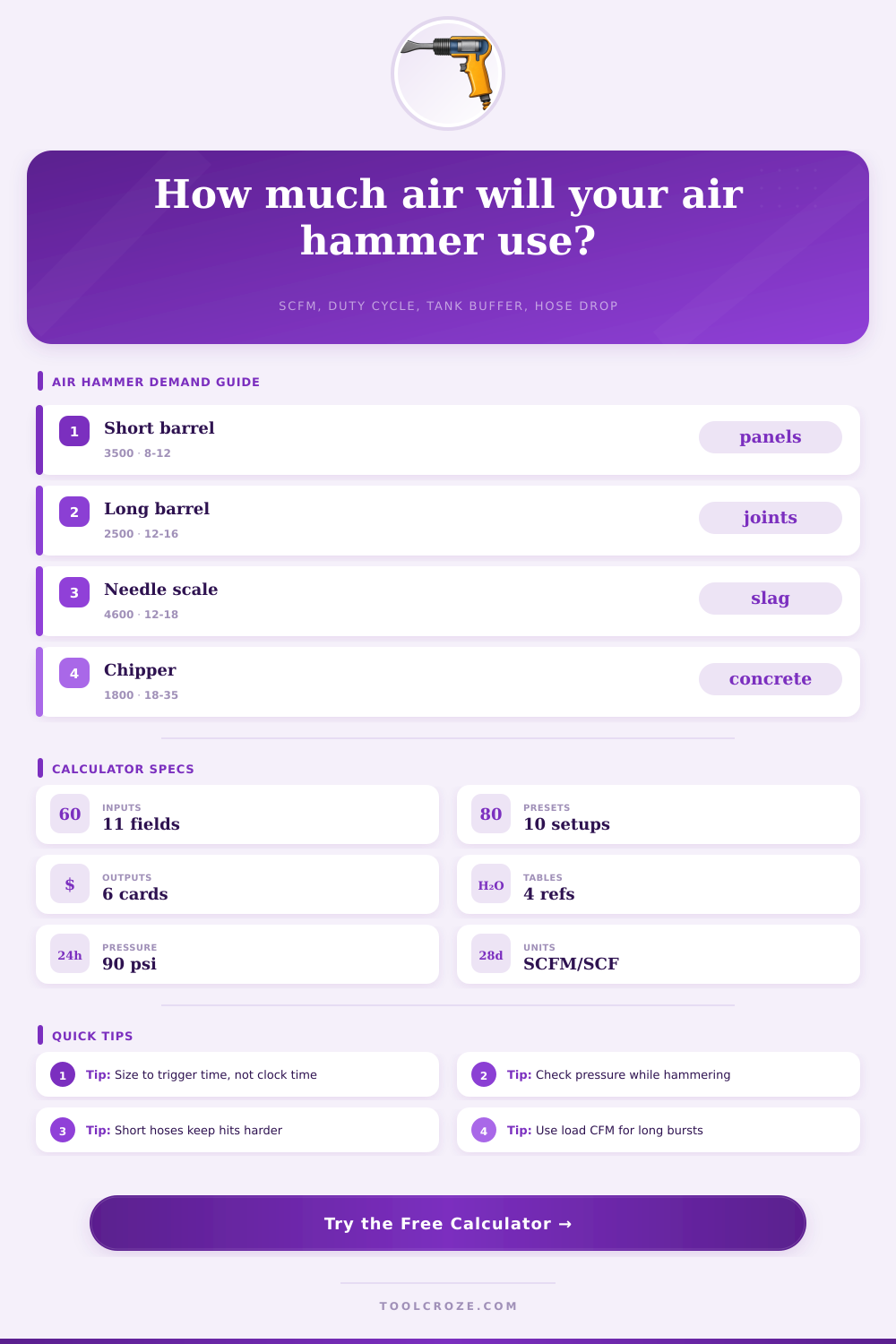
Air Hammer Air Consumption Calculator
Estimate triggered SCFM, average shop-air demand, receiver tank buffer, hose pressure loss, and compressor headroom for air hammers, air chisels, needle scalers, and chipping hammers.
⚙Real Air Hammer Presets
Pick a setup to load a realistic starting point, then adjust the rated CFM, hose, pressure, trigger rhythm, and compressor capacity to match your shop.
📏Air Hammer Setup
Calculation Breakdown
🔨Hammer, Chisel, and Material Comparison Grid
📊Air Hammer Reference Tables
| Hammer class | Typical BPM | Stroke range | Load CFM range | Minimum hose |
|---|---|---|---|---|
| Short-barrel body hammer | 3,200 to 3,800 | 1.6 to 2.0 in | 8 to 12 SCFM at load | 1/4 in for short bursts |
| Standard air chisel | 4,000 to 5,000 | 1.6 to 2.6 in | 10 to 14 SCFM at load | 3/8 in preferred |
| Long-barrel automotive hammer | 2,200 to 3,000 | 3.0 to 3.8 in | 12 to 18 SCFM at load | 3/8 in high-flow |
| Needle scaler attachment | 4,000 to 4,800 | 1.5 to 2.5 in | 12 to 18 SCFM at load | 3/8 in high-flow |
| 2 in chipping hammer | 1,900 to 2,400 | 2.0 in | 22 to 30 SCFM at load | 1/2 in recommended |
| 4 in chipping hammer | 1,200 to 1,600 | 4.0 in | 30 to 45 SCFM at load | 1/2 in recommended |
| Chisel task | Common bit | Material behavior | Air load factor | Planning note |
|---|---|---|---|---|
| Sheet-metal cutting | Panel cutter or ripper | Thin steel, intermittent bite | 0.85x | Short bursts, modest tank draw |
| Exhaust seam splitting | Flat chisel | Rusty mild steel, uneven load | 1.00x | Keep pressure at the tool stable |
| Rivet punching | Taper punch or rivet cutter | Hard point load | 1.10x | Needs sharp impacts more than high BPM |
| Ball joint separation | Fork separator | Tapered joint, heavy rebound | 1.25x | Long barrel and 3/8 in hose help |
| Tile thinset scraping | Wide scraper | Abrasive layer, long passes | 1.15x | Average CFM dominates the job |
| Concrete scaling | Scaling chisel | Hard aggregate, continuous load | 1.35x | Use chipping-hammer class capacity |
| Brick mortar chipping | Moil point or narrow chisel | Joint work with long trigger time | 1.45x | Watch compressor duty cycle closely |
| Weld slag scaling | Needle bundle | Surface scale, lighter impact | 0.95x | Coverage time sets total air use |
| Hose inside diameter | At 10 SCFM, 50 ft | At 20 SCFM, 50 ft | Best hammer match | Field note |
|---|---|---|---|---|
| 1/4 in | About 7 to 9 psi drop | Often excessive | Panel cutters, quick bursts | Convenient but restrictive |
| 5/16 in | About 4 to 5 psi drop | About 9 to 11 psi drop | Light automotive chiseling | Better than 1/4 in on reels |
| 3/8 in | About 2 psi drop | About 4 to 5 psi drop | Long-barrel air hammers | Common high-flow choice |
| 1/2 in | Under 1 psi drop | About 1 to 2 psi drop | Chipping hammers | Bulky but preserves impact |
| Use pattern | Duty cycle | Compressor planning | Receiver role | Pressure check |
|---|---|---|---|---|
| Body panel trimming | 10 to 25 percent | Average SCFM may be enough | Tank bridges short bursts | Measure during a 5 sec cut |
| Suspension separation | 20 to 40 percent | Add margin for stubborn joints | Tank helps but recovers often | Keep tool near 90 psi running |
| Tile or scale removal | 50 to 80 percent | Size close to load demand | Tank drains quickly | Watch falling regulator gauge |
| Concrete or mortar chipping | 70 to 100 percent | Use continuous-duty capacity | Receiver is only a cushion | Use larger hose and fittings |
💡Practical Air Hammer Tips
Air hammers use compressed air to create fast and repeated blows with those tools. Air hammers use those compressed air blows to cut metals, split seam, and chip concrete. Air hammers require a large amount of compressed air to perform there tasks.
Therefore, you need to ensure that the air compressor can provide the air hammer with the amount of compressed air it require to complete the work. The amount of air that an air hammer requires are dependent on the air hammer, the air hose, and the air compressor tank. If you dont ensure that the air compressor that you use has the appropriate amount of air power for the air hammer that you are using, then the air hammer will feel weakly when you operate it.
How to Pick the Right Compressor, Tank and Hose for an Air Hammer
Additionally, the air compressor will continuously run while you use the air hammer as the air compressor tries to replace the amount of air that the air hammer is consume. The duty cycle for an air hammer is a measurement of the amount of air the air hammer consumes while you perform specific action with the air hammer. Therefore, the duty cycle is not a measurement of the total amount of time you work with the air hammer.
Instead, it measure the amount of time that you pull the trigger on the air hammer. For example, if you pull the trigger for five second and do this three times in a minute, the air hammer is consuming air for twenty-five percent of that minute. If you use the air hammer to chip concrete, you will use it for longer bursts of work.
This creates a higherer duty cycle for the air hammer, meaning that the air hammer will require a larger air compressor to perform those tasks. Another factor that someone uses to calculate the amount of power that will be delivered to the air hammer is the pressure at the air hammer. The pressure at the air hammer will be less than the pressure that is set at the air compressor regulator.
As the air travels from the air compressor to the air hammer through the air hose, the air hose reel, and the air quick couplers, the air pressure will decrease. Any reduction in air energy will result in the air hammer slowing down. To compensate for the slower air hammer, you will press it harder against the work you are processing.
Pressing the air hammer harder will increase the amount of air that the air hammer consumes. The pressure at the air hammer must be calculated, which takes into consideration the regulator pressure, the diameter of the air hose, and the length of the air hose. The third factor that you must calculate for effective work with the air hammer is the size of the receiver tank.
The receiver tank will provide the air hammer with a reserve of compressed air that allows the air hammer to work for a short amount of time before the air pressure in the tank drop. For example, a thirty-gallon receiver tank will allow the air hammer to work for a short amount of time before the air pressure drops to zero from that tank. Additionally, the receiver tank will lose its air quick if you use the air hammer for continuous task.
This tank will tell you how long the air hammer can be used before the air compressor must start again. However, this tank will not tell you if the air compressor is large enough to supply the air to the air hammer. The size of the air hose that you use with the air hammer will impact the amount of air pressure that reaches the air hammer.
Additionally, the size of the air hose will create a tradeoff between the amount of air pressure and the weight of the air hose. For example, a quarter inch air hose is easy to manage on a hose reel. However, if you are using a long barrel air hammer, a quarter-inch air hose can create a significant drop in the air pressure that reaches the air hammer.
Using a three-eighths-inch or a half-inch air hose will reduce the drop in air pressure. However, the air hose will be heavier and more expensive with a larger diameter. The total amount of air that you will use during the job will determine the runtime of the air compressor and the cost of the electricity that will be used to operate the air compressor.
The small amount of air that is required to operate the air hammer will increase if you work for twenty or forty minutes. Additionally, if there are air leak in the system, the total amount of air that is demanded will be even greater. Calculating the total amount of air that will be demanded will allow you to determine if a larger air compressor is required, if a second receiver tank is needed, or if the air hose that are used with the air hammer can be shortened.
If the air compressor and air hammer are correctly matched, the air compressor will be able to keep up with the air hammer’s demand. As a result, the air hammer will continue to hit the work with power.