Air Compressor HP to CFM Calculator
Estimate compressor free-air delivery from motor horsepower, pressure, efficiency, stage type, inlet conditions, power factor, and service factor.
Estimated Compressor Delivery
Calculation Breakdown
| Motor HP | Typical 90 PSI CFM | Typical 125 PSI CFM | Typical 175 PSI CFM |
|---|---|---|---|
| 1.5 HP | 4.5 to 6.5 SCFM | 3.8 to 5.3 SCFM | 2.8 to 4.1 SCFM |
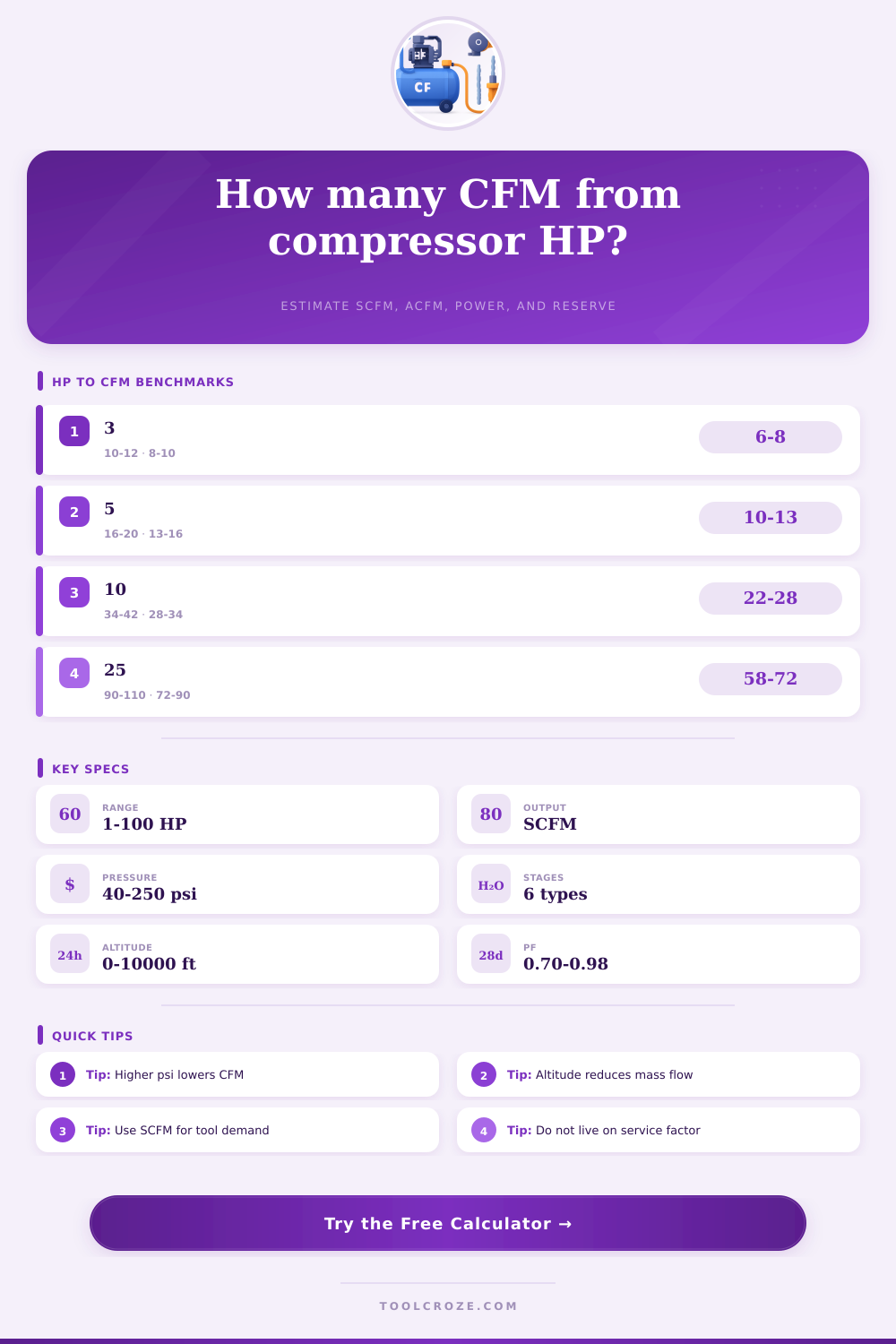
| 3 HP | 10 to 12 SCFM | 8 to 10 SCFM | 6 to 8 SCFM |
| 5 HP | 16 to 20 SCFM | 13 to 16 SCFM | 10 to 13 SCFM |
| 10 HP | 34 to 42 SCFM | 28 to 34 SCFM | 22 to 28 SCFM |
| 25 HP | 90 to 110 SCFM | 72 to 90 SCFM | 58 to 72 SCFM |
| Stage Type | Useful Pressure Band | Efficiency Range | Best CFM Use |
|---|---|---|---|
| Single-stage reciprocating | 80 to 125 psig | 55% to 72% | Intermittent shop air |
| Two-stage reciprocating | 125 to 200 psig | 62% to 78% | Higher pressure piston units |
| Oil-flooded rotary screw | 90 to 150 psig | 65% to 82% | Continuous plant air |
| Scroll compressor | 80 to 120 psig | 52% to 68% | Clean smaller air systems |
| Rotary vane | 90 to 125 psig | 58% to 73% | Steady moderate demand |
| High-pressure booster | 175 psig and up | 45% to 65% | Specialty high pressure air |
| Pressure Change | Approx CFM Effect | Motor Effect | Use In Estimate |
|---|---|---|---|
| 80 to 90 psig | CFM drops about 4% to 7% | HP rises slightly | Light tools, blow-off |
| 90 to 125 psig | CFM drops about 12% to 20% | More heat and load | General shop systems |
| 125 to 175 psig | CFM drops about 15% to 25% | Two-stage preferred | High pressure storage |
| 175 to 250 psig | CFM drops sharply | Check duty and cooling | Specialty compressed air |
| Inlet Condition | Density Impact | SCFM Impact | Adjustment Clue |
|---|---|---|---|
| Sea level, 68°F | Baseline | No derate | Use rated values |
| 3000 ft altitude | Lower pressure | About 10% less mass flow | Increase HP or add storage |
| 6000 ft altitude | Much lower pressure | About 19% less mass flow | Check tool SCFM margin |
| 100°F inlet | Hotter air | About 5% less mass flow | Improve intake ventilation |
When you are choosing an air compressor, it is essential to have an understanding of the fact that the horsepower of the air compressor are not the same as the airflow that the air compressor will provide. Many people makes a mistake when purchasing an air compressor because they are often focused on the horsepower of the compressor. It is possible for the air compressor to have a high horsepower but still not provide enough airflow for the users needs if the air compressor isnt sized correct.
Several different factors will influence the relationship between the horsepower of an air compressor and the airflow that the air compressor will provide. These factors include the discharge pressure of the air compressor, the temperature of the air that the air compressor is use, the altitude at which the air compressor will be used, and the technology that is used in the air compressor. Each of these factors will influence how the air compressor performs, so it is essential to factor these into the purchasing decision to determine the standard cubic feet per minute of air that an air compressor will provide.
Choose an Air Compressor by Airflow, Not Horsepower
One of the factors that many people underappreciates when purchasing an air compressor is the factor of pressure. The higher the discharge pressure of an air compressor is set, the higher the compression ratio of the air compressor. A higher compression ratio means that the motor within the air compressor will move less air.
For example, an air compressor may provide four standard cubic feet of air per minute per horsepower if the air pressure is set to ninety pounds per square inch. However, at one hundred seventy-five pounds per square inch, the same air compressor will provide less airflow. Using the calculator included with this article can help to show how high the pressure will be set and how much that will reduce the airflow that the air compressor will provide.
Another factor that will influence an air compressors output is the altitude of the area in which it is to be use. At higher altitudes, the barometric pressure is lower. The lower the barometric pressure of the inlet air is, the less dense the air will be.
For example, at altitudes of five thousand feet above sea level, the mass flow of an air compressor will drop by nearly twenty percent compared to the amount of mass that would be moved at sea level. The altitude input on the calculator will allow the air compressor to be sized correctly based off the air density at the altitudes at which the air compressor will be used. The technology that is used in the air compressor will also change the amount of air that it can deliver.
For example, rotary screw compressors tend to maintain their efficiency even at higher output pressures, and they are continuously design to work for long periods of time. Piston compressors, also known as reciprocating compressors, are more inexpensive if used intermittently rather than continuously, as the efficiency of these models will decrease as the output pressure increases. The technology input on the calculator will allow the user to account for these differences in the technology that is manufactured and will ensure that the output airflow is correctly calculated for the air compressor that is to be purchased.
Efficiency is another factor that will influence the amount of air that the air compressor can provide. The efficiency of an air compressor is a representation of the percentage of the energy that the motor produces that becomes compressed air; the remainder becomes heat due to inefficiencies within the air compressor. Two-stage compressor models tend to have high efficiencies of around seventy percent when well maintained.
A poorly maintained compressor may have an efficiency of only fifty percent. Lower efficiencies mean that the energy from the motor will convert to heat rather than compressed air. The percentage of the efficiency of the air compressor can be adjusted within the calculator to provide the proper estimation of the amount of air that the air compressor will deliver.
Another factor to consider when purchasing an air compressor is the motors service factor. This represents the amount of horsepower that the motor can provide above its rated horsepower. For instance, a service factor of one point one five mean that the motor can provide fifteen percent more horsepower for a short period of time.
This factor is beneficial for situations where the air compressor may need to increase its rate of output for a short time. However, it should not be used to provide continuous additional horsepower above what is provided by the motors specifications. The calculator will separate the continuous horsepower from the service factor to provide an accurate estimate of the amount of air that the air compressor can deliver.
One more factor to consider is the temperature of the air that the air compressor uses. An air compressor will move less air if the intake air is hotter than air at a cooler temperature. Hotter air is less dens than cooler air.
For this reason, if an air compressor is placed in a very hot area, it will move less air than if it were in a cooler area. Good intake air conditions will allow an air compressor to move more air. Therefore, it is important to ensure that the intake air is of good quality.
Finally, the estimated standard cubic feet per minute that the air compressor will provide should be compared to the consumption requirements of the air tools that will be used. Most air tools has a figure that represents the amount of air that the tool will consume at a specific air pressure. For instance, a tool may require six standard cubic feet of air per minute at ninety pounds per square inch.
If the air compressor is set to a higher pressure, it will provide less air at the outlet of the air compressor. To ensure that the air compressor can provide enough air for the tools that are to be operated, the numbers should of been compared using the calculator.