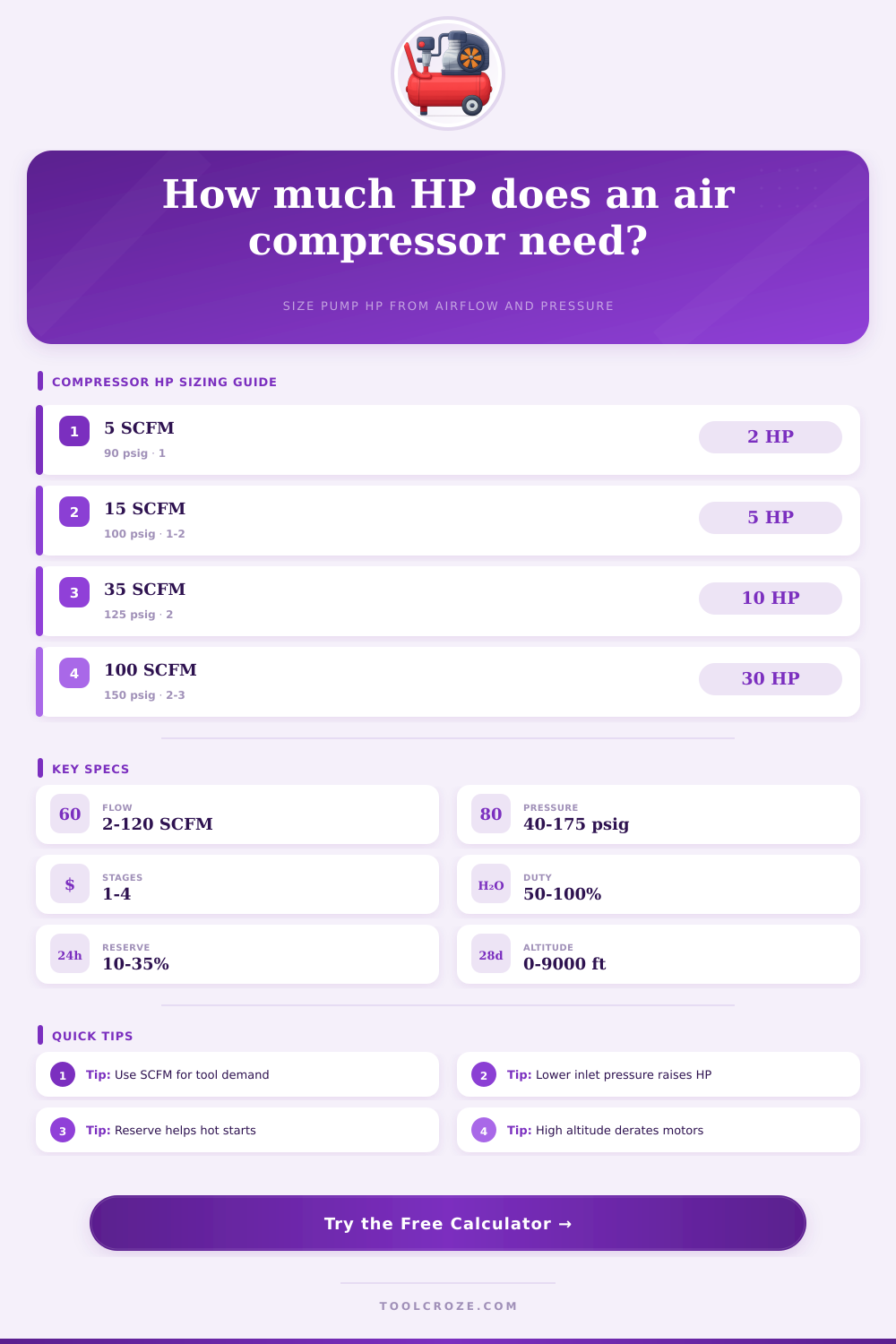
Air Compressor Horsepower Calculator
Estimate compressor brake horsepower, motor nameplate horsepower, inlet ACFM, pressure ratio, duty-cycle pump flow, reserve margin, and altitude derating from required air demand.
Calculation Breakdown
| Air Use Case | Typical Demand | Usual Pressure | HP Sizing Note |
|---|---|---|---|
| Tire inflator and blow gun | 2-6 SCFM | 80-100 psig | Duty cycle is usually more important than peak pressure. |
| Framing nailer pair | 4-8 SCFM | 90-120 psig | Receiver storage can handle short bursts, but motor reserve helps recovery. |
| HVLP spray gun | 10-18 SCFM | 35-55 psig | Lower pressure helps HP, but continuous airflow raises duty demand. |
| Plasma cutter | 5-10 SCFM | 80-100 psig | Dry air pressure drop should be included in reserve margin. |
| Dual-action sander | 12-22 SCFM | 85-100 psig | Near-continuous sanding often needs a higher duty cycle setting. |
| Blast cabinet nozzle | 20-45 SCFM | 90-120 psig | Nozzle wear increases demand; reserve should not be trimmed too close. |
| Discharge Pressure | Sea-Level Ratio | Practical Stage Count | Horsepower Behavior |
|---|---|---|---|
| 40 psig | 3.7:1 | 1 stage | Often moderate HP when airflow is high, common for spray applications. |
| 90 psig | 7.1:1 | 1-2 stages | Standard shop pressure; efficiency assumptions strongly affect HP. |
| 125 psig | 9.5:1 | 2 stages | Two-stage compression usually improves temperature and power behavior. |
| 150 psig | 11.2:1 | 2-3 stages | Reserve and cooling assumptions matter more at this ratio. |
| 175 psig | 12.9:1 | 2-3 stages | Check pump rating, motor service factor, and discharge temperature limits. |
| Altitude | Approx. Atmosphere | SCFM to ACFM Effect | Motor Derate Used |
|---|---|---|---|
| 0 ft | 14.70 psia | 1.00 x SCFM | 0% |
| 3000 ft | 13.17 psia | 1.12 x SCFM | 0% |
| 5000 ft | 12.23 psia | 1.20 x SCFM | 5% |
| 7000 ft | 11.34 psia | 1.30 x SCFM | 11% |
| 9000 ft | 10.50 psia | 1.40 x SCFM | 17% |
| Compressor Type | Efficiency Input | Reserve Input | Use This When |
|---|---|---|---|
| Small direct-drive piston | 55-65% | 20-35% | Hot intermittent service, small flywheel, and limited cooling. |
| Belt-drive single-stage piston | 60-72% | 15-30% | General shop air with moderate recovery time and common 90-125 psig use. |
| Two-stage piston | 68-78% | 10-25% | Higher pressure, better cooling, and steady receiver recovery. |
| Lubricated rotary screw | 70-85% | 10-20% | Continuous plant air, stable inlet conditions, and controlled oil temperature. |
| Oil-free or dry process air | 60-78% | 15-30% | Extra heat, filtration pressure drop, and package losses are expected. |
When choosing the horsepower that your air compressor will have, it is necesary to consider the requirements of your tool. While it might seem like a simple purchase, there are many reason that it is a difficult task to select an apropriate air compressor for your workshop. The most important reason is that the horsepower that is listed for air compressors does not necesarly indicate the performance that the air compressor will exhibit.
One of the first factors to consider is the demand for air from the tools that the user will utilize with the air compressor. Air demand is often represented in unit of Standard Cubic Feet per Minute, or SCFM. This unit represents the total volume that the air tools will use, adjusted to standard conditions (typically 60°F and sea level).
How to Choose the Right Air Compressor Horsepower
The air compressor itself does not move SCFM, but instead it moves the unit of Actual Cubic Feet per Minute (ACFM). ACFM refers to the total volume of air that the air compressor pump must move. Because air density decrease at higher altitudes, ACFM will increase at higher altitudes.
Therefore, the pump will have to work harder to push the same amount of air as SCFM demand. It is essential to understand the difference between these two unit of measurement. The second factor to consider is the air pressure that the air tools require.
The air compressor will have to move air from the inlet of the air compressor to the outlet of the air compressor. The air will have to be compressed from the inlet air pressure to the required outlet air pressure. Single-stage air compressors generally have a low ratio of outlet to inlet pressure.
However, as the ratio increases, single-stage air compressors become less efficient at perform the required work. Multi-stage air compressors lose some of the internal heat that the compression process creates, allowing them to be more efficiently at higher pressure ratios. Therefore, the ratio of outlet to inlet air pressure is another factor to consider when purchasing an air compressor.
Another factor to consider is the duty cycle of the air compressor. The duty cycle of an air compressor is the amount of time that the motor is running compared to the total amount of time. Air compressors do not run continuously.
Instead, they will run until the air tank reaches the required pressure, and then the motor will stop. If the air tools are using up the air in the tank faster then the air compressor is replacing that air in the tank, then the motor will be working constant. This is detrimental to the air compressor system.
Therefore, the duty cycle of an air compressor must be considered to ensure that the air compressor motor can handle the demands of the air tools. Another factor to consider is the altitude at which the air compressor will be used. Air compressors move air at a certain density.
The density of the air molecules decreases with higher altitude. This has a direct impact on the air compressor’s ability to deliver the required amount of air to the air tools. Furthermore, air compressor motors lose some of their effectiveness at cooling at higher altitudes.
Therefore, another factor to consider is the air compressor’s altitude. Efficiency is the fifth factor to consider when purchasing an air compressor. Efficiency is a unitless number that represents the ratio of the theoretical work that an air compressor is required to perform to the actual amount of shaft power that the air compressor pump demands.
The efficiency of air compressors ranges from small piston air compressors having low efficiency ratios to rotary screw air compressors losing little heat during operation, exhibiting high efficiency. A high number (closer to 100%) will result in an undersize air compressor motor. Therefore, efficiency must be a consideration when purchasing an air compressor.
The sixth factor to consider is the possibility of tool overlap. Tool overlap occurs when more than one air tool is in operation at the same time. Rather than purchasing an air compressor that can supply air to a single tool, most individuals will require an air compressor that can provide air to a variety of air tools.
Additionally, air compressor motors are generally not designed to supply air to every air tool at the same time. Therefore, it is important to consider tool overlap when purchasing an air compressor. The seventh factor to consider is the size of the air tank that will be used with the air compressor.
A larger air tank allows the air compressor to work less frequent during the workday. Additionally, a larger air tank helps to even out the air supply to the air tools. Should the air compressor have an undersized air tank, the air compressor will work more frequently to supply the same amount of air to the air tools.
Additionally, the air compressor motor and valves will eventually wear down from the starting and stopping of the motor. Therefore, tank size is another factor to consider when purchasing an air compressor. Another factor to consider is the temperature at which the air compressor will be used.
If the air compressor is placed in a poorly ventilated area, it may be breathing its own hot exhaust. The intake of hot air will lead to the air compressor having to work harder to supply air to the air tools (as air molecules are less dense at higher temperatures). Additionally, hot air places stress on the air compressor valves and coolers.
Therefore, the operating temperature of the air compressor is another factor to consider when purchasing the air compressor. Another consideration for air compressor motors is the size of the motor. It is not necessary to purchase the air compressor motor that is calculated to be required to supply air to the air tools.
The motor size should be the next standard rating above the calculated number. Additionally, air compressor motors come in sizes that cannot be continuously adjusted. Therefore, the next size up will allow for future addition of air tools.
Additionally, it will allow for a margin of error in changes in operating conditions of the air compressor. When selecting an air compressor for an air compressor shop, the goal is for the air compressor to start, recover pressure in the tank without working constantly, and not overheat. Each factor discussed above can have a direct impact on the performance of that air compressor.
By considering each of these factor, individuals can avoid the cost of purchasing an air compressor that is not capable of performing the tasks required of the air compressor.