Air Compressor Energy Consumption Calculator
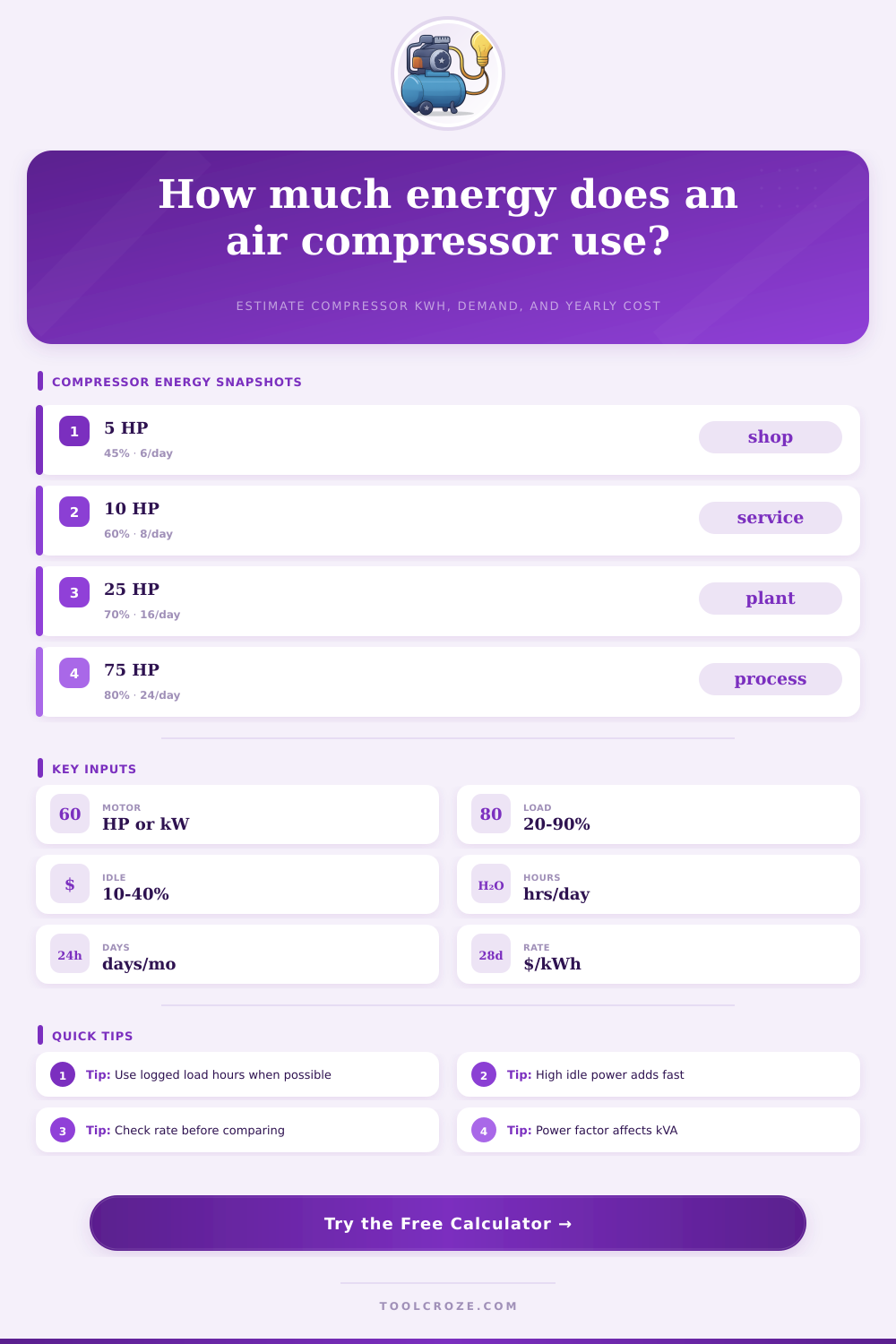
Estimate compressor input kW, daily kWh, monthly energy use, loaded and unloaded energy split, kVA, and annual operating cost from real duty cycle inputs.
Choose a starting point, then adjust the load cycle, idle demand, schedule, and utility rate for your air system.
| Motor Size | Shaft Output | Input at 90% Eff. | Typical Use |
|---|---|---|---|
| 2 HP piston | 1.49 kW | 1.66 kW | Garage tools, short runs |
| 5 HP reciprocating | 3.73 kW | 4.14 kW | Body work, tire tools |
| 10 HP rotary screw | 7.46 kW | 8.29 kW | Small production air |
| 25 HP plant compressor | 18.65 kW | 20.72 kW | One or two shifts |
| 50 HP base machine | 37.30 kW | 41.44 kW | Packaging or machining |
| 100 HP process air | 74.60 kW | 82.89 kW | Continuous industrial load |
Stop/Start Piston
Load/Unload Screw
Modulating Inlet
VSD Trim
Base/Trim Pair
Timed Shutdown
| Control Type | Typical Unloaded Power | Best Load Pattern | Calculation Note |
|---|---|---|---|
| Pressure switch stop/start | 0% to 5% | Short intermittent use | Use low unload draw if motor stops between cycles. |
| Load/unload rotary screw | 20% to 40% | Regular demand with receiver storage | Idle kWh can dominate at low duty cycle. |
| Inlet modulation | 45% to 70% | Nearly steady demand near capacity | Part-load energy is often higher than expected. |
| Variable speed drive | 8% to 18% | Changing air demand through the shift | Use lower idle draw when the drive can slow down. |
| Sequenced base/trim | 10% to 25% | Multiple compressors with controls | Estimate each machine separately for best accuracy. |
| Blended Rate | Cost per Avg kW/Month | Cost per Avg kW/Year | Use Case |
|---|---|---|---|
| $0.08/kWh | $58 | $701 | Low industrial energy tariff at 24 hr/day average demand. |
| $0.12/kWh | $86 | $1051 | Moderate commercial energy tariff. |
| $0.16/kWh | $115 | $1402 | Common blended shop estimate. |
| $0.22/kWh | $158 | $1927 | Higher utility cost or demand-heavy region. |
| $0.30/kWh | $216 | $2628 | High cost energy, remote sites, or peak-heavy billing. |
| Schedule | Hours/Day | Days/Month | Annual Hours |
|---|---|---|---|
| Occasional garage | 1 to 2 | 4 to 8 | 48 to 192 |
| Light service shop | 4 to 6 | 18 to 22 | 864 to 1584 |
| Single production shift | 8 to 10 | 20 to 23 | 1920 to 2760 |
| Two-shift plant | 14 to 18 | 22 to 26 | 3696 to 5616 |
| Continuous process | 24 | 30 to 31 | 8640 to 8928 |
Air compressors uses electricity. Often, they use more electricity than you might expects. Air compressors use electricity even when they are not producing air, because they is idling.
You must understands the difference between the motor rating and an actual electricity that the air compressor draw. The efficiency of the air compressor determine how much electricity is required to produce the air compressor’s rated output. For example, a 10 horsepower air compressor with 90 percent efficiency will require more electricity than an air compressor of the same size that have 94 percent efficiency.
How Air Compressors Use Electricity
Use the calculator to enter the efficiency of your air compressor and it motor size to determine how much electricity it will draw. The duty cycles of an air compressor is another very important factor. The duty cycle determine how the air compressor behave during operation.
Air compressors with a duty cycle of 60 percent will behave different than air compressors with a duty cycle of 85 percent. Air compressors will draw power even when they are in an unloaded state. In an unloaded state, an air compressor will draw between 20 and 40 percent of its full load.
Since the air compressor is idling while in this unloaded state, this can add to the total cost of electricity that the air compressor incur. Air compressors has different control methods that determines the amount of electricity they use. Stop-start piston compressors will draw no electricity when they is off.
Load/unload rotary screw compressors will draw electricity even when they are off because there motor will always be spinning. Variable speed drives will draw less electricity from the motor because it is not required to spin at full speed all of the time. The reference tables can tell you the percentage of unloaded power draw for each of these control method.
The operating schedule of your air compressor will have an effect on the total cost of the air compressor for that year. Two air compressors that are otherwise identical may have vastly different cost for the year based on how many hour each air compressor is running. The schedule of when and how many hours the air compressor will be running will determine the number of hours that it will be working and idling.
If there are long breaks in which the air compressor will not be producing air, that will add to the total electricity bill for the year. The electricity rate that is paid for the air compressor will determine the cost of electricity. Twelve cents per kilowatt-hour will cost more than twenty-two cents per kilowatt-hour for idle time.
The electricity rate may also include demand charge for electricity use. Demand charges will be based off the highest reading of power use in fifteen-minute intervals within a given month. If the air compressor start and stop frequently, this can drasticly increase the demand charge for electricity.
Power factor is another technical detail regarding electricity use of the air compressor. The power factor will determine how much electricity the air compressor use to perform work relative to the total electricity that the air compressor draws. If the power factor is low, the air compressor will draw more electricity than if it had a higher rating for power factor.
The calculator allow you to determine the full load input of the air compressor in kVA to ensure that the power line into the air compressor are sized apropiately. Air compressor systems may encounter different issues that will affect the electricity use of the air compressor. For example, air leak in the system will use more electricity from the air compressor because the air compressor will have to work harder to compensate for the leaks.
The same hold true for dirty filter and valves on the air compressor that will force it to work harder to achieve the same output. There are different factor for air compressor electricity use that can be measured, but there are also factor that can be changed. For instance, motor efficiency, control method, and operating schedule are three difficult factor to change.
However, you can change the duty cycle, as can the leak in the air compressor system. Use the electricity calculator to establish a baseline for electricity use, and from that starting point, you can determine which changes will be worth implement for your air compressor system. You should of checked the motor efficiency first.