Acre to Linear Feet Calculator
Convert acres or hectares into boundary length, frontage run, strip length, multi-row fencing, setback routes, post counts, and waste-adjusted linear feet.
1 Land and Fencing Presets
Load a realistic parcel or fence scenario, then adjust acres, shape, perimeter mode, rows, setbacks, and waste for the actual site.
2 Calculator Setup
3 Results
Calculation Breakdown
4 Parcel and Shape Grid
5 Acre Conversion References
| Reference | Linear feet for 1 acre | Formula | Best use |
|---|---|---|---|
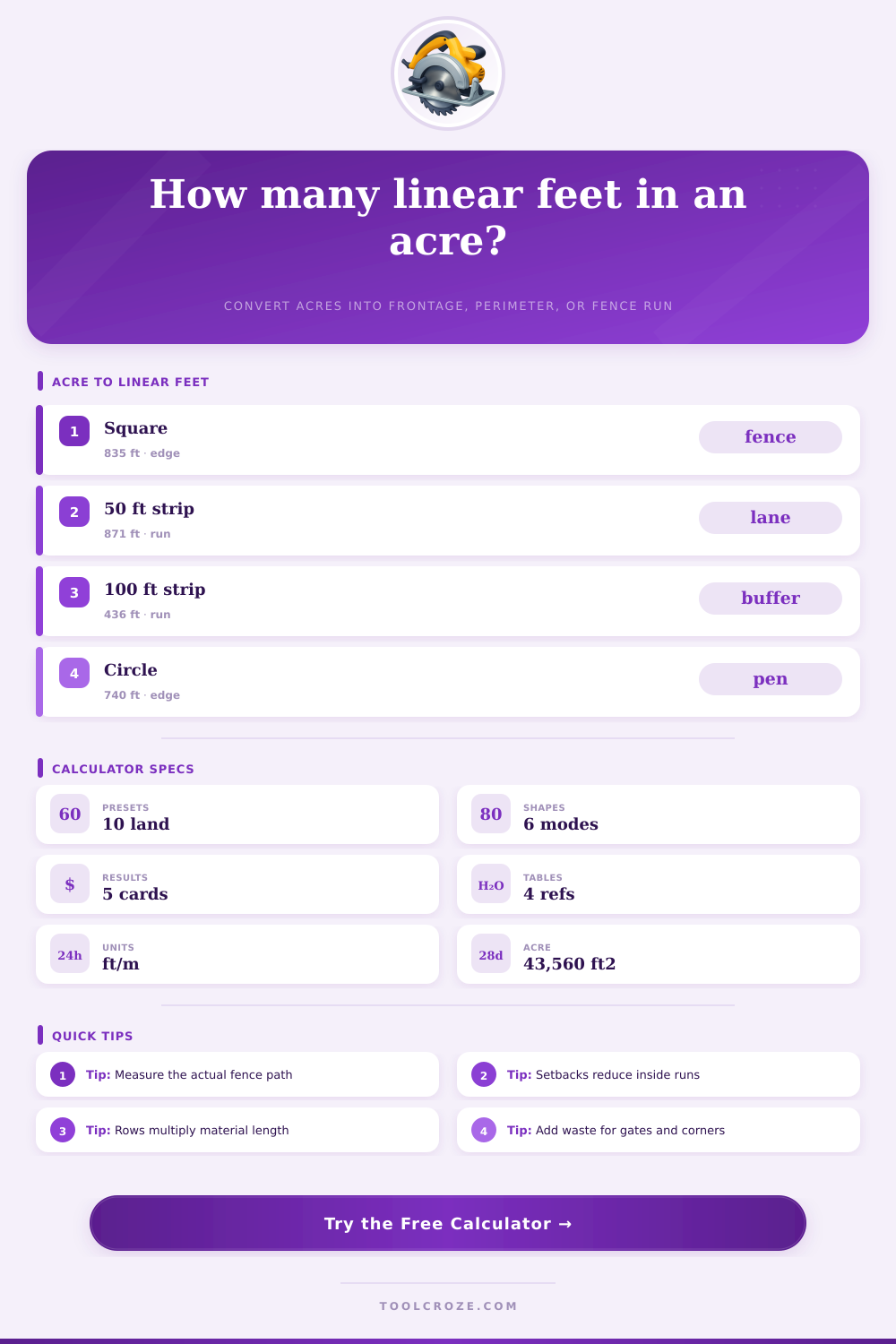
| Square boundary | 834.8 ft perimeter | 4 x sqrt(43,560) | Simple fenced parcel |
| 25 ft strip | 1,742.4 ft run | 43,560 / 25 | Trail or utility strip |
| 50 ft strip | 871.2 ft run | 43,560 / 50 | Road frontage buffer |
| 100 ft strip | 435.6 ft run | 43,560 / 100 | Pasture lane or swale |
| Circular boundary | 740.1 ft circumference | 2 x pi x sqrt(A/pi) | Round pen or pond edge |
6 Shape and Perimeter Mode Table
| Shape or mode | What the calculator solves | Primary measurement | Practical note |
|---|---|---|---|
| Square | Side = square root of area | Acres only | Fast benchmark for one acre fencing |
| Rectangle | Depth from area and frontage | Frontage width | Common for surveyed lots and fields |
| Frontage strip | Run from area divided by strip width | Strip width | Best for road, creek, or easement strips |
| Trapezoid | Depth from average front/back width | Front and rear widths | Useful when parcel sides taper |
| Setback boundary | Interior route after setbacks | Side, front, rear setbacks | Reflects fences placed inside property lines |
7 Fencing Planning Table
| Planning item | Typical input | Calculator effect | Measure carefully |
|---|---|---|---|
| Fence rows | 1 to 4 rows | Multiplies route length | Separate runs, parallel fences, or repeated strand rows |
| Waste allowance | 5% to 15% | Adds extra linear feet | Gate openings, corners, splices, and layout changes |
| Post spacing | 6 ft to 12 ft | Estimates post count | Terrain, corners, ends, and gate braces |
| Setbacks | 0 ft to 50 ft | Reduces interior route | Local rules, easements, and survey pins |
| Frontage mode | One property side | Returns one linear side | Road frontage, screening, and hedgerow layouts |
8 Common Parcel Size Table
| Parcel area | Square side | Square perimeter | 50 ft strip run |
|---|---|---|---|
| 0.25 acre | 104.4 ft | 417.4 ft | 217.8 ft |
| 0.50 acre | 147.6 ft | 590.4 ft | 435.6 ft |
| 1 acre | 208.7 ft | 834.8 ft | 871.2 ft |
| 2 acres | 295.2 ft | 1,180.8 ft | 1,742.4 ft |
| 5 acres | 466.7 ft | 1,866.8 ft | 4,356.0 ft |
Land is purchased by acres, but people buy fences by linear feet. The longer the length of your fence line, the more it costs, whether you have a square plot or a long narrow piece of land. Because one acre equals 43,560 square feet, the perimeter can vary depending on the shape.
So before buying posts and wire, youll want to know exactly how much to order, which means knowing your measurements and converting them correctly between feet (linear) and acres (area). The way you lay out your acre determines it’s perimeter. For example, if it is a perfect square acre, then the perimeter is about 835 linear feet, or if laid out as a long rectangle against the road at 50 feet wide, then it’s 871 feet, or if laid out in a circular acre, then it is 740 feet.
How Much Fence Do You Need for an Acre
Each scenario will call for a varying length of fence, so by knowing the area, frontage width, and desired shape, you can figure out the remaining dimensions without doing the math yourself. That’s how setbacks affect your usable fencing space. In many jurisdictions, the fence has to be on the property line, which means you have to count back from both sides of the line a certain amount, and the amount you count back reduces what you can do inside.
So every time you count back from the line (the setback), it shorten the perimeter length where youll actually install anything. When you factor in the setback distance, you can calculate exactly how much fencing youll actually need. Keep in mind that other features might eat up land within your parcel, such as utility corridors or easements.
These also reduce the area you can fence, so factor them into your measurements. Once you have your perimeter, multiply that measurement by the number of fence rows you need. A linear foot equals one strand of wire, so four rows mean four times the material.
Remember to add extra for gates, corners, end braces, splice pieces, and incidental cuts. Adding a 10 percent waste factor (which I always do) to your final count ensures you order enough supplies and wont run short at the end of the run. Spacing is pretty straightforward (and can change based off your terrain).
For level ground, eight-foot intervals are fine; tighter spacing is necessary in corners and other spots prone to instability. Your initial measurement provides an estimate of all your posts plus that last one closing the loop, though youll probably have to add a couple more if your land isnt quite so even. Take the guesswork out by walking the proposed course first with some string and stakes, then order accordingly.
That way you know how much space is realy available and where special accommodations is needed. Some parcels are irregular; how do we calculate them? If your parcel is triangular or tapers to a point on one side, its perimeter wont be identical to that of an average rectangle.
To account for this, you can adjust your perimeter formula for triangles and trapezoids (after all, land doesnt exactly conform to perfect geometry!). Because computer-mapped property data may sometimes omit subtle changes in elevation or other curves, always check dimensions in person as well. Something like a small bend that seems inconsequential on screen can contribute appreciably to total length once laid out in reality.
Nevertheless, use the estimated calculation as your starting point when it comes to figuring materials orders and budgets. Linear measurements are also useful for other site improvements:. If youre planning windbreak plantings, an irrigation line, or a driveway edge, you can use the same perimeter formula to calculate material needs…
When laying landscape fabric or groundcover along borders, knowing your linear footage tells you exactly how much material to buy. (Once you have your boundary length), you can estimate materials for multiple projects simultaneous., Measuring in linear distance also makes it easier to compare the costs of different landscape systems. There is a science behind this measurement.
It isnt as simple as typing in an acreage then seeing your material cost. It accounts for the specific area, exact shape, required setbacks, and row multipliers. You just need to plug those details in and review the numbers.
It’s still no substitute to being there, but it can eliminate guessing what kind of materials you will need. Do multiple scenarios based on how you plan to lay things out, look at the material costs and throw in a little extra because you are buying by the bag. That way you purchase just enough and dont waste time running to the nursery.
You should of checked the price of the wire too.