Acme Thread Load Capacity Calculator
Estimate safe axial load, thread engagement, nut stripping, flank bearing, drive torque, efficiency, and buckling margin for Acme lead screws and power screws.
| Thread form | Included angle | Approx root depth | Best use |
|---|---|---|---|
| General purpose Acme | 29 deg | 1.0 x pitch | Power screws, vises, clamps, slides |
| Centralizing Acme | 29 deg | 1.0 x pitch | Better radial centering and bearing contact |
| Stub Acme | 29 deg | 0.6 x pitch | Shorter depth where root strength matters |
| Metric trapezoidal | 30 deg | About 0.5 x pitch radial | Metric lead screws with similar load checks |
| Material pair | Typical role | Useful allowable range | Calculation note |
|---|---|---|---|
| Alloy steel screw / SAE 660 bronze nut | General power screw | 18 to 26 ksi bearing | Good anti-galling pair for repeated movement |
| Low-carbon steel screw / cast iron nut | Slow handwheel mechanism | 12 to 18 ksi bearing | Conservative when lubrication is uncertain |
| Stainless screw / bronze nut | Corrosion resistant drive | 14 to 22 ksi bearing | Check galling and use lower friction only if lubricated |
| Steel screw / acetal nut | Light-duty positioning | 2 to 5 ksi bearing | Usually limited by wear and temperature before screw strength |
| Engagement ratio | Typical full threads | What it means | Recommended action |
|---|---|---|---|
| 0.5 x diameter | 2 to 5 threads | Short nut, first thread highly loaded | Use only for light, well-supported adjustments |
| 1.0 x diameter | 4 to 10 threads | Common compact Acme nut length | Check shear and bearing before increasing load |
| 1.5 x diameter | 6 to 15 threads | Better strip resistance and wear life | Good target for shop press and jack screws |
| 2.0 x diameter | 8 to 20 threads | Long nut with diminishing returns | Alignment and lubrication become more important |
| End condition | Effective length factor K | Stiffness level | Use in calculator |
|---|---|---|---|
| Free-pinned | 2.00 | Weak column | Use for overhung or poorly guided compression screws |
| Pinned-pinned | 1.00 | Baseline column | Use for simple bearings at both ends |
| Fixed-pinned | 0.70 | Stiffer column | Use when one end has a rigid thrust support |
| Fixed-fixed | 0.50 | Strong column | Use only when both ends are well guided against rotation |
When you bite down on your work with a bench vise, there’s an often-satisfying crunch of teeth closing. It sounds solid, secure. But lurking beneath the cast iron tooth is a thin rod of steel twisting in tension.
That steel rod are stronger at one end than the other; it’s no stronger than its least reliabel shape. Power screws is sold by outside diameter. The thinking is that a bigger screw carries more weight. This holds true if you’re hoisting a chunk of steel from a shelf, it doesn’t hold true when that chunk of steel have a thread in it.
Why Acme Screws Break
For carrying large axial loads, the Acme profile has a robust twenty-nine degree included angle, but geometry creates stress concentrations that is easy to misjudge. The downside is that the geometry concentrate stresses in ways you can easily get wrong without doing the math.
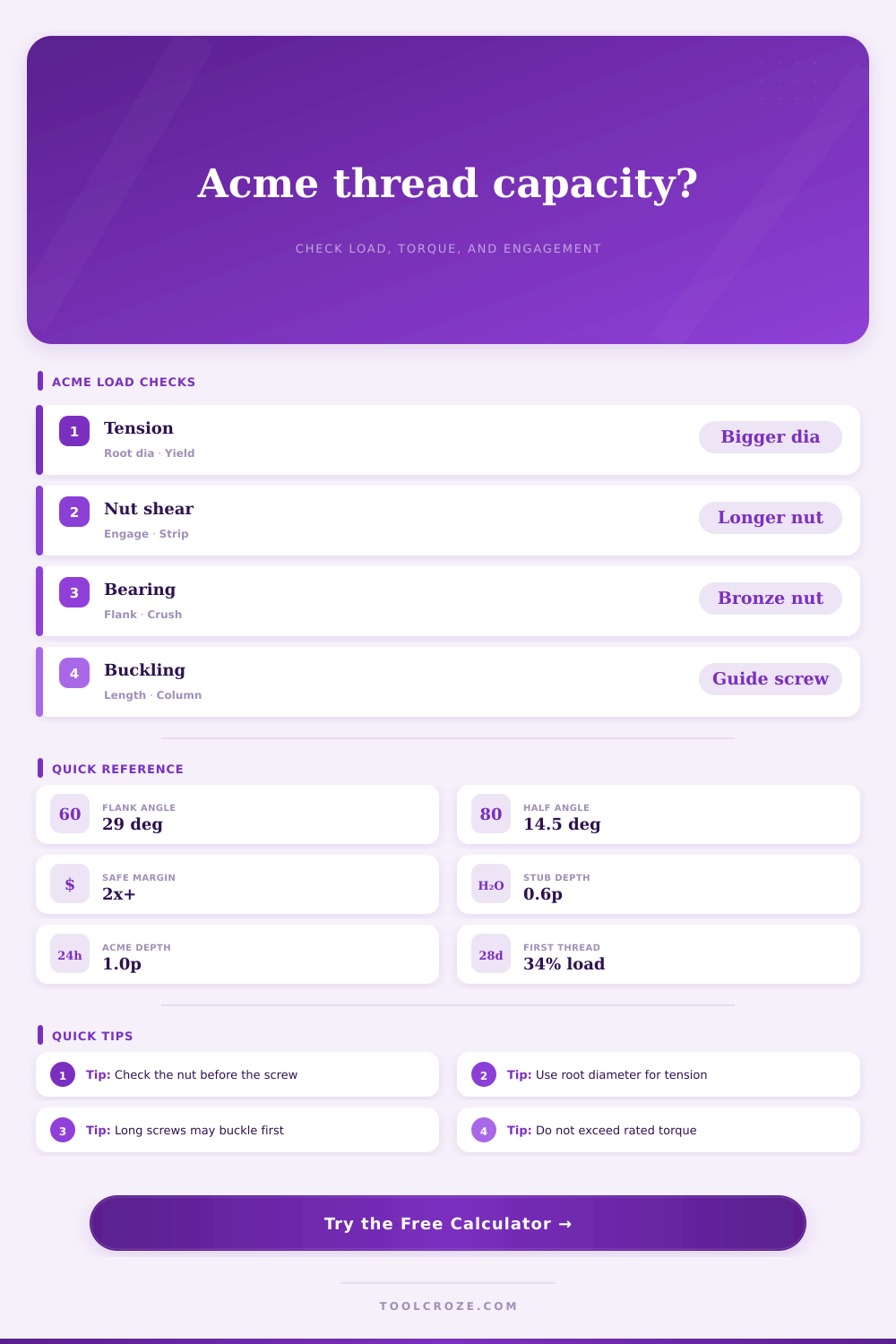
There’s a tool (above) that will do this for you based off your configuration. It measures buckling margins, flank bearing, nut shear and root tension. You won’t have to guess if your screw will pull out. You might wonder if your nut will strip or if your column will bend. That’s where the tool comes in to play.
That’s the key, it’s not so much how strong the screw itself is but rather what exactly is being tested to determine that strength. The test for tensile strength measures diameter at the root of the screw. This is the thinnest section of metal. If it give way, the screw stretches its thread and will permanently elongate or bind immediately.
That’s why material selection is most important here. Screws made from heat treated alloy steel can withstand far more tension than screws made from mild steel. But if the nut isn’t capable of supporting this strength, it doesn’t matter at all. This leads us back to the nut.
That’s frequently where homemade jacks and presses fails. Acme thread relies on flank contact for the load pushing on the angled surfaces of the thread. When pressure on those flanks exceeds the material limit of the nut, the threads gets crushed. In this case, the go-to is a bronze nut because it resists galling against steel screws. But bronze is also softer than steel.
As the chart on the page shows, changing materials changes range of allowable stresses. Using a bigger screw doesn’t mean you can put more load on it without switching nut materials.
Another area where gut instinct is wrong is with thread engagement. People will often guess that increasing the nut length increases safety by twice as much. Nope. The initial threads near the screw head are doing most of the work. They accounts for about one-third of the total axial load in many situations. Beyond a certain length, adding more doesn’t help all that much. That’s why it calculates the shear area of the threads actualy engaged. And if you’re working on a high-load application and have a short brass collar, it’ll also prevent a stripped-out nut.
And finally you can buckle long screws. Long before the metal yields in tension it will snap or bend if held between two adult-sized sofa as a slender rod in compression. It’s a column stability issue different than a material strength issue. How long is it? What are the end conditions? A free-swaying screw on the bottom has far less buckling capacity then one that is guided at both ends. If you get this one wrong your calculation will show lots of margin in tension but the screw will bow out sideways under moderate pressure.
Just as important is torque. How much turning force must be applied to lift your load? If that force is coming from some kind of gearbox and/or motor then this is vital. This is because friction is huge on this front. For example, a well-lubricated bronze-on-steel interface can have a coefficient of 0.15. A dry, gritty interface will double that. That doesn’t alter the load capacity, it alters the drive requirements significantly.
The bottom line is that designing a size for an Acme screw is a matter of balancing multiple potential ways it could fail, with one ultimately ruling the day. There’s no way around it. Something in the whole system rules out the other something. You should of figured out what that something is before you construct the thing. Then we can let the math compare things. But you’ve got to give realistic values for your duty cycle, support, and friction.
Next time you design a lift or tighten a clamp, don’t just focus on the major diameter. Look at the nut length. Check the root. Check the unsupported span. These are all geometric limits that can mean the difference between a smooth operation and a total failure.