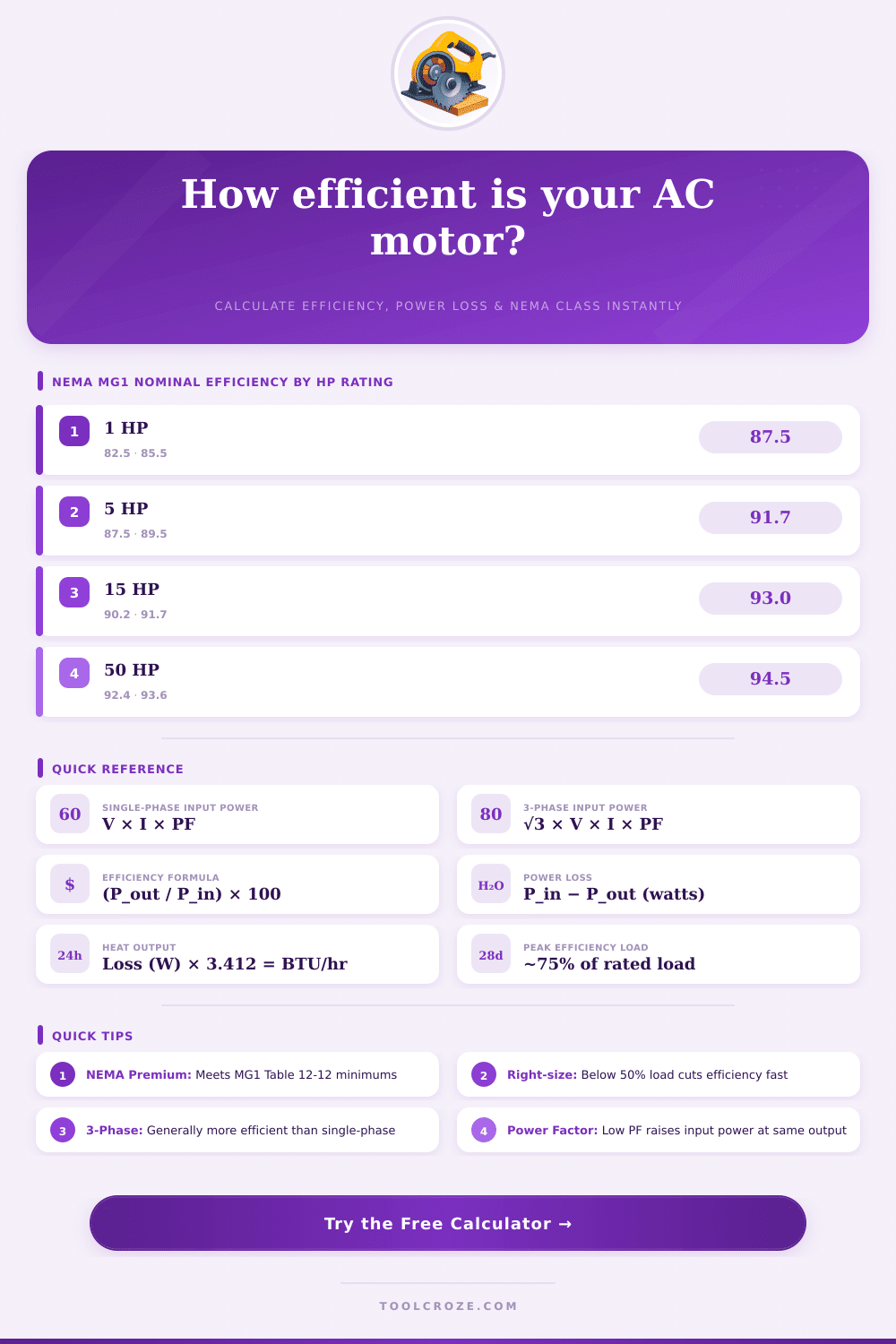
⚡ AC Motor Efficiency Calculator
Calculate single-phase & 3-phase AC motor efficiency with NEMA MG1 class comparison
| HP Rating | Standard (%) | Energy Efficient (%) | NEMA Premium (%) |
|---|---|---|---|
| 1 HP | 82.5 | 85.5 | 87.5 |
| 1.5 HP | 84.0 | 86.5 | 88.5 |
| 2 HP | 84.0 | 87.5 | 89.5 |
| 3 HP | 85.5 | 88.5 | 89.5 |
| 5 HP | 87.5 | 89.5 | 91.7 |
| 7.5 HP | 88.5 | 90.2 | 91.7 |
| 10 HP | 89.5 | 91.7 | 91.7 |
| 15 HP | 90.2 | 91.7 | 93.0 |
| 20 HP | 91.0 | 92.4 | 93.0 |
| 25 HP | 91.7 | 93.0 | 93.6 |
| 30 HP | 91.7 | 93.0 | 93.6 |
| 40 HP | 92.4 | 93.6 | 94.1 |
| 50 HP | 92.4 | 93.6 | 94.5 |
| 75 HP | 93.0 | 94.1 | 95.0 |
| 100 HP | 93.6 | 94.5 | 95.4 |
| 150 HP | 93.6 | 95.0 | 95.8 |
| 200 HP | 94.5 | 95.0 | 96.2 |
| Load Level (%) | Standard Motor Eff. (%) | NEMA Premium Eff. (%) | Efficiency Difference |
|---|---|---|---|
| 25% | ~80.0 | ~84.0 | +4.0% |
| 50% | ~86.0 | ~90.0 | +4.0% |
| 75% | ~88.5 | ~92.5 | +4.0% |
| 100% | ~87.5 | ~91.7 | +4.2% |
| 115% | ~85.0 | ~89.0 | +4.0% |
| Power Factor | 3-Phase Input (kW) @ 10 kW out, 90% eff. | Line Current Impact | Efficiency Rating |
|---|---|---|---|
| 0.65 | ~17.3 kW apparent | Very high current draw | Poor |
| 0.75 | ~14.9 kW apparent | High current draw | Below average |
| 0.85 | ~13.2 kW apparent | Moderate current | Average |
| 0.90 | ~12.5 kW apparent | Low-moderate current | Good |
| 0.95 | ~11.8 kW apparent | Near optimal | Excellent |
AC motors work by converting electrical energy into mechanical motion by means of magnetic fields. The level that they successfully do that we call efficiency of the motor (that is), the ratio between the useful mechanical energy that exits, and the entering electrical energy. The higher the efficiency, the less energy lost as heat instead of for actual work.
Most ac motor types have efficiency between 83% and 92 percent. Models that save energy can reach even more, what results in fewer lost amounts overall and fewer heat output. Less heat has bigger value than it seems, because it helps the motor stay reliable and work well year after year.
AC Motor Efficiency and Types
AC induction motors (sometimes called asynchronous), depend on electromagnetic induction to turn the rotor. Their levels of efficiency range between 85% and 95 percent. Two-pole builds commonly reach maximum around 90% to 93%, because of how they are done.
Even so, induction motors do not limit to 87%, as some beleive. Some of them reached 97%, and synchronous motors can beat that.
Brushless ac motor types usually fall in the range of 85% to 90%. Tests in real life from makers even so sometimes reveal much lower values, around 70% in some cases. The difference between the official figures and what really happens in usage deserves our attention.
Various kinds of motors act at different levels. An average single-phase asynchronous motor is not especially good in efficiency, if I must be honest. Motors with permanent magnet and synchronous types that commonly get used in cars and portable devices tend to bee tinier, less warm and widely more efficient, although they cost more at first.
One sometimes compares them with induction types, but they are entirely different stuff.
Efficiency gains in the upper part add up more quickly than one hopes. When a motor works at 90% efficiency, it wastes 10% of its energy as heat. If one raises that to 98%, it only lost 2%.
If you think about the cause like this, it shows big decrease of lost energy in the whole system.
AC motors beat brushed DC motors in efficiency and lasting power. DC motors own brushes that wear down over time, what causes more problems with care later. Basic DC motors in series stay around 85% efficient, while modern ac motor types with permanent magnet reach the middle to high 90 percent.
Brushed DC motors, honestly, do not impress, they usually range between 50% and 80%, because a lot of energy spills as heat in the coils and in the brush spots.
To run an ac motor, one usually needs an inverter to control the power. The inverter itself has efficiency between 75% and 95 percent, what directly affects the whole system. In recent years inverters became much better, what gives motors better ways tocontrol.
Motors with inverters now provide truly quick response and energy-rich solution for many uses today.