Abrasive Belt Surface Speed Calculator
Estimate belt SFPM, m/min, effective drive RPM, material speed match, contact heat load, and practical heat risk for belt grinders and sanders.
⚙Named Grinder and Sander Presets
Choose a common shop setup, then adjust the fields for your actual driven wheel, pulley ratio, belt, grit, pressure, and material.
📏Belt Speed Inputs
Calculated Belt Speed and Heat Load
🧱Selected Material and Spec Grid
📊Material Speed Reference
| Material | Typical SFPM | Typical m/min | Heat Behavior | Practical Note |
|---|---|---|---|---|
| Mild steel | 2500 to 4500 | 760 to 1370 | Medium | Good general range for ceramic or zirconia belts. |
| Stainless steel | 1800 to 3200 | 550 to 975 | High | Lower speed and fresh abrasive help reduce blue heat. |
| Tool steel / knife steel | 1500 to 3000 | 455 to 915 | High | Use short passes and cooling near hardened edges. |
| Aluminum | 3500 to 6000 | 1065 to 1830 | Medium | Open coat or lubricant helps reduce belt loading. |
| Hardwood | 1800 to 3500 | 550 to 1065 | Medium | Watch burn marks at fine grit and firm pressure. |
| Plastic / acrylic | 900 to 1800 | 275 to 550 | Very high | Slow speed and light pressure reduce melting. |
⚒Drive Wheel and RPM Examples
| Drive Wheel | 1725 RPM | 1800 RPM | 3450 RPM | 3600 RPM |
|---|---|---|---|---|
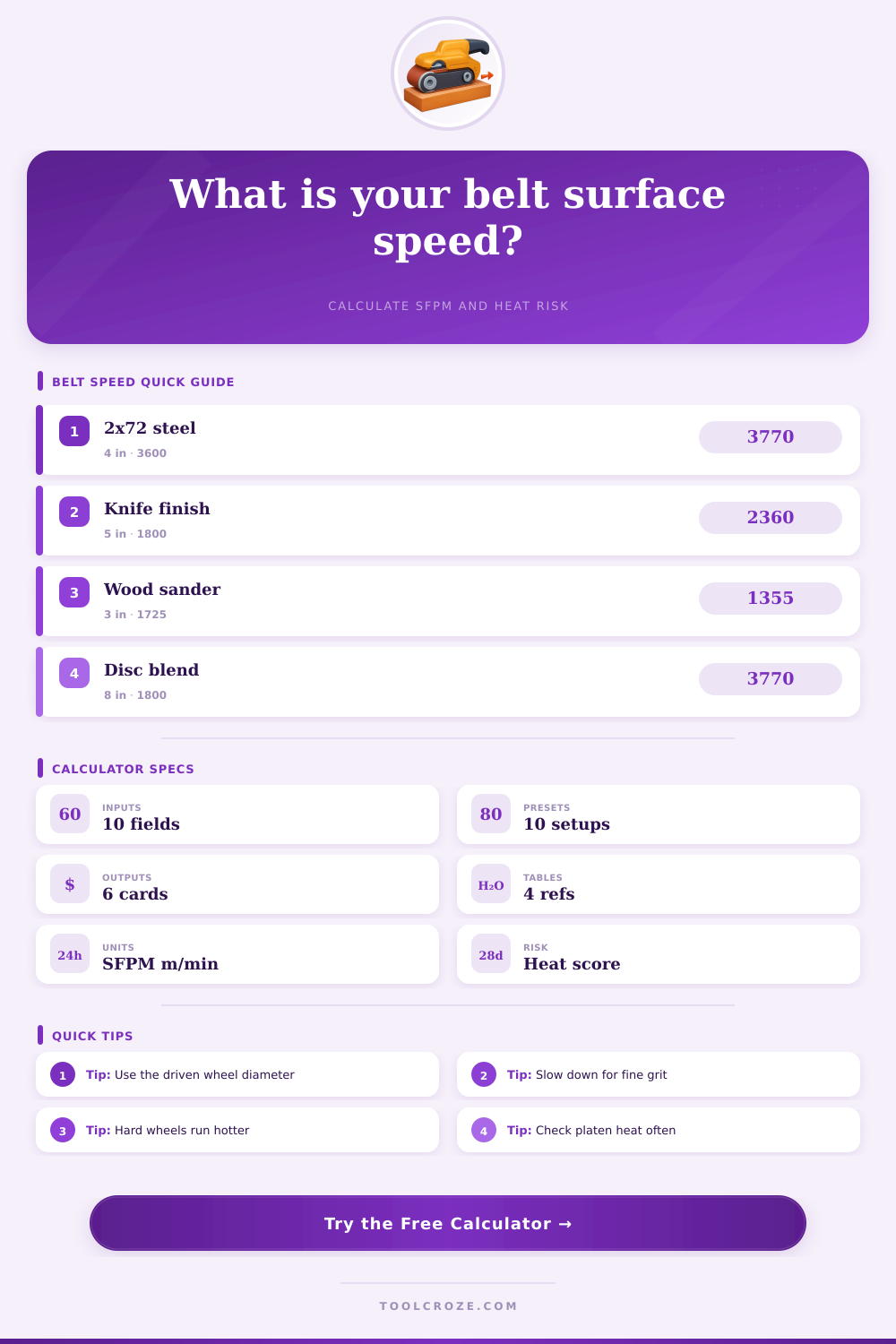
| 2 in / 51 mm | 903 SFPM | 942 SFPM | 1806 SFPM | 1885 SFPM |
| 3 in / 76 mm | 1355 SFPM | 1414 SFPM | 2709 SFPM | 2827 SFPM |
| 4 in / 102 mm | 1806 SFPM | 1885 SFPM | 3613 SFPM | 3770 SFPM |
| 5 in / 127 mm | 2258 SFPM | 2356 SFPM | 4516 SFPM | 4712 SFPM |
| 8 in / 203 mm | 3613 SFPM | 3770 SFPM | 7226 SFPM | 7540 SFPM |
🔬Grit, Pressure, and Contact Reference
| Factor | Lower Heat Choice | Neutral Choice | Higher Heat Choice | Use Case |
|---|---|---|---|---|
| Grit | 24 to 60 | 80 to 120 | 220 and finer | Fine grit rubs more and clears chips slower. |
| Pressure | Feather or light | Medium | Firm or heavy | Pressure multiplies heat load at the contact patch. |
| Contact | Slack or soft wheel | Medium wheel | Hard wheel or platen | Hard contact raises local pressure and scratch definition. |
| Belt width | 3 in and wider | 2 in | 1 in or narrow | Narrow belts concentrate force into less area. |
🔧Named Machine Setup Reference
| Preset | Wheel | Motor RPM | Ratio | Typical Work |
|---|---|---|---|---|
| KMG 2x72 steel profiling | 4 in | 3600 | 1.00 | Mild steel stock removal with 36 grit. |
| Bader BIII knife finish | 5 in | 1800 | 0.75 | Knife edge finishing with light pressure. |
| Wilton Square Wheel general | 8 in | 3450 | 0.50 | General fabrication blending on medium wheel. |
| JET 6x48 wood sanding | 3 in | 1725 | 1.00 | Hardwood and softwood sanding. |
| Timesavers wide belt finish | 8 in | 1800 | 0.85 | Wide belt finishing with fine grit. |
This abrasive belt surface speed calculator determines SFPM and m/min. It also calculates the belt pass rate, driven wheel RPM, material speed match, and heat risk based off your grinder set-up.
Have you ever been grinding along with the belt singing when suddenly, whoosh! Your workpiece suddenly go all blue at the edges or burns. Yeah, you heard that noise. Speed and heat is talking to each other; your eyes just aren’t reading well enough yet.
Why Surface Speed Matters for Grinding
On the surface, surface speed appears to be a single easy number. But behind the scenes, it decide if your 80-grit belt loads up and dies in thirty seconds. It also decides whether it eats through steel with a clean bite. Nail it and everything is smooth sailing, screw it and you’re always chasing some problem that seems random until you catch on: it isn’t. But here’s the surprising part: it really is that simple.
How fast is abrasive flying by your metal? It is measured in surface feet per minute. If you get an abrasive wheel up to four inches in diameter and run your motor full blast, then yea, you’ve got yourself some over 3700 SFPM for sure. Swap out a bigger pulley or smaller wheel and you’re looking at less than 2000. That distance make all the difference; each material has its sweet spot and will forgive (or punish) you accordingly. Tool steel and stainless won’t tolerate being outside their comfort zone long before mild steel start to forgive.
Speed doesn’t come alone; it’s also what makes the math interesting. The coarser the grain, the more aggressively it cut and clears chips. A coarse grit will cut aggressively and clear chips fast, so they can usually handle higher speeds without overheating. Drop down to 220 or 400 grit, however, and that same speed feels like using a belt sander crafted out of glass. It accounts for this in the calculator, and shows you the tradeoff prior to ruining a finish or burning a blade.
Similarly, contact wheel hardness is a silent but critical factor. Soft wheels is more flexible, spread pressure, and dissipate heat better. If you use a hard wheel or flat platen, the same amount of pressure and speed will concentrate into a smaller spot. That heats up the workpiece rapidly. Similarly, narrow belts focus force on less abrasive surface area. It matters. It’s why two operator may be running the same RPM and getting entirely different results.
Most folks underestimate one variable. It is pressure. When things seem too slow for stock removal, it’s tempting to put on more pressure but that increases heat exponentially, much more then slightly increasing speed. The best bet is usually to reduce pressure first and fine-tune speed as needed. Protect tempers; save belt.
One that most people don’t consider is belt length: because a long belt takes more time to complete one loop than a short one, it has a bit of time to cool between contacts with the piece being worked on. You may find yourself running a short belt faster and thus trapping some heat. It tracks the number of passes per second so you can see how much abuse the abrasive go through.
But then there’s what the math doesn’t see that matters in real-world terms as well: Is it new zirconia or ground-down aluminum oxide? Air blast or coolant on the belt? And how steady are you feeling today? Still, knowing where to aim takes away much of the guesswork. Do I go with 2800 SFPM for this job or is that brash or dumb? For them it’s a conversation rather than a number; the best operators hear what the belt says, watch for the sparks, feel the heat from the work piece in their hands and adjust accordingly.
Grinding becomes control rather than guesswork when the numbers on the screen match what you sense in the world around you. And that’s the quiet promise of all good abrasive calculations. It doesn’t make you more skilled or experienced. It just gives you the map, so you could of spent less time lost and more time cutting cleanly and confidntly.