AAC Block Adhesive Calculator
Estimate AAC block adhesive bags from wall area, block size, wall thickness, joint thickness, vertical joint coverage, openings, mortar yield, and waste allowance.
⚙Project Presets
📏AAC Wall And Adhesive Inputs
Adhesive Coverage Results
🧱AAC Material Snapshot
⚖Adhesive And Mortar Spec Comparison
📋Common AAC Block Size Reference
| Nominal Block Size | Face Area | Blocks Per Area | Calculator Use |
|---|---|---|---|
| 600 mm x 200 mm x 100 mm | 0.120 m² | 8.3 blocks/m² | Interior partitions and non-load walls |
| 600 mm x 200 mm x 150 mm | 0.120 m² | 8.3 blocks/m² | Exterior infill and thicker partitions |
| 600 mm x 250 mm x 150 mm | 0.150 m² | 6.7 blocks/m² | Faster laying with taller blocks |
| 625 mm x 250 mm x 200 mm | 0.156 m² | 6.4 blocks/m² | Large-format walling systems |
| 24 in x 8 in x 4 in | 1.33 ft² | 0.75 blocks/ft² | Imperial utility partitions |
| 24 in x 8 in x 8 in | 1.33 ft² | 0.75 blocks/ft² | Imperial exterior or thick walls |
📐Joint Thickness And Coverage Reference
| Joint System | Typical Joint | Coverage Behavior | Planning Note |
|---|---|---|---|
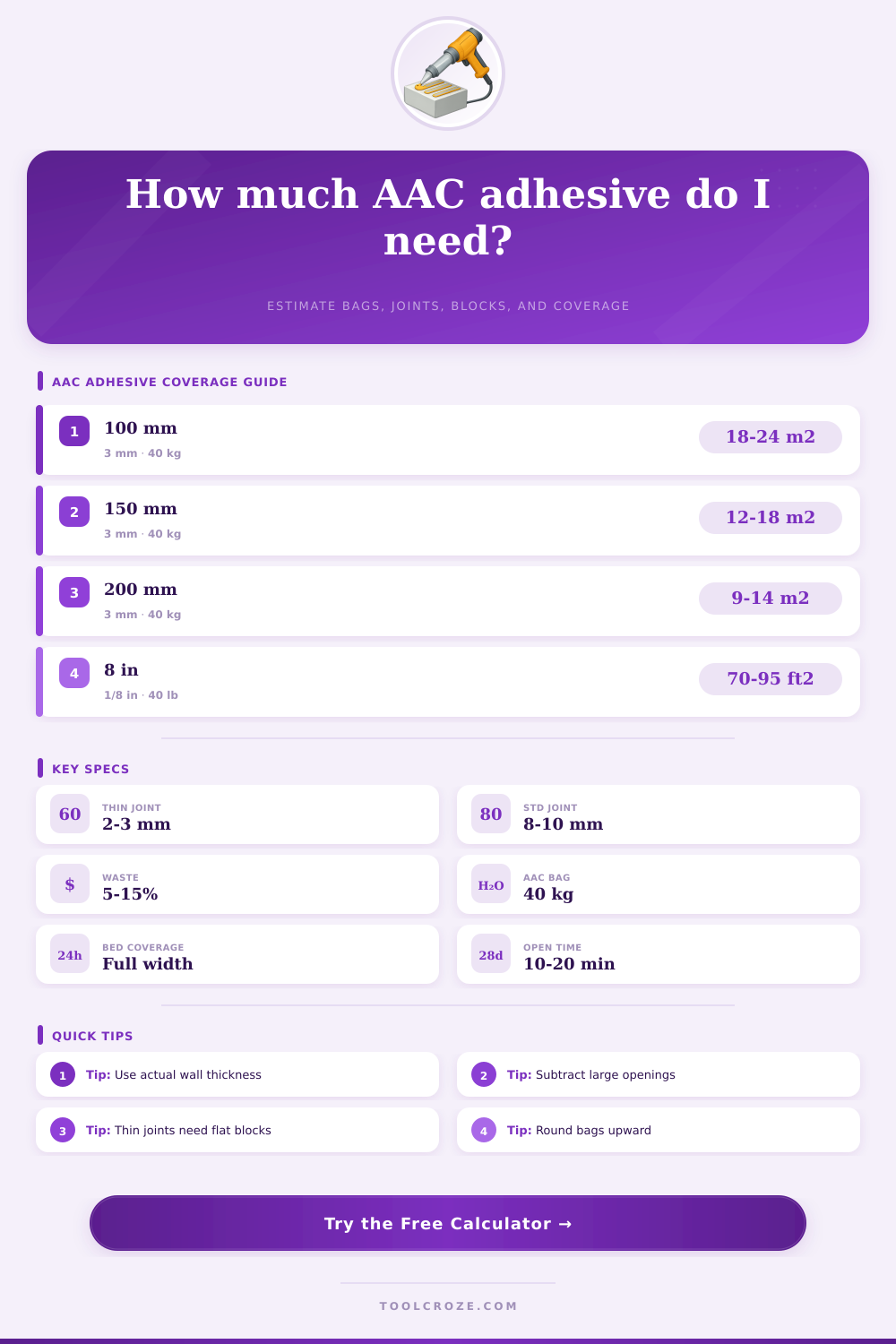
| AAC thin-bed adhesive | 2 mm to 3 mm | Low volume, high wall coverage | Needs clean, flat blocks and proper notched trowel use |
| Thicker correction bed | 4 mm to 6 mm | About double the adhesive of a 3 mm joint | Use only where the product permits heavier bedding |
| First course leveling bed | 8 mm to 12 mm | Adds volume along the base run | Often handled separately from thin-bed joints |
| Standard mortar joint | 8 mm to 10 mm | Much higher volume than thin-bed adhesive | Confirm compatibility with AAC and project specification |
| Tongue-and-groove head joints | Ends only | Vertical joint usage can drop sharply | Still butter cut ends, returns, jambs, and corners as specified |
📊Bag Yield And Wall Coverage Reference
| Bag Or Mix Type | Typical Yield | Example Coverage | Best Fit |
|---|---|---|---|
| 40 kg AAC thin-bed bag | 22 L to 26 L mixed | About 12 m² to 24 m² depending on wall thickness | Most AAC block wall adhesive takeoffs |
| 25 kg AAC thin-bed bag | 14 L to 16 L mixed | Use custom bag size if the label differs | Small projects or regional bag sizes |
| 40 lb AAC adhesive bag | 0.33 ft³ to 0.40 ft³ | About 70 ft² to 140 ft² depending on thickness | Imperial estimates with thin joints |
| Sand-cement mortar | Varies by mix | Coverage falls quickly at 3/8 in joints | Only when specified or permitted for AAC blocks |
| Custom site mix | Enter label yield | Calculator uses volume and bag size entries | When technical data sheets give exact yield |
🏗Common AAC Wall Scenario Reference
| Scenario | Typical Inputs | Joint Assumption | Waste Allowance |
|---|---|---|---|
| Interior partition | 100 mm to 125 mm block, 2.4 m to 2.7 m high | 3 mm thin-bed, full bed, moderate head joints | 5% to 10% for clean runs |
| Exterior infill wall | 150 mm to 200 mm thick block with openings | 3 mm thin-bed plus cut-end buttering | 10% to 15% for jambs and returns |
| Loadbearing AAC wall | 200 mm or thicker wall section | Full-width bedding and specified vertical joints | 10% normal allowance |
| High commercial wall | Long runs, taller courses, service openings | Thin-bed with extra transfer control | 15% for height, staging, and interruptions |
| Repair or infill patch | Short run, many cuts, existing masonry edges | Heavier bedding at starts and returns | 15% to 20% for irregular work |
💡AAC Adhesive Calculation Tips
In order to adhere to AAC block, a specific type of thin bed mortar is required. Thin-bed mortar are applied in thin layers to AAC blocks, and an individual must apply thin-bed mortar with high precision to the AAC blocks. Changes in the thickness of the thin-bed mortar will alter the amount of adhesive that an individual have to purchase.
If an individual increase the thickness of the thin-bed mortar by as few as a few millimeters, the individual will use significant more adhesive to cover the area of AAC blocks. For these reasons, it is necessary for an individual to calculate the thickness of the thin-bed mortar for AAC walls to determine how much adhesive is require to complete the wall. The first course of AAC blocks require a different calculation than the remaining course of AAC block for walls.
How to Calculate Adhesive Needed for AAC Block Walls
Due to the fact that many AAC slab and footing base are not level, the first course of AAC blocks will require a thicker bed of mortar in order to even out the differences in height of the foundation. The leveling bed is thicker than a thin-bed joint of mortar, and it contains more adhesive than a thin-bed joint. An individual may purchase adhesive for the first course of AAC blocks, but if an individual dont account for the adhesive that is required for the thick leveling bed, the individual may run out of adhesive before the AAC wall is construct.
Thus, the individual must treat the first course of AAC blocks separately when calculating the adhesive requirement for the wall. Another factor that will impact the amount of adhesive required to construct an AAC wall is the vertical joint between the AAC blocks. Some systems of AAC blocks require that the vertical joints has adhesive applied to the end joints only.
Other systems require that an individual applies adhesive to every vertical joint between the AAC blocks. The system that is used will impact the amount of adhesive that will be used in the construction of the wall. The vertical joint system must be accounted for in the calculation of the amount of adhesive that will be require.
Another factor to consider in the calculation of adhesive requirements is the waste that will occur. Not all of the adhesive that is poured into the bucket will adhere to the AAC blocks. Some of the adhesive will stick to the bucket, some will fall on the floor.
Additionally, some of the adhesive will be squeeze out of the joints between the AAC blocks. A waste factor of ten percent of the total amount of adhesive required is standard for AAC block construction. However, a higher waste percentage may be require if the AAC wall contain many windows or doors.
AAC blocks must be cut to fit windows and doors, which create more edges that require adhesive. Additionally, the cutting of AAC blocks create waste in the number of AAC blocks that can be used to construct the wall. The thickness of the AAC blocks will also impact the amount of adhesive that is required.
A thick load-bearing wall will require more adhesive than a thin interior wall. If an individual is constructing an entire house with AAC blocks, the thick walls will require more bag of adhesive than thin walls. Finally, the type of adhesive that is used will also impact the amount of adhesive that is required.
Some type of adhesive will stretch further than other types of adhesive. An individual will have to refer to the tables that are published for the adhesive to determine how many square meters of AAC blocks one bag of adhesive will cover.