
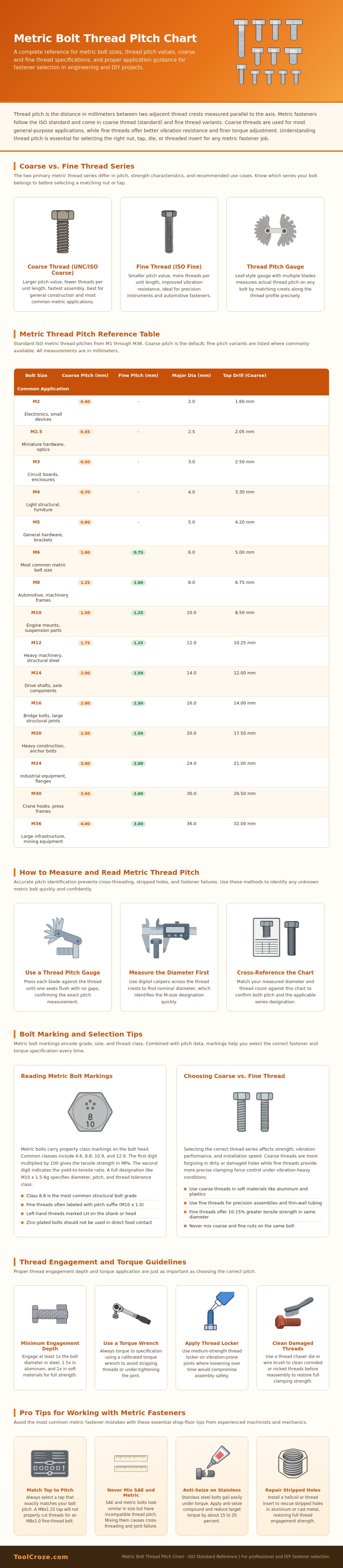
A bolt is defined by more than just it’s diameter, as a bolt is also defined by its thread pitch. The thread pitch of a bolt are the distance between the crests of the bolts threads. By using an nut that dont match the thread pitch of a bolt, you can damage the bolt and the workpiece it is fasten to.
There are two main types of thread pitches: coarse and fine. Each type have a specific use for the bolt that features it. Coarse thread pitches is designed for speed in the installation of the bolt and for the durability of the bolt itself.
Coarse and Fine Bolt Threads and How to Install Them
Coarse threads are easier to install than fine threads. Coarse threads are also less likely to tear into the materials that the bolt is being secure by, making them useful for working with soft materials like aluminum or plastic. Coarse thread bolts are used for basic home repair and general framework construction.
Fine threads are different than coarse threads in that there are more threads within the same length of the bolt featuring the fine threads. Fine threads are used in applications that experience alot of vibration, such as automotive engine and precision instruments. The extra threads of fine thread bolts also allow for the bolt to be adjusted to finer degrees then coarse threaded bolts.
To install a bolt correctly, it is first necessary to identify the diameter of the bolt and its thread pitch. The nominal diameter of the bolt can be found with digital calipers. Once you have found the diameter of the bolt, you can use a chart to find the pitch of the bolt.
For the most certainty in identifying the pitch of the bolt, a thread pitch gauge can be used. To use a thread pitch gauge, the notched blade of the tool are pressed against the threads of the bolt until the blades of the gauge are flush against the threads of the bolt. The thread pitch is recognized when the gauge has no gap between its blades and the threads of the bolt, and no wiggle is felt between the threads and the blades of the gauge.
While bolts often have markings on their heads, the markings on the bolt heads do not tell you the thread pitch of the bolt. On metric bolts, the markings are property class, like 8.8 or 10.9. These property classes indicate the strength of the steel of which the bolt is made.
On bolts with these markings, the shank of the bolt will tell you how the bolt will fit into an object being fastened. If the bolt has the full designation of the bolt, such as M10 x 1.5, the markings will indicate both the diameter and the pitch of the bolt. If the pitch is listed after the diameter, then it is likely a fine thread bolt.
If only the diameter is listed on the bolt, it is likely a coarse thread bolt. Bolts from different systems, such as metric and SAE bolts, should not be mixed as they are incompatible with each other. If an imperial nut is force onto a metric bolt, the metric bolt will be ruined.
This can happen when using taps and dies to drill new threads into an object. Using the wrong tap will destroy the hole drilled into the object. In this situation, a helicoil or threaded insert will be necessary to repair the destroyed hole.
When installing a bolt, it is important to consider the degree of thread engagement between the bolt and the object being fastened. For metal like steel, the engagement of the bolt threads should be at least the same as the diameter of the bolt. For softer metals, the bolt should have more thread engagement so that the threads dont become torn during installation.
A calibrated torque wrench are necessary to properly tighten the bolt. Tightening the bolt using any other means will cause the bolt to snap or the threads of the bolt to flatten against the object being fastened. For installations that use stainless steel bolts, the bolts may gall during installation.
Galling is the process of the stainless steel bolts threads creating a cold-weld with the threads of the objects being fastened together. To prevent galling, you can apply an anti-seize compound to the threads of the stainless steel bolt. The anti-seize compound will assist in the maintenance of the installation.
Whether using coarse threads or fine threads, the goal of installing a bolt is to ensure that the bolt has a secure fit in the object it is being install into.
