
When using pneumatic tools, there may come a time when the tool dont have the power that is required to complete a task. Whether it is an impact wrench or a sander, these tools will not have the power to perform their functions if the air hose that is connected to them is the issue. The loss of power from a pneumatic tool is usualy not the result of the air compressor or the regulator on the tool being the issue.
Instead, the power loss is due to an air hose that is attached to the pneumatic tool. The bottleneck that is created in the air hose prevents the air from reaching the pneumatic tool with the power that is required to allow the tool to perform its task. In order to understand the effect that the air hose have upon the pneumatic tool, it is first important to understand the concept of air pressure and air flow.
How Air Hoses Affect Air Tool Power
Air pressure is the potential energy that is contained within the air compressor tank. Air flow, on the other hand, is the actual movement of the air through the air hose from the compressor to the pneumatic tool. The unit of measurement for air flow is cubic feet per minute.
If a large volume of air needs to move through an air hose with a narrow diameter, there will be friction between the air and the air hose. In order to avoid this, the air hose that is used with a pneumatic tool must have a large enough diameter to allow for the necessary air flow from the tool to the pneumatic implement. If the pneumatic tool requires a large volume of air to maintain its RPMs, then the air hose will not be able to supply that amount of air flow if it is of a narrow diameter.
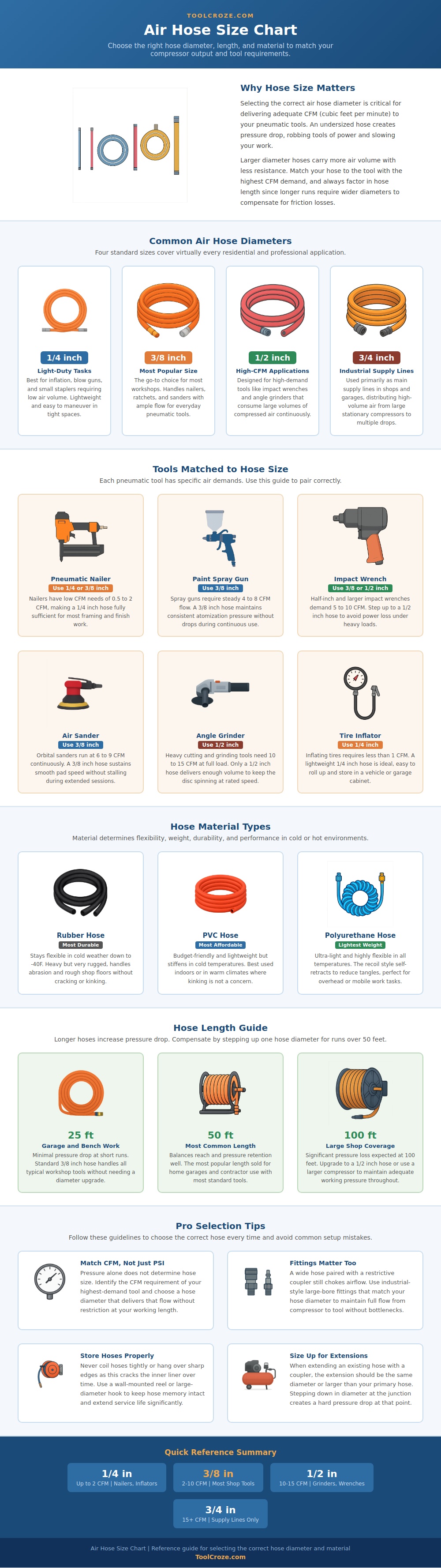
The size of the air hose that is used with the pneumatic tool will depend off the type of task that the pneumatic tool will perform. For tasks that require only small amount of air, such as inflating tires or using a brad nailer, a thin air hose will be an appropriate choice. The tasks that are to be performed require so little air that a thin air hose will provide enough air for those tasks to be completed.
Furthermore, a thin air hose will be lighter to maneuver in the work area and will require fewer coiling of the hose to store the air hose. For the majority of tasks in the shop or workshop, however, an air hose with a medium diameter will be the best choice. Tools such as nail guns, ratchets, and orbital sanders requires medium air hose diameters in order to meet the RPMs that those pneumatic tools require.
For the heavy duty pneumatic tools, such as angle grinders or large impact wrenches, an air hose of a large diameter will be required. These types of tools require a large volume of air to perform their tasks. If a user uses an air hose of standard shop size with these heavy-duty tools, the tools will not have the power to perform the tasks that they are often used for.
A heavy-duty air hose will allow the air to reach the pneumatic tool in the required amount to allow the tool to perform its tasks. Another factor to consider when purchasing an air hose is the material of the hose. Rubber is a very durable material that will hold up well in the workshop.
This material will be beneficial for air hoses that need to be dragged across the concrete floor in the workshop. Additionally, rubber is flexible in cold weather, making it a good choice for workshops in the winter. PVC is a lighter and less expensive material that would work for many workshops.
The downside to this material is that it become brittle in cold temperatures. Polyurethane is another material used for air hoses. This material is often used for coiled air hoses because the material is springy so that the air hose does not tangle while in use.
Polyurethane is lighter than rubber but is not as durable as rubber. The length of the air hose will also have an effect upon the amount of power that is delivered to the pneumatic tool. The longer the air hose, the more friction that the air will encounter as it moves through the hose.
The more friction in the air hose, the less air pressure that will be delivered to the pneumatic tool. Using a very long air hose, such as one that is fifty or one hundred feet in length, may pose a problem in delivering enough air pressure to the pneumatic tool. In order to combat the friction that occurs with longer air hoses, an air hose of a larger diameter should be used.
This will help to minimize the drop in air pressure along the length of the air hose. Finally, another consideration is the width of the air hose and the coupler that attaches to the pneumatic tool. The air hose that is used should be of a consistent width from the air compressor to the trigger of the pneumatic tool.
A wide air hose with a narrow coupler, for example, will cause a bottleneck in the air supply to the pneumatic tool. The air compressor, air hose, and pneumatic tool couplers should all be of the same width so that the pneumatic tools will receive the power levels that the tool manufacturers has advertised for their tools.
