🔧 Torque Wrench Adapter Calculator
Calculate the correct torque wrench setting when using extensions, crowfoot, or offset adapters
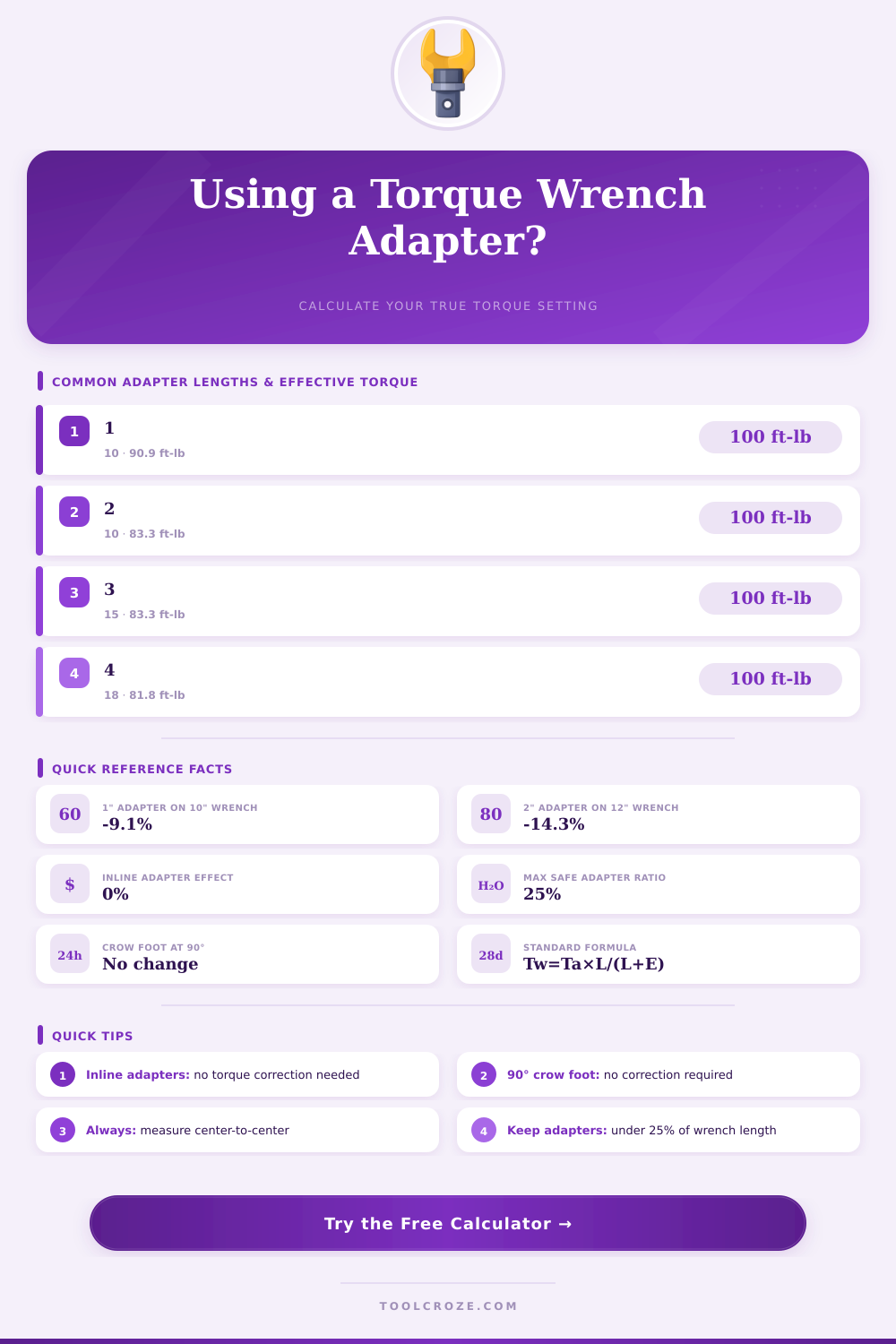
| Wrench L (in) | Adapter E (in) | E/(L+E) Error% | Set for 80 ft-lb | Set for 100 ft-lb | Set for 150 ft-lb |
|---|---|---|---|---|---|
| 10 | 1 | 9.1% | 72.7 ft-lb | 90.9 ft-lb | 136.4 ft-lb |
| 10 | 2 | 16.7% | 66.7 ft-lb | 83.3 ft-lb | 125.0 ft-lb |
| 12 | 1 | 7.7% | 73.8 ft-lb | 92.3 ft-lb | 138.5 ft-lb |
| 12 | 2 | 14.3% | 68.6 ft-lb | 85.7 ft-lb | 128.6 ft-lb |
| 15 | 1.5 | 9.1% | 72.7 ft-lb | 90.9 ft-lb | 136.4 ft-lb |
| 15 | 3 | 16.7% | 66.7 ft-lb | 83.3 ft-lb | 125.0 ft-lb |
| 18 | 2 | 10.0% | 72.0 ft-lb | 90.0 ft-lb | 135.0 ft-lb |
| 18 | 4 | 18.2% | 65.5 ft-lb | 81.8 ft-lb | 122.7 ft-lb |
| 20 | 2 | 9.1% | 72.7 ft-lb | 90.9 ft-lb | 136.4 ft-lb |
| 24 | 3 | 11.1% | 71.1 ft-lb | 88.9 ft-lb | 133.3 ft-lb |
| ft-lb | in-lb | Nm | kgf-m | Common Use |
|---|---|---|---|---|
| 5 | 60 | 6.8 | 0.69 | Small fasteners, sensors |
| 10 | 120 | 13.6 | 1.38 | Oil drain plug (small) |
| 18 | 216 | 24.4 | 2.49 | Spark plugs |
| 25 | 300 | 33.9 | 3.46 | Intake manifold bolts |
| 40 | 480 | 54.2 | 5.53 | Brake caliper bolts |
| 65 | 780 | 88.1 | 8.99 | Oil filter housing |
| 80 | 960 | 108.5 | 11.06 | Cylinder head (small) |
| 100 | 1200 | 135.6 | 13.83 | Lug nuts (typical) |
| 125 | 1500 | 169.5 | 17.28 | Cylinder head (large) |
| 150 | 1800 | 203.4 | 20.74 | Axle nuts (light vehicle) |
| 200 | 2400 | 271.2 | 27.65 | Axle nuts (truck) |
| Wrench Model Type | Drive Size | Typical Length (in) | Length (mm) | Max Range (ft-lb) |
|---|---|---|---|---|
| Click-type (compact) | 1/4 in | 9–11 | 229–279 | 0–20 |
| Click-type (standard) | 3/8 in | 11–14 | 279–356 | 0–75 |
| Click-type (standard) | 1/2 in | 14–18 | 356–457 | 10–150 |
| Click-type (heavy duty) | 1/2 in | 18–22 | 457–559 | 25–250 |
| Click-type (large) | 3/4 in | 24–30 | 610–762 | 50–600 |
| Beam-type | 1/2 in | 15–20 | 381–508 | 0–200 |
| Digital torque wrench | 1/2 in | 14–18 | 356–457 | 0–250 |
| Dial-type | 3/8 in | 11–15 | 279–381 | 0–100 |
| Adapter Type | Angle Effect | Formula Used | Correction Needed? | Notes |
|---|---|---|---|---|
| Extension bar (inline) | 0° | T×L/(L+E) | Yes | Adds to effective length |
| Crowfoot (inline) | 0° | T×L/(L+E) | Yes | Same as extension |
| Crowfoot (perpendicular) | 90° | No correction | No | Set wrench to target torque |
| Crowfoot (angled) | 0–90° | T×L/(L+E×cosθ) | Partial | Use angle correction |
| Offset adapter | varies | T×L/(L+E×cosθ) | Partial | Measure perpendicular offset |
| Universal joint | varies | Avoid if possible | Complex | Introduces friction losses |
| Wobble extension | varies | Avoid if possible | Complex | Inconsistent at high torque |
When you use a torque wrench with an extension, the extension will change the amount of torque that is deliver to the fastener. A torque wrench work by using the principle of a lever. The torque wrench measures the force that is apply to the drive square of the wrench.
When you add an extension to the torque wrench, the length of the lever are increased. With an increased length of the lever, the torque that is delivered to the fastener will be more higher then that of the setting on the torque wrench. To avoid applying too much torque to the fastener, you will have to adjust the setting on the torque wrench to account for the extension of the torque wrench.
Using an Extension on a Torque Wrench
Too much torque may cause the fastener to loosen or strip over time. In order to calculate the extension of the torque wrench, you have to measure the length of the torque wrench and the length of the extension. The length of the torque wrench is measured from the center of the drive square to the center of the torque wrench.
The length of the extension is measured from the center of the drive square to the center of the fastener. To calculate the extension, the ratio of the length of the torque wrench to the total length of the wrench and extension have to be used. For instance, if the torque wrench is 15 inches in length and the extension is 3 inches in length, then using the extension will increase the torque by 17%.
In order to set the wrench to the proper torque value for the fastener, you will have to adjust it to a lower value on the torque wrench. If an adapter is being use at an angle, such as a crowfoot wrench, the angle of the extension will also have to be factored into the calculation for the extension of the torque wrench. A crowfoot wrench that is use in a perpendicular line will not increase the length of the extension and will not require any torque adjustments.
In order to properly measure the length of the tool, it is important to make sure that it is measured from the center of the drive square to the point where your hand pivot on the torque wrench. Additionally, you have to measure the extension from the center of the drive square to the center of the fastener. It is easy to make error in these measurements; however, if you dont properly measure the length of the tool, your calculation of the extension will be incorrect.
The drive square size have an impact on the extension calculation. If a smaller drive square is use on the torque wrench, it is more likely to be used for applications requiring lower amounts of torque. The use of universal joints or wobble extensions will also impact the extension calculation.
When using universal joints, there will be friction in the universal joint and the extension may flex; therefore, the extension will not be accurate. The use of universal joints will also reduce the accuracy of the torque wrench. Depending on the type of tool and the use of the tool, different type of torque adjustments may be required.
For instance, many vehicles use extensions for lug wrenches to allow for better access to the lug nuts. In these cases, extensions for lug wrenches may increase the torque by 10 to 15 percent. For spark plugs, the use of crowfoot wrenches at a 90-degree angle will not require torque corrections; however, if the spark plug wrench is extended in a straight line, the torque wrench will have to be adjusted.
In either case, it is recommended that when using a torque wrench, you should always pull on the tool rather than push on the tool. By pulling on the tool, side load on the wrench will be avoided. Additionally, you should calibrate the torque wrench once a year to allow for the fatigue of the spring inside the tool.
In order to properly use a torque wrench, it is important to understand the concept of torque. Torque is the amount of stretch that the torque wrench applies to the fastener. If there is too little torque apply to the fastener, the fastener may back out of the application.
In contrast, if there is too much torque applied to the fastener, the fastener may break or yield. In order to reach areas where the fastener is difficult to access, extensions is used. However, the extension change the leverage of the torque wrench; therefore, it is best to use short extensions with the torque wrench.
Extensions that are longer than 25% of the length of the torque wrench should not be used. If possible, it is best to avoid the use of extensions with the torque wrench and simply use a longer torque wrench instead. Finally, it is essential to make sure that when applying torque to an application, the units are correctly convert from one unit of measurement to another.
For instance, 100 foot-pounds is equal to 136 Newton-meters and 100 foot-pounds is also equal to 1200 inch-pounds.