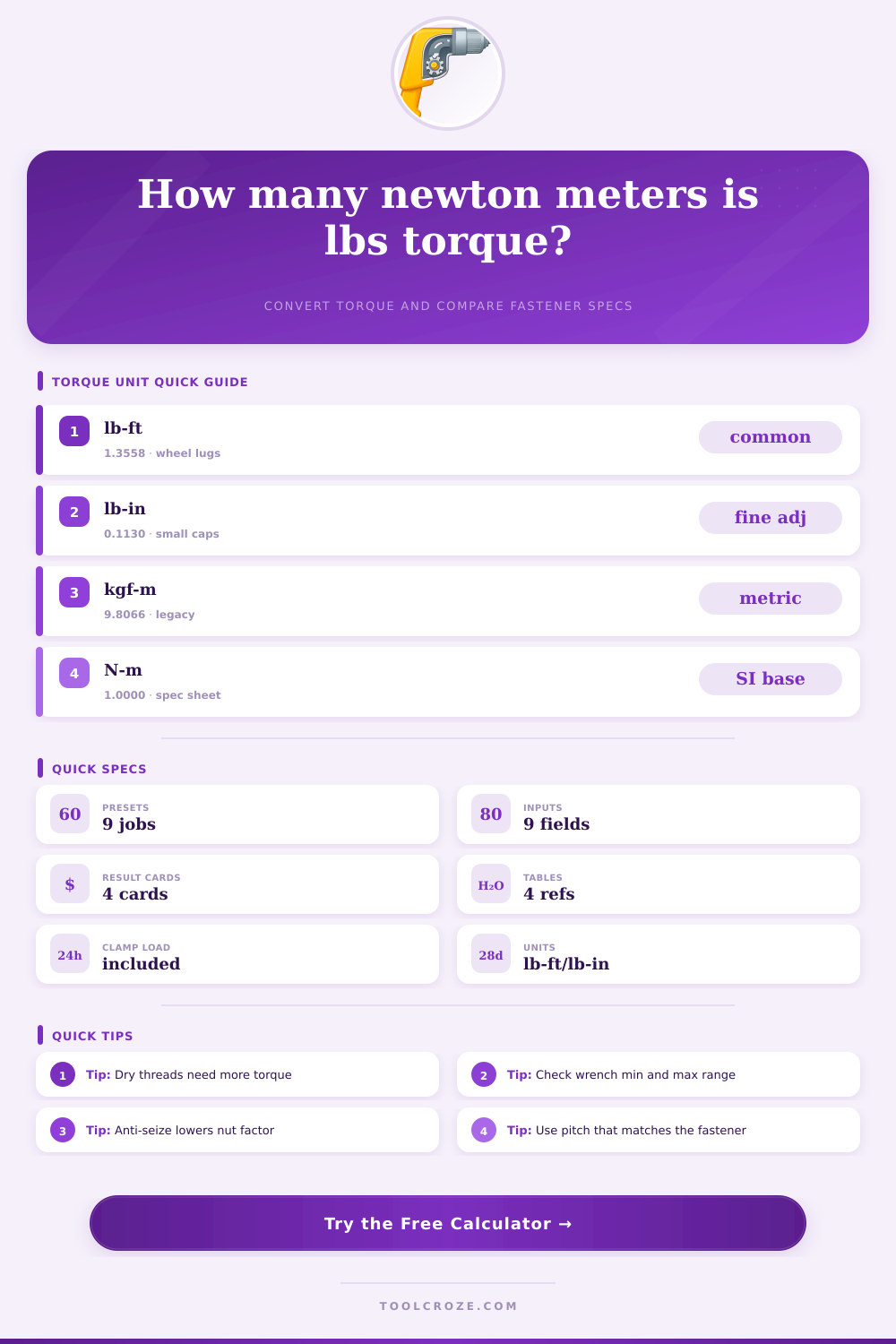
🔧 Lbs to Newton Meter Converter
Convert pound-based torque to newton meters, compare common fastening specs, estimate clamp load, and check whether your torque wrench range fits the job.
📌 Preset Torque Jobs
⚙ Torque Converter Setup
🎯 Conversion Results
📊 Grade and Material Snapshot
📑 Torque Reference Tables
| Unit pair | Multiplier | Example | Converted |
|---|---|---|---|
| lb-ft to N-m | 1.3558 | 75 lb-ft | 101.7 N-m |
| lb-in to N-m | 0.1130 | 120 lb-in | 13.6 N-m |
| N-m to lb-ft | 0.7376 | 40 N-m | 29.5 lb-ft |
| kgf-m to N-m | 9.8066 | 3.5 kgf-m | 34.3 N-m |
| Fastener | Thread | Typical torque | Use case |
|---|---|---|---|
| M6 A2-70 | 1.0 mm | 9-11 N-m | Stainless covers |
| M8 8.8 | 1.25 mm | 24-30 N-m | Machine guards |
| 3/8 in Grade 5 | 16 TPI | 31-35 lb-ft | Frame brackets |
| 1/2 in wheel stud | 20 TPI | 95-110 lb-ft | Passenger vehicles |
| Lubrication | Nut factor K | Clamp trend | Common note |
|---|---|---|---|
| Dry zinc | 0.20 | baseline | General assembly |
| Light oil | 0.18 | higher preload | Less friction scatter |
| Phosphate/oil | 0.17 | higher preload | Often used on structural bolts |
| Anti-seize | 0.15 | highest preload | Reduce applied torque |
| Wrench class | Working band | Drive | Best fit |
|---|---|---|---|
| Micro | 2-20 N-m | 1/4 in | Throttle bodies, plugs |
| Light service | 10-80 N-m | 1/4 or 3/8 in | Covers, clamps, stems |
| General service | 30-150 N-m | 3/8 in | Brackets, calipers |
| Heavy service | 80-300+ N-m | 1/2 or 3/4 in | Suspension, lugs |
📋 Material and Spec Comparison
SAE carbon steel
Higher proof stress than stainless in the same diameter.
Dry torque values are usually higher because K stays near 0.20.
Stainless assemblies
Lower proof stress and more galling sensitivity.
Use lower torque or lubricant-managed procedures when allowed.
Fine pitch threads
More tensile area for the same diameter and finer angle travel control.
Often chosen where vibration resistance or precise preload matters.
Coated structural bolts
Friction can vary widely with plating and wax topcoats.
Always match torque tables to the specified finish and washer stack.
💡 Shop Notes
This calculator converts lbs torque to newton meters and adds clamp-load, pitch-travel, and wrench-range checks so you can compare service specs before tightening threaded hardware.
Torque is the measurement of the rotational force that is applied to a fastener. The torque to a fastener are used to create the clamp load that is placed within a joint. Clamp load is the force that holds two part of a joint together, and clamp load is the result of the tightening of a bolt or nut.
If the incorrect amount of torque is applied to a bolt or nut, the fastener can become too loose or too tight. If a fastener is too loose, the joint can fail. Additionally, if a fastener is too tight, the threads may strip or the bolt may break.
What Torque Is and What Affects It
Torque can be expressed in a variety of units of measurement. For instance, you can use both the units of pound-feet (lb-ft) and newton meters (N-m) to express torque. Most service manuals will use pound-feet to express the required torque for a component.
However, many torque wrench will be calibrated in newton meters. To convert pound-feet to newton meters, you can multiply the value in pound-feet by the factor of 1.356. Thus, if the spec for a bolt is 100 lb-ft, you would multiply that value by 1.356 to determine the amount of newton meters that should be applied to the bolt.
Because there are different units for torque, it is essential to use a conversion factor between those units to ensure the proper amount of torque is applied to each bolt. Another of the factors that can impact the effect of torque is the friction between the threads of the bolt. The friction between the threads of a bolt is often represented by a coefficient known as the nut factor.
The coefficient of friction between dry threads will be more higher than the friction between lubricated threads. Thus, if a lubricant is applied to a bolt that is specified to be a dry bolt, the bolt will reach a higher clamp load than that which the manual intended. Consequently, if torque is applied to a dry bolt that is later lubricated, that bolt may become over-tightened.
Additionally, the grade of a bolt is another of the factors that impact the effect of the torque that is applied to that bolt. The grade of a bolt determines the maximum strength that the bolt can possess. For instance, bolts with an SAE Grade 5 or SAE Grade 8 will have different tensile strengths than other bolts of different grades.
If the torque that is applied to a bolt is too high for the maximum strength of that bolt grade, the bolt may be forced beyond its proof load. If the proof load of a bolt is exceeded, the bolt may stretch in a way that permanently alters its structure. Therefore, it is important to read the specification sheet for a bolt to ensure that the applied torque does not go beyond the maximum strength of the bolts grade.
Another of the factors that can impact the effect of torque is the thread pitch of the bolt. Thread pitch is the distance between threads on a bolt. Bolts with fine threads have a smaller distance between threads than bolts with coarse threads.
Additionally, the thread pitch impacts the distance that a bolt advances with each rotation of the bolt. Therefore, it is essential to understand the thread pitch of a bolt to ensure that the joint created with that bolt remains of consistent integrity. Finally, the type of torque wrench that is used will impact the accuracy of the torque that is applied to a bolt.
Torque wrenches are most accurately within their specified range. The range of a torque wrench is usually between 20 and 80 percent of the maximum torque that the wrench can handle. Therefore, using a wrench with a high maximum torque specification for tasks that require a relatively low amount of torque will impact the accuracy of the torque that is applied to the bolt.
Additionally, the size of the bolt that is being torqued also indicates which type of wrench should be utilized; using the wrong type of wrench will impact the accuracy of the torque that is applied to the bolt. Some of the most common error in the application of torque is not accounting for the differences in threads. For instance, the torque value that is specified for bolts with dry threads is applied to bolts that are lubricated with anti-seize or other lubricants.
Additionally, using an imperial torque wrench on a bolt with a metric specification without properly converting the units will also result in an incorrect torque value being applied to the bolt. Both of these types of errors can lead to the threads being stripped from the bolt. Thus, it is important to always account for the unit specifications, the lubrication requirements of the bolt, and the grade of the bolt.
Additionally, by following the specification sheet for each bolt and accounting for the factors of friction and units, the technician will be able to properly and safely apply the correct amount of torque to that bolt.