🧱 Grout Mix Ratio Calculator
Calculate exact water-to-powder ratios for sanded, unsanded, Portland cement, and custom grout mixes.
✅ Mix Results
📋 Mix Breakdown
| Grout Type | Powder Weight | Min Water | Ideal Water | Max Water |
|---|---|---|---|---|
| Sanded Grout | 5 lbs (2.27 kg) | 0.8 qt (0.76 L) | 1.0 qt (0.95 L) | 1.2 qt (1.14 L) |
| Sanded Grout | 10 lbs (4.54 kg) | 1.6 qt (1.51 L) | 2.0 qt (1.89 L) | 2.4 qt (2.27 L) |
| Unsanded Grout | 5 lbs (2.27 kg) | 0.75 qt (0.71 L) | 0.95 qt (0.90 L) | 1.15 qt (1.09 L) |
| Unsanded Grout | 10 lbs (4.54 kg) | 1.5 qt (1.42 L) | 1.9 qt (1.80 L) | 2.3 qt (2.18 L) |
| Portland Neat | 50 lbs (22.7 kg) | 4.6 qt (4.35 L) | 5.5 qt (5.20 L) | 6.4 qt (6.06 L) |
| 1:2 Cement:Sand | 50 lbs (22.7 kg) | 6.2 qt (5.87 L) | 7.2 qt (6.81 L) | 8.5 qt (8.04 L) |
| Non-Shrink Grout | 50 lbs (22.7 kg) | 4.8 qt (4.54 L) | 6.0 qt (5.68 L) | 7.5 qt (7.10 L) |
| W/P Ratio Range | Consistency | Application Method | Typical Use |
|---|---|---|---|
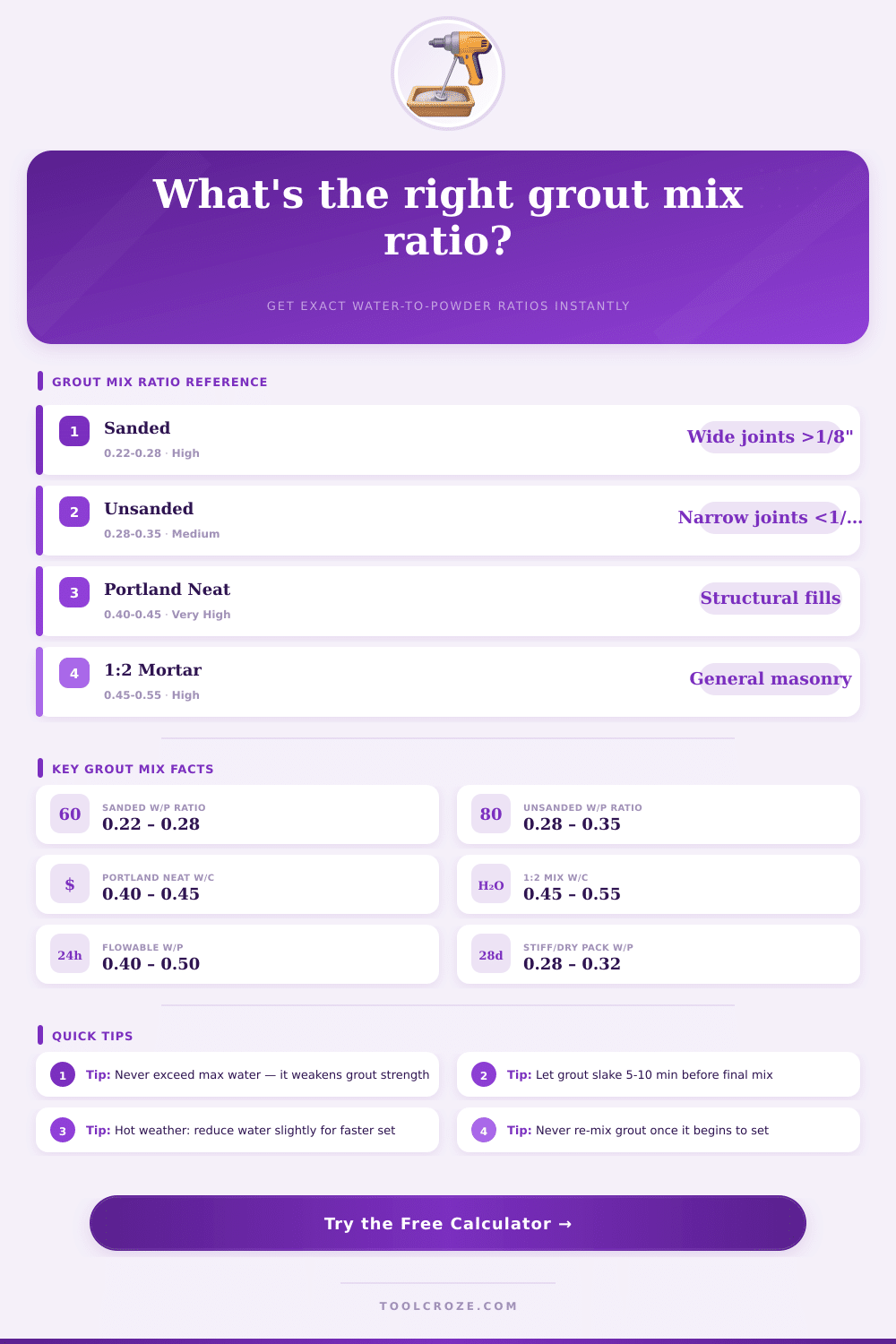
| 0.28 - 0.32 | Stiff / Dry Pack | Hand tamped, packed | Vertical joints, structural fills |
| 0.32 - 0.40 | Normal / Plastic | Float or rubber grout float | Standard tile joints, floor grout |
| 0.40 - 0.50 | Flowable / Fluid | Poured or pumped | Post-tension anchors, self-leveling |
| > 0.50 | Highly Fluid | Pumped under pressure | Specialized industrial only |
| Temperature Range | Water Adjustment | Setting Time Effect | Notes |
|---|---|---|---|
| Cold (<50°F / <10°C) | +2 to 3% more water | Sets 20-40% slower | Use warm water; protect from freezing |
| Normal (50-80°F / 10-27°C) | No adjustment | Standard setting time | Ideal conditions for grouting |
| Hot (>80°F / >27°C) | -2 to 3% less water | Sets 15-30% faster | Mix smaller batches; shade the work area |
| Very Hot (>95°F / >35°C) | -4 to 5% less water | Sets 40-50% faster | Use chilled water; work in early morning |
Correct the proportion of grout mix is really important. If you add too much water, it weakens the grout and can cause shrinking or little splits. Also, too little water makes the mix hard to work with, and it will not cover spaces well.
Using the right proportion helps the grout reach the wanted strength, easy working and lasting.
How to Mix Grout Right
A common starting spot is one part water to three parts grout powder. Pour the water in the powder step by step, while you mix to escape lumps. The final mix should have smooth consistency, be easily spread and stay in its form without flowing.
A proportion of 3:1 for grout and water by volume works well, when you mix less than a whole bag.
Different types of products need different proportions, so always look first at the instructions of the maker. Usually, around two quarters of water work for 25 pounds of powder grout. Some products say five cups of fresh water for a 25 pound bag of grout with sand.
Add the grout in the water slowly, do not toss it all at once. If you pour too much powder fast, clumpy grout stays at teh bottom of the bucket.
Weigh the powder and the water to ensure the best results. Typical weight proportions range between 0.18 and 0.22, but it depends on the product. For instance, one kind uses a mix proportion of 5:1 by weight.
So, checking the bag or the data sheet is always a wise idea.
Saying this hear has real value. With the consistency of grout there is a lot of flexibility. It does not need to be perfectly precise.
Grout is based on cement with some added stuff for more flexibility. Unless the mix becomes too liquid because of too much water, it is hard to mess up seriously. Even so, wrong proportions can still lead to weak structure or rough working.
When grout is too thin, problems come after. It does not set right. If it flows in the joints too easily, that shows that it is too liquid.
The grout should be fully filled in the joints. It firms up after a bit of time, so do not worry if it seems thick at first.
Start with a small amount. Mix only half or quarter of the grout powder first. Like this, if the proportions do not work, you can fix easily.
Working in small parts also stops the grout from drying too soon, especially on big areas. Wrong amounts of water weaken the mix and can cause the grout to fail later. The mixer should not spin more than 700 rpm, because most drills spin tooquickly to mix grout.
Use the right mixing tool with a paddle to make a big difference.