🪚 Bandsaw Blade Length Calculator
Calculate exact blade length for any bandsaw — 2-wheel or 3-wheel designs — in inches or millimeters
| Material | Blade Speed (SFPM) | Recommended TPI | Blade Width | Hook Angle |
|---|---|---|---|---|
| Softwood (Pine) | 2500–3000 | 2–4 | 1/4"–3/4" | 5–10° |
| Hardwood (Oak) | 1500–2500 | 3–6 | 1/4"–1" | 0–5° |
| Plywood | 2000–3000 | 4–6 | 1/4"–1/2" | 0–5° |
| MDF / Particle Board | 1500–2500 | 4–6 | 1/4"–1/2" | 0° |
| Aluminum | 2500–3000 | 6–14 | 1/4"–1/2" | 0–5° |
| Mild Steel | 100–200 | 14–24 | 1/4"–1/2" | 0° |
| Stainless Steel | 75–150 | 14–24 | 1/4"–1/2" | 0° |
| Acrylic / Plastic | 1500–2500 | 6–10 | 1/8"–1/2" | 0–5° |
| Blade Width | Kerf Width | Min Turn Radius | TPI Range | Best Use | Max Length (typical) |
|---|---|---|---|---|---|
| 1/8" (3mm) | 0.018" | 3/16" | 14–24 | Tight scrollwork | 105" |
| 3/16" (5mm) | 0.020" | 5/16" | 10–14 | Curves, inlays | 105" |
| 1/4" (6mm) | 0.025" | 5/8" | 6–10 | General curves | 125" |
| 3/8" (10mm) | 0.025" | 1-1/2" | 4–6 | General straight/curves | 145" |
| 1/2" (13mm) | 0.025" | 2-1/2" | 3–6 | Ripping, resawing | 160" |
| 3/4" (19mm) | 0.028" | 5" | 2–4 | Heavy resaw | 160" |
| 1" (25mm) | 0.030" | 7" | 2–3 | Industrial resaw | 200" |
| Saw Size | Wheel Dia. | C-to-C Dist. | Blade Length | Throat Depth | Best For |
|---|---|---|---|---|---|
| 9" Benchtop | 9" | 9" | 59.5" (1511mm) | 8.5" | Light hobby work |
| 10" Benchtop | 10" | 10.5" | 64" (1626mm) | 9.5" | Hobby & small shop |
| 12" Floor | 12" | 12.5" | 75" (1905mm) | 11.5" | Small shop general |
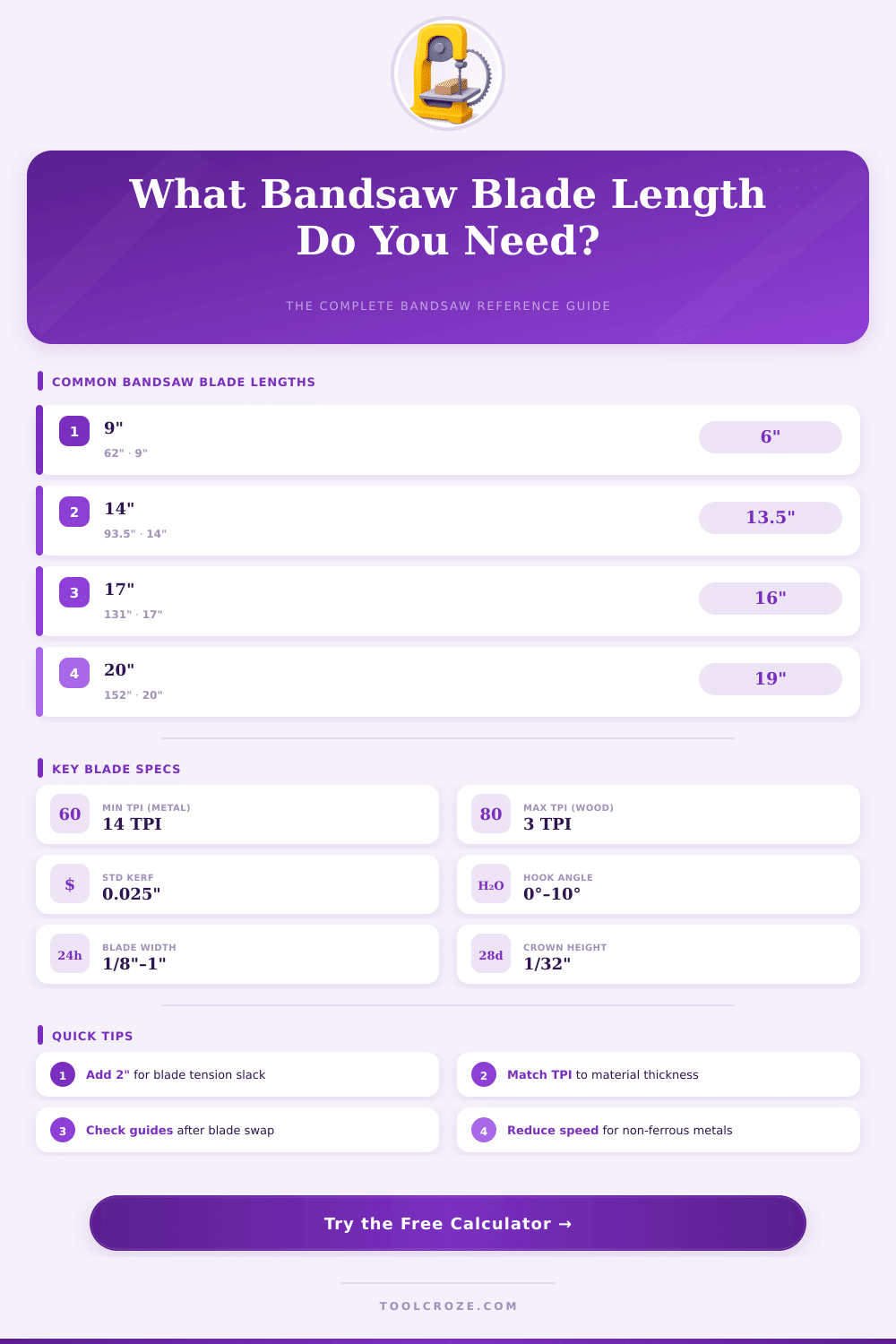
| 14" Floor | 14" | 14.5" | 93.5" (2375mm) | 13.5" | General woodworking |
| 17" Cabinet | 17" | 17.5" | 115" (2921mm) | 16.5" | Resawing, furniture |
| 18" Industrial | 18" | 18.5" | 122" (3099mm) | 17.5" | Production resaw |
| 20" Industrial | 20" | 22" | 152" (3861mm) | 19.5" | Heavy industrial |
| 24" Industrial | 24" | 24" | 163" (4140mm) | 23.5" | Sawmill / lumber |
Get the right length of the bandsaw blade for a band saw is really important. The blades of such saws come in various lengths, widths, thicknesses and arrangements of teeth. So when you sort new replacement, know exactly the needed length.
The simplest way to find it without a machine is to use the net to find a tool on a page for order blades.
How to Find the Right Bandsaw Blade Length
Also it is possible to measure by hand. First take the distance between the centres of the wheels of the band saw, when they are fully stretched. Later add the diameter of both wheels and multiply by 3.14 to find the whole length of the blade.
The formula says: the length of the blade matches the way around the first wheel plus that of the second, what is radius of the first times 3.1416 plus radius of the second times 3.1416, plus twice the distance between the centres. Here the total way around both wheels: it matches the way around one wheel, so diameter of the wheels times pi, plus double distance between the centres of the hubs.
A simple trick is to roll the used blade right on the floor. Mark the spot where it starts, roll it until the mark touches the floor again, and later measure between the two marks. Like this you find the length of the blade.
The lengths of blades differ according to the kind of machine. Typical sizes include 59½ inches, 70½, 72½, 99¾, 101½, 111, 125 and 145 inches. A bandsaw blade of 93½ inches works for almost every 14-inch two-piece cast band saw, that was produced.
A bandsaw blade of 143 inches suits for any 19-inch saw from all makers, while a 105-inch blade goes to some other standard sizes. Standards for band saws help, that the blades can swap between different brands.
Sometimes the listed lengths do not match with the reality. One band saw had a test blade, that measured 99¾ inches, not the 100 inches, that one said. Another manual mentioned 80 inches, but close measurement with a tight tape gave 81.5 inches.
In one manual of a saw even appeared too different lengths in various parts, while the label on the machine pointed to a third value.
The stretch leaves a bit of play room. Usually the range is one to two inches over and under the ideal length. Measuring the length of the stretch screw helps to count that range.
When the screw has four inches, the play room is around two inches. The centre of that range is the best for a good blade.
The size of the wheels of the saw also matters. For more small devices with wheels of 9 to 12 inches, one needs thinner blades, to avoid breaking of the welds. The width one can change on every saw, if the guides are wide enough.
For curved cuts, use a narrow blade, for instance of three eighth inches, for a radius of 50 mm. When one resaws, the widest blade, that the saw allows, is a good idea. If a machinestore is near, one can take big blade material to any needed length and weld it there.