⚡ Aluminum Wire Gauge Calculator
Find the correct AWG size for aluminum wiring — enter current load, run length & voltage to get instant wire sizing with voltage drop analysis
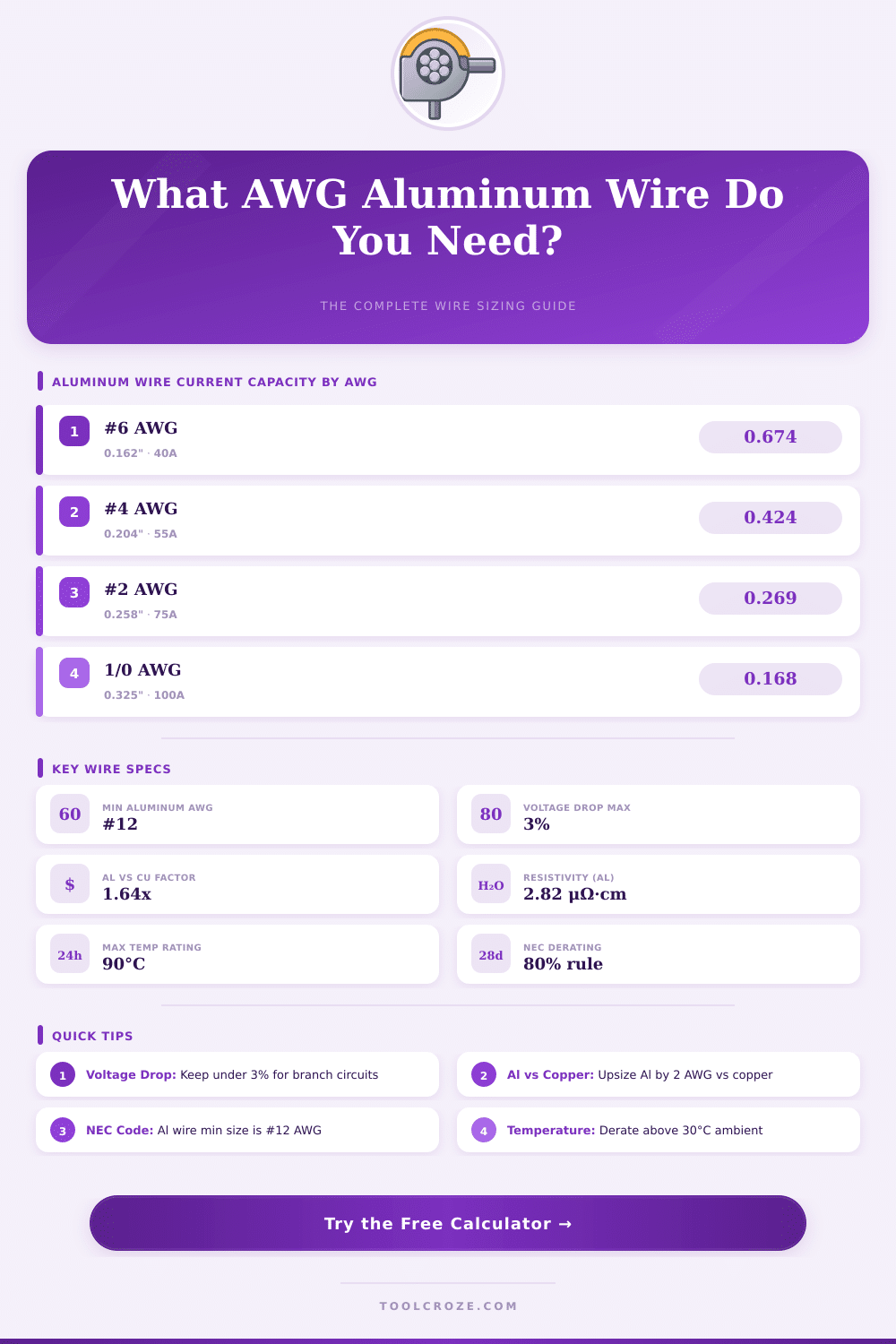
| AWG / kcmil | Diameter (in) | Area (mm²) | 60°C Amps | 75°C Amps | 90°C Amps | Resistance (Ω/kft) |
|---|---|---|---|---|---|---|
| #12 AWG | 0.0808" | 3.31 | 15A | 20A | 25A | 1.680 |
| #10 AWG | 0.1019" | 5.26 | 25A | 30A | 35A | 1.060 |
| #8 AWG | 0.1285" | 8.37 | 30A | 40A | 45A | 0.659 |
| #6 AWG | 0.1620" | 13.3 | 40A | 50A | 60A | 0.674 |
| #4 AWG | 0.2043" | 21.2 | 55A | 65A | 75A | 0.424 |
| #2 AWG | 0.2576" | 33.6 | 75A | 90A | 100A | 0.269 |
| #1 AWG | 0.2893" | 42.4 | 85A | 100A | 115A | 0.213 |
| 1/0 AWG | 0.3249" | 53.5 | 100A | 120A | 135A | 0.168 |
| 2/0 AWG | 0.3648" | 67.4 | 115A | 135A | 150A | 0.133 |
| 3/0 AWG | 0.4096" | 85.0 | 130A | 155A | 175A | 0.105 |
| 4/0 AWG | 0.4600" | 107.2 | 150A | 180A | 205A | 0.0836 |
| 250 kcmil | 0.5000" | 127 | 170A | 205A | 230A | 0.0708 |
| 350 kcmil | 0.5916" | 177 | 200A | 240A | 270A | 0.0505 |
| 500 kcmil | 0.7071" | 253 | 230A | 280A | 310A | 0.0354 |
| AWG | 30A / 50ft | 30A / 100ft | 60A / 50ft | 60A / 100ft | 100A / 100ft | 200A / 100ft |
|---|---|---|---|---|---|---|
| #6 AWG | 1.01% | 2.02% | 2.02% | 4.04% | — | — |
| #4 AWG | 0.64% | 1.27% | 1.27% | 2.54% | 4.24% | — |
| #2 AWG | 0.40% | 0.81% | 0.81% | 1.61% | 2.69% | — |
| 1/0 AWG | 0.25% | 0.50% | 0.50% | 1.01% | 1.68% | 3.36% |
| 2/0 AWG | — | — | 0.40% | 0.80% | 1.33% | 2.66% |
| 3/0 AWG | — | — | — | 0.63% | 1.05% | 2.10% |
| 4/0 AWG | — | — | — | 0.50% | 0.84% | 1.67% |
| Application | Typical Load | Min Al AWG (75°C) | Typical Run | Notes |
|---|---|---|---|---|
| 100A Service Entrance | 100A / 240V | 1/0 AWG | Up to 150ft | NEC 230.42 |
| 200A Main Service | 200A / 240V | 4/0 AWG | Up to 100ft | SER cable common |
| Sub-Panel Feeder 60A | 60A / 240V | #4 AWG | Up to 75ft | Min 2% V-drop |
| EV Charger 50A | 50A / 240V | #4 AWG | Up to 100ft | Continuous load x1.25 |
| Central AC 30-50A | 40A / 240V | #6 AWG | Up to 75ft | Check MCA on nameplate |
| Electric Dryer | 30A / 240V | #8 AWG | Up to 50ft | 4-wire NEC 2020 |
| Well Pump (1HP) | 15A / 240V | #10 AWG | Up to 150ft | Check V-drop for long runs |
| Barn / Outbuilding | 60-100A / 240V | #4 – 1/0 AWG | Up to 500ft | Size for V-drop not ampacity |
| 3-Phase 480V Panel | 100A / 480V | #2 AWG | Up to 200ft | THHN/THWN in conduit |
| Street Lighting Circuit | 20A / 120V | #8 AWG | Up to 200ft | Long run: size for V-drop |
AWG measures relate to the American Wire-Rating. One uses it as the usual way to estimate the thickness of solid or empty aluminum wire. When one mentions kinds of wires, CU shows copper, while TO points to aluminium.
It is useful to know about those ratings because they help to understand the weight of the wire, and that weight shows how much current the wire can safely last.
Aluminum and Copper Wire Sizes (AWG)
One tricky spot with ratings is, that the same number does not always mean the same thickness between different metals. For instance, 18th rating for steel wire reaches 0.0478 inches of thickness, but for aluminium it is only 0.0403 inches. From those differences it follows, that one must check the right table to ensure, that the metal matches the right sizes.
In home buildings aluminum wire almost does not show, except for big ratings of braided aluminum wire, those bigger than 8 AWG. One did not make small ratings of aluminium during many decades. Even so aluminium one uses daily for outside service wires, simply not for internal wiring.
Upper or underground service cables usually are aluminum. The main troubles with aluminium concern links, not the cable itself. If one uses the right fittings, problems should not happen.
Small ratings of aluminum wire suffer because of something called metal creep. Here is one reason, that 12th rating of aluminium works bad for home wiring. Also, copper and aluminum wire of same rating have the same physical weight, what makes it harder to install bigger aluminium threw walls.
Copper cable can be thinner than aluminum for equal ability to carry flow. For instance, 1/0 aluminium lasts almost as much flow as 2nd copper, however the aluminium has a cross area of 100.80 mm² rather than 33.60 mm² for the copper.
For 100-ampere main service, 2nd AWG aluminium must be the most small standard size. 8th rating of aluminum wire works for 40 amps with 75-degree insulation. On the other hand, 6th AWG aluminium only fits for 40-amp circuit, so it matters to check, that the breaker matches.
For an electrical vehicle charger rated at 11.5 kW, the smallest wire rating is 4 AWG for copper or 3 AWG for aluminium.
Figuring out the wire rating in a panel can be hard. Wires like 4, 6 and 8 ratings commonly mix, especially in old wiring or those with thick insulation. Special tools for checking wires, made for common metals or especially for copper and aluminium, work most well.
Using a gauge is probably the fastest and most reliable way to check. Some folks simply buy a stainless gauge strip and adapt it with a Dremel for thebigger sizes.
Aluminum wire is also used in fence targets. A roll of 250 feet of 17th rating aluminum wire with a shiny surface works well for guarding livestock. The thicker @12.5 rating wire shows less internal resistance, what delivers a stronger shock from the same charger.
For food uses, aluminum wire comes in ratings like 12 and 16, and it bends and shapes easily.