⚙️ Grinding Wheel Speed Calculator
Calculate safe RPM, surface speed (SFM/m/s), and operating limits for any grinding wheel size and material
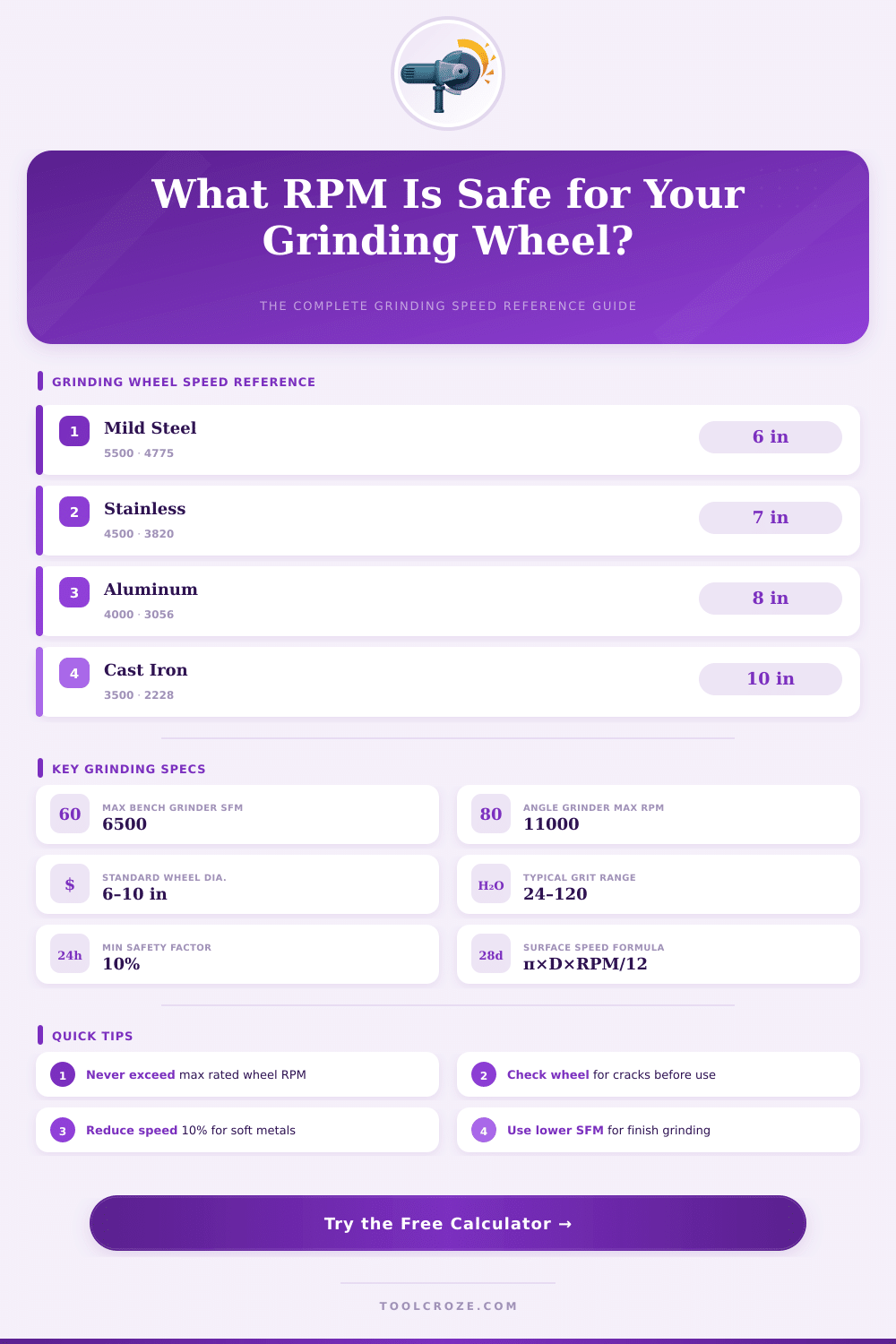
| Material | Rec. SFM | 6" Wheel RPM | 8" Wheel RPM | 10" Wheel RPM | Feed Rate (in/min) |
|---|---|---|---|---|---|
| Mild Steel | 4500–6500 | 2865–4138 | 2149–3103 | 1719–2483 | 0.5–2.0 |
| Tool Steel / HSS | 3500–5000 | 2228–3183 | 1671–2387 | 1337–1909 | 0.3–1.5 |
| Stainless Steel | 3500–5000 | 2228–3183 | 1671–2387 | 1337–1909 | 0.3–1.2 |
| Cast Iron | 3000–5000 | 1909–3183 | 1432–2387 | 1146–1909 | 0.4–1.8 |
| Aluminum | 4000–6000 | 2546–3820 | 1910–2865 | 1528–2292 | 0.5–3.0 |
| Titanium | 1500–3000 | 955–1910 | 716–1432 | 573–1146 | 0.1–0.5 |
| Carbide | 800–2000 | 509–1273 | 382–955 | 306–764 | 0.1–0.4 |
| Concrete / Masonry | 2500–4500 | 1592–2865 | 1194–2149 | 955–1719 | 0.5–2.5 |
| Wheel Size | Typical Max RPM | Max SFM | Grit Range | Best For | Grinder Type |
|---|---|---|---|---|---|
| 4.5" (115mm) | 13,300 | 15,700 | 24–120 | Steel, stainless | Angle grinder |
| 5" (125mm) | 12,200 | 16,000 | 24–120 | Steel, aluminum | Angle grinder |
| 6" (150mm) | 4,140 / 8,500 | 6,500 | 36–120 | Tool sharpening | Bench / angle |
| 7" (180mm) | 8,500 | 15,600 | 24–100 | Steel, masonry | Angle grinder |
| 8" (200mm) | 3,580 | 7,500 | 36–120 | General grinding | Bench / pedestal |
| 9" (230mm) | 6,600 | 15,700 | 16–80 | Heavy removal | Large angle grinder |
| 10" (250mm) | 2,870 | 7,500 | 36–120 | Precision grinding | Pedestal grinder |
| 12" (300mm) | 2,390 | 7,500 | 36–120 | Large workpieces | Surface grinder |
| Task | Wheel Size | Recommended RPM | Grit | Est. Time |
|---|---|---|---|---|
| Sharpen chisel / plane iron | 6" bench | 3,450 | 80–100 | 2–5 min |
| Dress weld on 1/4" plate | 4.5" angle | 11,000 | 36–60 | 1–3 min |
| Regrind twist drill bit | 6" bench | 3,450 | 60–80 | 3–8 min |
| Remove rust from steel | 4.5" flap | 9,000 | 40–60 | 2–10 min |
| Finish stainless weld | 7" angle | 6,500 | 80–120 | 3–8 min |
| Surface grind flat bar | 10" surface | 2,800 | 60–80 | 5–20 min |
| Grind carbide tool tip | 6" green | 3,450 | 80–120 | 5–15 min |
| Cut concrete joint | 9" diamond | 6,000 | N/A | 1–5 min/ft |
The speed of grinding wheel work is more important than what most folks imagine. Really there exist two different ways to consider it, and honestly, each of them measures different parts. RPM; so revolutions per minute, points how many full revolutions the wheel makes in 60 seconds.
Also, there is SFPM, which means surface feet per minute. This measures how far one grain of abrasive material truly moves along the surface of the wheel in that same time. Usually, the speed of grinding wheels is pointed by means of SFPM, while the label of your machine shows it in RPM.
How to Understand Grinding Wheel Speed
Here is the cause: each grinding wheel bears a maximum RPM rating printed directly on the label, and that value is not random. If you pass it, centrifugal forces start to build, which can lead to dangerous explosion. Recall that old story about the farmer, that kept expanding the speed of his grinder, believing that it would improve the results.
He kept turning it more and more quickly, until one day the grinding wheel simply burst while it worked. It killed him right away. So it does not matter to play with those limits, the label knows what it warns.
Changing between SFPM and RPM is not too difficult, when you know the formula. Simply multiply your RPM by 0.26, then multiply that result by the diameter of your wheel in inches. For instance, if your label shows 3400 RPM with a 7-inch wheel, you receive around 6188 SFPM.
If your surface speed stays at the bottom limit, you will see that clear red flame, and truly, you will need to add more presusre to reach any grinding progress.
The diameter of the wheel changes the whole calculation. At the same RPM, that smaller 4.5-inch wheel will reach clearly lower surface speed than a 7-inch, maybe even 33 percent more slowly. Here is useful advice: as your wheel wears over time, you can simply raise the RPM to keep the surface speed at the desired level.
For iron metals, experience points that a 6-inch wheel turning at 3450 RPM gives good results. An 8-inch wheel at that speed is a bit too fast, while a 10-inch at 1750 RPM becomes a bit too slow. Raise it to 3600 RPM, and sharply those 8-inch grinders seem too strong for most tasks, but 6-inch ones stay almost fine.
When you work with high speed steel and want to avoid damage from heat, slow grinders at around 1350 RPM help too protect the knives against overheating.
When you reach 8500 SFPM, usually one chooses a grinding wheel with organic bond for safety, although some new glass bonds can handle such speeds today. For cylindrical tool milling, the wheels best work in three separate speed ranges: between 5500 and 6500 SFPM, then at 8500 SFPM, and finally around 12000 SFPM.
But speed only forms part of the story. The size of grains, the makeup of the bond, the grade of hardness, the type of cooling liquid and the material that you grind, everything plays a big role in the final surface quality. The grade of the wheel, from A at the soft end until Z at the hard end, affects everything, from the maximum turning speed to the need of cooling flow, the feed rate and the cut depth.
Matchingtogether the speeds of your bit and wheel is key for good surface quality and accuracy.