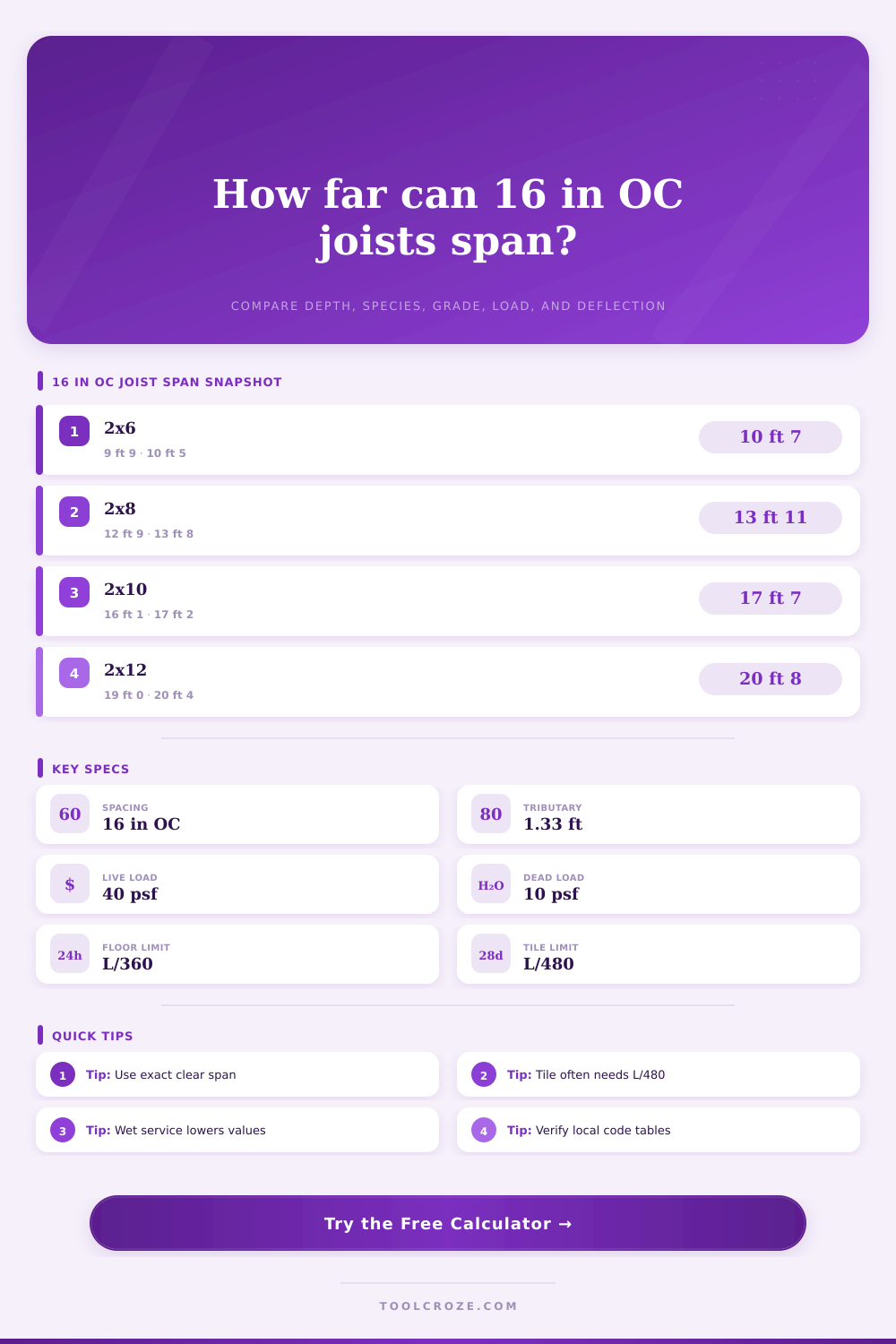
Estimate 16 in OC joist span table values from species, grade, joist depth, live load, dead load, deflection limit, and tributary width.
⚙Span Table Inputs
16 in OC equals 1.333 ft tributary width per joist.
Design values are approximate reference inputs for comparison.
Use clear span between supports, not total board length.
Enter 16 for standard 16 on center layout.
Optional allowance for a tub, island, safe, or concentrated item.
Calculated 16 in OC Span Table Result
📊Material and Spec Comparison
16 in
Default OC spacing
1.333 ft
Tributary width
L/360
Common floor limit
40+10
Typical floor psf
📐Reference Span Tables
Joist size
SPF #2
Hem-Fir #2
DFL #2
Southern Pine #2
2x6 at 16 in OC
9 ft 9 in
9 ft 6 in
10 ft 5 in
10 ft 7 in
2x8 at 16 in OC
12 ft 9 in
12 ft 6 in
13 ft 8 in
13 ft 11 in
2x10 at 16 in OC
16 ft 1 in
15 ft 8 in
17 ft 2 in
17 ft 7 in
2x12 at 16 in OC
19 ft 0 in
18 ft 6 in
20 ft 4 in
20 ft 8 in
🌲Species Design Value Table
Species and grade
Fb bending
E stiffness
Fv shear
Fc perp
SPF #2
875 psi
1.4 Mpsi
135 psi
425 psi
Hem-Fir #2
850 psi
1.3 Mpsi
150 psi
405 psi
DFL #2
900 psi
1.6 Mpsi
180 psi
625 psi
Southern Pine #2
1100 psi
1.6 Mpsi
175 psi
565 psi
DFL Select Structural
1500 psi
1.9 Mpsi
180 psi
625 psi
⚖Load and Deflection Reference
Use case
Live load
Dead load
Deflection
Notes
Bedroom or living area
40 psf
10 psf
L/360
Common residential floor
Tile bathroom
40 psf
15 psf
L/480
Stiffer finish check
Sleeping attic storage
30 psf
10 psf
L/360
Use local attic rules
Ceiling joist only
20 psf
5 psf
L/240
Not a floor rating
Balcony or assembly
60 psf
10 psf
L/360
Higher live load
📏Joist Depth Section Properties
Nominal size
Actual size
Section modulus
Moment of inertia
Typical role
2x6
1.5 x 5.5 in
7.56 in³
20.8 in⁴
Short spans, ceilings
2x8
1.5 x 7.25 in
13.14 in³
47.6 in⁴
Decks, small rooms
2x10
1.5 x 9.25 in
21.39 in³
98.9 in⁴
Common floors
2x12
1.5 x 11.25 in
31.64 in³
178.0 in⁴
Longer floor spans
Span table tip: A 16 in OC joist carries a 16 inch tributary strip. Changing spacing changes line load directly, so a 12 in layout can span farther and a 24 in layout usually spans less.
Deflection tip: Strength may pass while stiffness controls. For tile, stone, plaster, or sensitive finishes, compare the L/480 or L/720 result before choosing a joist depth.
Always verify final joist spans with local building code span tables or a qualified design professional. Do not cut, notch, drill, or overload joists beyond approved structural limits.
' + unit + '
';
}
function breakRow(label, value) {
return '
' + label + '' + value + '
';
}
function governingName(values) {
var min = values[0].value;
var name = values[0].name;
var i = 0;
for (i = 1; i < values.length; i = i + 1) {
if (values[i].value < min) {
min = values[i].value;
name = values[i].name;
}
}
return name;
}
function tcjCalculate() {
var input = readInputs();
var wood = species[input.speciesKey];
var size = sizes[input.sizeKey];
var width = size.b;
var depth = size.d;
var sectionModulus = width * depth * depth / 6;
var inertia = width * Math.pow(depth, 3) / 12;
var area = width * depth;
var tribFt = input.spacing / 12;
var livePlf = input.live * tribFt;
var deadPlf = input.dead * tribFt;
var totalPlf = livePlf + deadPlf;
var fbAdj = wood.fb * input.repetitive * input.wet * input.duration;
var fvAdj = wood.fv * input.wet * input.duration;
var fcAdj = wood.fc * input.wet;
var requestedSpan = input.span;
var momentFtLb = totalPlf * requestedSpan * requestedSpan / 8 + input.point * requestedSpan / 4;
var bendingStress = momentFtLb * 12 / sectionModulus;
var liveDeflection = uniformDeflection(livePlf, requestedSpan, wood.e, inertia);
var totalDeflection = uniformDeflection(totalPlf, requestedSpan, wood.e, inertia) + pointDeflection(input.point, requestedSpan, wood.e, inertia);
var livePointDeflection = pointDeflection(input.point, requestedSpan, wood.e, inertia);
var allowableDeflection = requestedSpan * 12 / input.deflection;
var reaction = totalPlf * requestedSpan / 2 + input.point / 2;
var shearStress = 1.5 * reaction / area;
var bearingStress = reaction / (width * input.bearing);
var bendingSpan = solveUniformPointSpan(fbAdj, sectionModulus, totalPlf, input.point);
var deflectionSpan = solveDeflectionSpan(wood.e, inertia, livePlf, input.point, input.deflection);
var shearSpan = 0;
var bearingSpan = 0;
var governingSpan = 0;
var utilization = 0;
var liveLimitFromBending = 0;
var liveLimitFromDeflection = 0;
var liveLimit = 0;
var status = '';
var govern = '';
var html = '';
if (totalPlf <= 0) {
totalPlf = 0.1;
}
shearSpan = ((fvAdj * area / 1.5) - input.point / 2) * 2 / totalPlf;
bearingSpan = ((fcAdj * width * input.bearing) - input.point / 2) * 2 / totalPlf;
shearSpan = clamp(shearSpan, 0, 40);
bearingSpan = clamp(bearingSpan, 0, 40);
governingSpan = Math.min(bendingSpan, deflectionSpan, shearSpan, bearingSpan);
govern = governingName([
{ name: 'bending stress', value: bendingSpan },
{ name: 'live-load deflection', value: deflectionSpan },
{ name: 'joist shear', value: shearSpan },
{ name: 'end bearing', value: bearingSpan }
]);
utilization = requestedSpan / governingSpan * 100;
if (utilization <= 85) {
status = 'Pass margin';
} else if (utilization <= 100) {
status = 'Near limit';
} else {
status = 'Over span';
}
liveLimitFromBending = ((fbAdj * sectionModulus / 12 - input.point * requestedSpan / 4) * 8 / (requestedSpan * requestedSpan) - deadPlf) / tribFt;
liveLimitFromDeflection = ((allowableDeflection - livePointDeflection) * 384 * wood.e * inertia / (5 * Math.pow(requestedSpan * 12, 4)) * 12) / tribFt;
liveLimit = Math.min(liveLimitFromBending, liveLimitFromDeflection);
liveLimit = Math.max(0, liveLimit);
html = html + resultCard('Governing Span', spanLabel(governingSpan), 'controls by ' + govern);
html = html + resultCard('Requested Span Use', round(utilization, 0) + '%', status);
html = html + resultCard('Live Deflection', deflectionLabel(liveDeflection + livePointDeflection), 'limit ' + deflectionLabel(allowableDeflection));
html = html + resultCard('Line Load Per Joist', lineLoadLabel(totalPlf), 'live ' + lineLoadLabel(livePlf) + ' + dead ' + lineLoadLabel(deadPlf));
html = html + resultCard('Bending Stress', round(bendingStress, 0) + ' psi', 'allowable ' + round(fbAdj, 0) + ' psi');
html = html + resultCard('Allowable Live Load', loadAreaLabel(liveLimit), 'at requested span');
html = html + '
';
html = html + breakRow('Input span and spacing', lengthLabel(requestedSpan) + ' span at ' + bearingLabel(input.spacing) + ' OC');
html = html + breakRow('Tributary width', round(tribFt, 3) + ' ft per joist');
html = html + breakRow('Species, grade, and size', wood.name + ', ' + input.sizeKey + ' actual ' + width + ' x ' + depth + ' in');
html = html + breakRow('Section properties', 'S = ' + round(sectionModulus, 2) + ' in³, I = ' + round(inertia, 1) + ' in⁴');
html = html + breakRow('Adjusted values', 'Fb ' + round(fbAdj, 0) + ' psi, Fv ' + round(fvAdj, 0) + ' psi, Fc perp ' + round(fcAdj, 0) + ' psi');
html = html + breakRow('Bending span check', spanLabel(bendingSpan));
html = html + breakRow('Deflection span check', spanLabel(deflectionSpan) + ' at L/' + input.deflection);
html = html + breakRow('Shear and bearing spans', spanLabel(shearSpan) + ' shear, ' + spanLabel(bearingSpan) + ' bearing');
html = html + breakRow('End reaction and bearing stress', round(reaction, 0) + ' lb reaction, ' + round(bearingStress, 0) + ' psi bearing');
html = html + breakRow('Total-load deflection', deflectionLabel(totalDeflection) + ' under live + dead + point load');
html = html + '
Here’s the deal: You’re standing in an empty room, holding a pile of lumber in one hand and a tape measure in the other, wondering if these joists is really going to support floor. In this moment, intuition is often useless; physics never consults gut feelings. Enter span tables, which take complicated engineering ideas and convert them into a basic measurement (distance) so that you don’t have to guess whether your floor might sag by next winter. This website’s span table calculator uses deflection, depth, load, species and grade checks to transform that uncertainty into a clear yes/no answer regarding how well 16-inch on-center joist span will perform.
You need to know: Wood’s not all the same. Even two pieces that appear similar on hardware store shelf will behave differently, Southern pine won’t act like Spruce-Pine-Fir. That’s where the reference table on the page come in. It clearly shows how both grade and species affects the maximum allowable span. Because the modulus of elasticity is different for Hem-Fir vs. Douglas Fir-Larch, for example, a piece of DF-L can span a little farther than a piece of Hem-Fir at an equal depth. Why? Because stiffer wood resist bending better, so you can stretch further across a wider gap before you exceeds the deflection limit. It may seem like a small detail, but it makes a big difference in how complicated (and thus costly) your framing lay-out needs to be.
Why Span Tables Are Important for Strong Floors
The same principles apply when calculating beam size. When using dimension lumber, width is less important than depth. That 2×10 will be dramatically stronger than a 2×8 because it contains more wood… Yes, but also because that extra depth shifts the material away from the neutral axis (a geometric advantage). As it gets taller it become exponentially stronger. If you’re thinking about creating an open floor plan or a large great room where there would be a long span between two adult-sized sofa, upgrading to a 2×12 may allow you to avoid installing secondary support beams down the middle of the area. Less obstructions under foot = more freedom with how you can decorate inside.
Many DIYers gets confused about the terms “dead load” and “live load,” but it’s simple if you just define the difference. Dead load refers to whatever the floor will carry all the time: the joists themselves, plus any drywall on the ceiling underneath, and the weight of the subfloor and the finish flooring. That never changes. What does change is live load: a bathtub full of water, someone walking across it, some furnitures moved around, a piano being played. For normal residential codes, live loads are frequently assumed to be 40 pounds per square foot in areas where people live. If you’re going to store big appliances or a library-full of books, that figure increase. Plug those figures into the tool, which does the math for you, ensuring the joist doesn’t bend or shear and fail under the combined stress.
Real comfort comes from deflection limits. Sure, the floor may be strong enough not to break when you walk on it, but if it’s bouncing like a trampoline… it’s still a bad floor. So there are codes: they say things like L/360 (which is what normal flooring requires) and L/480 (which is what tile or stone installs require). The reason is because tile is brittle. When the joist move too much, then the tile cracks. You can save some money by having really shallow joists that barely meet code strength requirements… and you’ll have a bouncy floor which unsets your guests and ruins your luxurios finishes. Oversizing for stiffness is better than undersizing for cost. You should of known that.
There’s also the issue of spacing. Typically, we build at 16 inches on center. This is the perfect balance between using as little material as possible while keeping our structures structurally sound. If we go to 24-inch centers, for example, we’ll save a bit of lumber. However, we’ll also create a much heavier load for every single joist to bear. We frequently have to beef up beams or dig deeper. Floors that want to be solid underfoot don’t usually compute when you space them out too much.
In all, constructing a home is a way of controlling these unseen forces. The bending moment, the shear stress, they’re not visible, yet when you mess up on one, you see what happens. Understand deflection limits, load types, and material stiffness, then check the span tables to make sure your floor stays flat, quiet, and safe. I’m glad I took the extra few minutes to measure twice. It’s peace of mind.
Hi, I am Thomas Martinez, the owner of ToolCroze.com! As a passionate DIY enthusiast and a firm believer in the power of quality tools, I created this platform to share my knowledge and experiences with fellow craftsmen and handywomen alike.