Thread Cutting Feed Per Rev Calculator
Calculate threading feed per revolution from pitch or TPI, including single-start and multi-start lead, feed per minute at RPM, travel allowance, pass count, and thread timing.
01Named threading presets
02Thread and lathe inputs
Thread feed and timing results
03Material and setup grid
04Named thread feed reference
| Thread preset | Pitch or TPI | Starts | Feed per rev | Typical RPM |
|---|---|---|---|---|
| M6 x 1.0 ISO | 1.0 mm pitch | 1 | 1.000 mm/rev | 180-350 |
| M10 x 1.5 ISO | 1.5 mm pitch | 1 | 1.500 mm/rev | 120-250 |
| 1/4-20 UNC | 20 TPI | 1 | 0.0500 in/rev | 180-400 |
| 1/2-13 UNC | 13 TPI | 1 | 0.0769 in/rev | 90-220 |
| 2-start 8 TPI | 8 TPI pitch | 2 | 0.2500 in/rev | 40-120 |
05Material threading spec grid
| Material | Starting RPM | Pass tendency | Relief guide | Feed note |
|---|---|---|---|---|
| Aluminum 6061 | 200-500 | Fewer passes | 1.5P-2P | Use clear chip space |
| Brass 360 | 180-450 | Medium passes | 1.5P-2P | Keep tool sharp |
| Mild steel 1018 | 120-300 | Medium passes | 2P-3P | Use cutting oil |
| 4140 alloy steel | 70-180 | More passes | 2P-3P | Reduce shoulder RPM |
| 304 stainless | 45-130 | More passes | 2P-4P | Avoid rubbing |
| Gray cast iron | 90-220 | Medium passes | 2P-3P | Dry or light oil |
06Thread form and depth references
| Thread form | Included angle | Approx radial depth | Compound angle | Use case |
|---|---|---|---|---|
| ISO metric | 60 degree | 0.6134 x pitch | 29-30 degree | General metric fasteners |
| Unified UNC/UNF | 60 degree | 0.6134 / TPI | 29-30 degree | Inch fasteners |
| Whitworth | 55 degree | 0.6403 x pitch | 27-28 degree | British form threads |
| ACME | 29 degree | 0.5000 x pitch | 14.5 degree | Power screws |
| Trapezoidal | 30 degree | 0.5000 x pitch | 15 degree | Metric power screws |
07Pitch and TPI conversion table
| Pitch mm | Approx TPI | Single-start lead | Two-start lead | Common note |
|---|---|---|---|---|
| 0.80 mm | 31.75 TPI | 0.0315 in | 0.0630 in | Small metric |
| 1.00 mm | 25.40 TPI | 0.0394 in | 0.0787 in | M6 coarse |
| 1.25 mm | 20.32 TPI | 0.0492 in | 0.0984 in | M8 coarse |
| 1.50 mm | 16.93 TPI | 0.0591 in | 0.1181 in | M10 coarse |
| 2.00 mm | 12.70 TPI | 0.0787 in | 0.1575 in | Large metric |
08Shop notes
Lathe Feed Calculator are a practical, handy tool that puts the right numbers in front of you to make lathe work easyer and safe. It calculates what you’ll actually turn and how far machine’s cutting tool move with each spindle rotation.
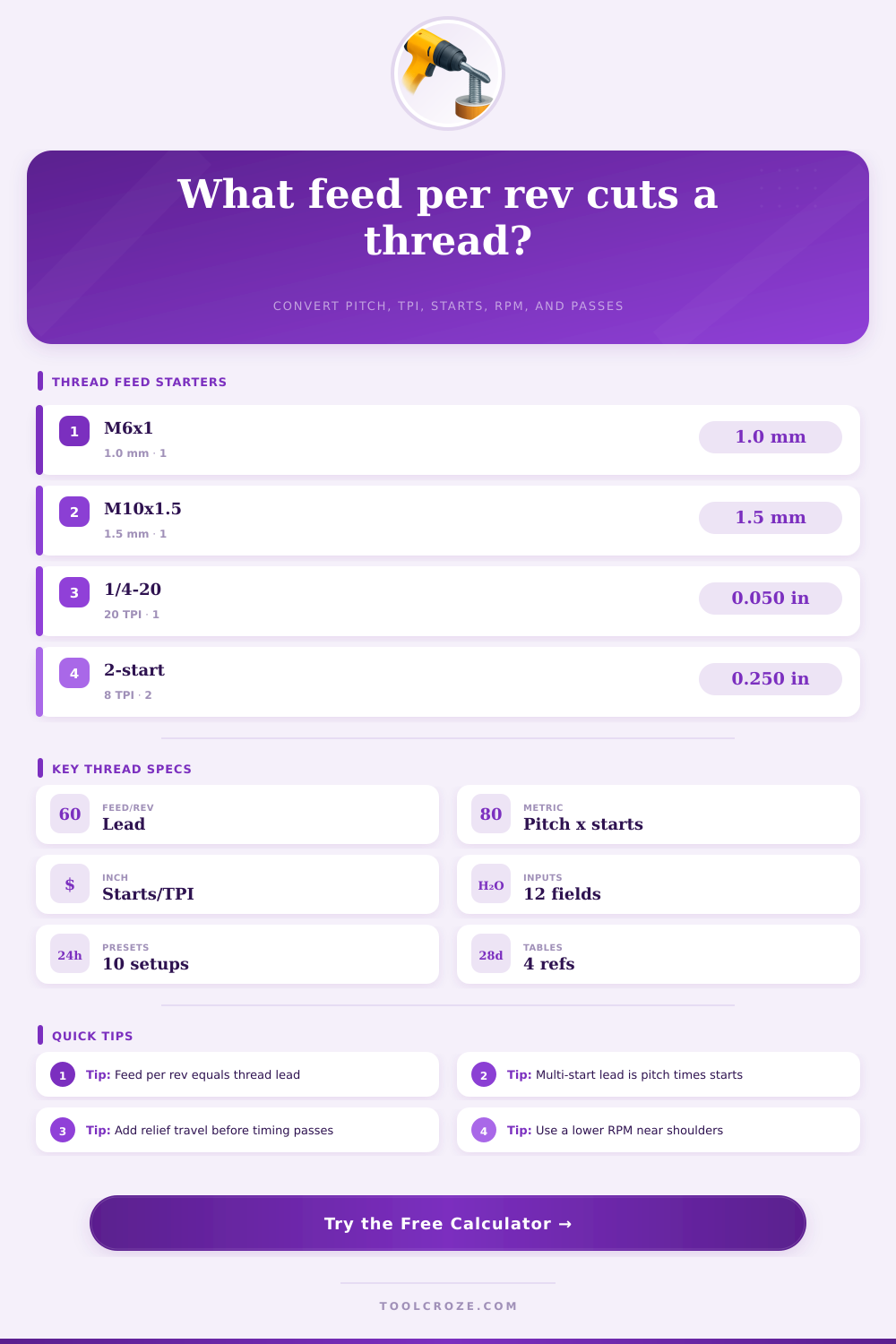
Get it right on feed per revolution and your threads is clean; get it wrong and you’re chasing it, ripping off its flanks, or heading for a shoulder crash. It’s simple. You can start with one thing: feed per rev equals pitch (1/TPI if you are thinking in English). With multiple starts, the lead increases rapidly because the tool must traverse each helix in one revolution. So an 8 TPI two-start thread require 0.250 inch of travel per revolution.
How Lathe Feed Calculators Help You Work Safer and Faster
The calculator will do your multiplying for you and also remind you that it’s the lead, not depth of cut that determine carriage speed. The other part of it is picking the appropriate spindle RPM. Go slower for smaller relief groove with harder material or if you have a lot of metal to remove in one pass. This ensures the tool clear out the chip before hitting runout. With softer alloys, you can speed things up until the material start heating up and work hardening surface.
Your material selector changes typical number of passes and suggested range based off this. 304 stainless doesn’t behave the same as 1018. These details make a difference if you’re running a batch of parts where consistent timing matter.
Another thing to watch out for is travel distance. Just cutting off the nominal doesn’t work. There must be an approach zone to get to full depth smoothly. There also need to be a relief groove on back side to clear the tool without leaving any step behind. Before you estimate how long the pass will take, add this distance. A spring pass require no infeed and is just finishing cut. It adds virtually nothing to depth but takes up seconds that add up over two dozen or five dozen parts.
The most common errors are due to overlooking impact of return time on overall cycle time estimates and confusing lead with pitch. For example, if you spend half as much time retracting, reversing, and re-engaging as you do for the actual cut, it double the total time for the job. Knowing that could of make all the difference when quantities rise and you decide to go with thread milling different than threading-in one set up.
Thread form also matter when feeding. For instance a 60 degree unified thread have a different chip load and radial depth than an Acme power screw. Those relationships is listed in the reference tables on the page, which allows for choosing target depths and picking compound angles without going to handbook each time.
It’s not so much about speed as it is about staying consistant. Get the feed per revolution dialed in right. Don’t exceed comfort zone of the material you’re cutting. Provide sufficient relief for the tool and let ‘er rip. All that adds up and your parts will match up every time. The carriage comes back around, the chip curls away cleanly, and you get into a rhythm. That rhythm is what has machinists coming back to lathe.