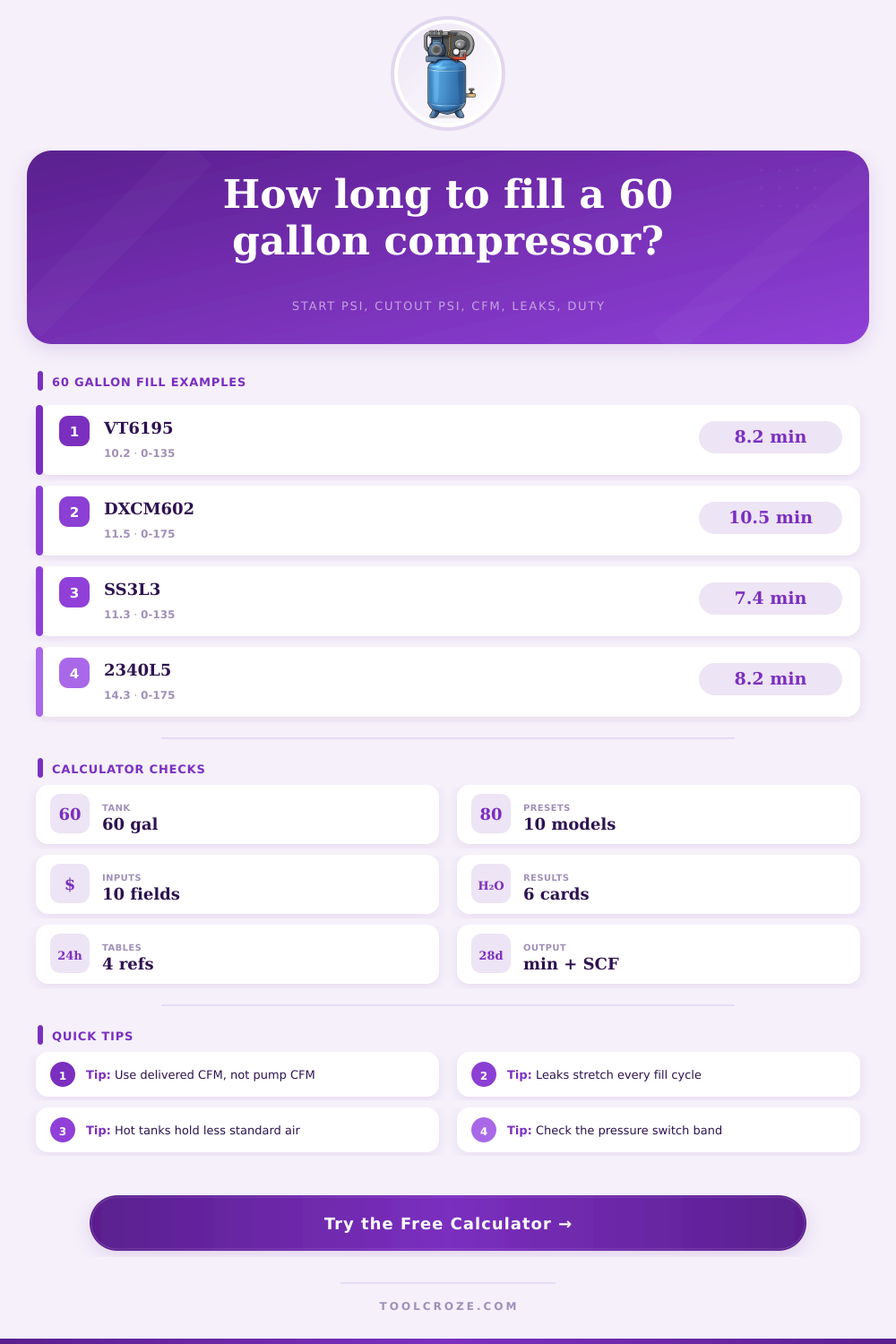
60 Gallon Compressor Fill Time Calculator
Estimate pump-up and recovery time for a 60 gallon shop compressor using start pressure, cutout pressure, delivered CFM, pump efficiency, temperature, leak rate, duty cycle, and recovery target.
▣ Real Compressor Presets
These presets use published delivered CFM and pressure ranges as starting points. Adjust efficiency, leaks, and duty to match the actual compressor condition.
⚙ Fill Time Inputs
▦ Compressor Spec Grid
☰ Reference Tables
Real 60 gallon compressor preset data
| Preset model | Tank | Delivered CFM basis | Max pressure | Default duty |
|---|---|---|---|---|
| Campbell Hausfeld VT6195 | 60 gal | 10.2 CFM at 90 PSI | 135 PSIG | 75% pump duty |
| Campbell Hausfeld VT6395 | 60 gal | 10.2 CFM at 90 PSI | 135 PSIG | 75% pump duty |
| Ingersoll Rand SS3L3 | 60 gal | 11.3 CFM at 90 PSI | 135 PSIG | 100% duty basis |
| Ingersoll Rand SS4L5 | 60 gal | 14.0 CFM at 90 PSI | 135 PSIG | 100% duty basis |
| Ingersoll Rand SS5L5 | 60 gal | 18.1 CFM at 90 PSI | 135 PSIG | 100% duty basis |
| Ingersoll Rand 2340L5 | 60 gal | 14.3 CFM at 90 PSI | 175 PSIG | 100% duty basis |
| Industrial Air ILA3606056 | 60 gal | 11.5 CFM at 90 PSI | 155 PSIG | 100% duty basis |
| DeWalt DXCM602 | 60 gal | 11.5 SCFM at 90 PSI | 175 PSIG | 75% shop basis |
| Husky C602H | 60 gal | 11.5 CFM at 90 PSI | 155 PSIG | 75% shop basis |
| Husky C603H | 60 gal | 11.5 CFM at 90 PSI | 175 PSIG | 75% shop basis |
Typical 60 gallon fill time by pressure band before leak adjustment
| Pressure band | SCF added at 60 gal | 10 CFM net | 12 CFM net | 15 CFM net |
|---|---|---|---|---|
| 0 to 120 PSIG | 65.4 SCF | 6.5 min | 5.5 min | 4.4 min |
| 0 to 135 PSIG | 73.6 SCF | 7.4 min | 6.1 min | 4.9 min |
| 0 to 155 PSIG | 84.5 SCF | 8.5 min | 7.0 min | 5.6 min |
| 0 to 175 PSIG | 95.4 SCF | 9.5 min | 8.0 min | 6.4 min |
| 110 to 135 PSIG | 13.6 SCF | 1.4 min | 1.1 min | 0.9 min |
| 135 to 175 PSIG | 21.8 SCF | 2.2 min | 1.8 min | 1.5 min |
Input adjustment guide
| Adjustment | Typical entry | What it changes | When to use it | Fill-time effect |
|---|---|---|---|---|
| Clean pump condition | 95% to 100% | Effective delivered CFM | New belt, clean filter, healthy valves | Shortest realistic fill |
| Older pump condition | 75% to 90% | Effective delivered CFM | Slow pump-up, dirty intake, worn rings | Longer fill time |
| Small system leak | 0.1 to 0.5 SCFM | Subtracts from fill rate | Normal couplers and drains | Minor but continuous delay |
| Noticeable leak | 1.0 to 3.0 SCFM | Subtracts from fill rate | Audible hiss or open auto drain | Large delay, may never reach cutout |
| Duty limit | 50% to 75% | Average pump output | Light-duty or hot-running compressor | Elapsed time increases |
Pressure and temperature correction notes
| Condition | Calculator handling | Practical read | Common symptom | Shop response |
|---|---|---|---|---|
| Average pressure above 90 PSI | Applies a pressure-taper factor | CFM often falls near cutout | Last 30 PSI is slower | Use measured high-pressure CFM if known |
| Hot 100°F receiver | Temperature factor reduces SCF stored | Fill may appear faster by pressure | Pressure drops after cooling | Retest after tank cools |
| Cold 40°F receiver | Temperature factor increases SCF stored | More standard air fits in tank | Motor may start harder | Use correct oil and voltage |
| Cut-in recovery test | Set start PSI to cut-in | Measures cycle recovery | Useful for tool pauses | Compare to tool idle time |
| Empty receiver test | Set start PSI to zero | Measures full pump-up | Good health benchmark | Record baseline after service |
ℹ Fill Time Tips
A 60-gallon receiver tank is used to stores compressed air, and a 60 gallon receiver tank can be use to power various tool. A 60 gallon receiver tank is large enough to power serious tools, yet it is small enough that the time that it takes to fill that tank becomes an important figure in those who uses various tools. It is important for individual to understand the various factors that can lead to change in the fill time for that 60 gallon receiver tank.
One of the main variable that can impact the time require to fill a 60 gallon receiver tank is the pressure within the tank. For instance, it will take longer to fill a 60 gallon receiver tank from 0 psi to 135 psi then it will take to fill that same tank from 110 psi to 135 psi. This is due to the effort that the compressor must exert in order to increase the pressure within the tank, and because the amount of air that is required to increase the pressure within the tank increase with the pressure level.
What Affects the Fill Time of a 60-Gallon Receiver Tank
By entering the start and cutout pressures for a 60 gallon receiver tank into a calculator, you can determine how the cutout settings will impact the output of the compressor. Another of the factor that can impact the amount of air that is contained within a 60 gallon receiver tank is the temperature within the tank. Because hot air is less dense than cold air, the same psi reading within a 60 gallon receiver tank will contain less cubic feet of air when that air is hot than it would contain if that tank were filled with cold air to the same psi reading.
Additionally, if the temperature within the tank drop, the pressure within that tank will drop with it. Therefore, it is important to consider the fact that temperature will impact the amount of air that is contained within a 60 gallon receiver tank. The fill time for a 60 gallon receiver tank can also be impacted by the leaks within the receiver tank, as well as the duty cycle of the compressor.
With regard to leaks within a 60 gallon receiver tank, air will continuously leave the tank, and the compressor will have to work to replace that lost air. Many compressor have a duty cycle, which represent the amount of time that the compressor must rest in order to avoid damage to the unit. If the duty cycle isnt respected, the compressor will lose some of its ability to output air into the receiver tank.
These factors can also be entered into the calculator for the tank to reflect the expected output of the compressor. The numbers that is calculated for a 60 gallon receiver tank will allow an individual to understand whether or not the compressor is capable of keeping up with the tools that are being use. If the compressor is not able to replace the air at the same rate that the tools are using that air from the 60 gallon receiver tank, the pressure will stall.
If the pressure in that tank rises slowly, the tools will have to be used with long periods of waiting until the air pressure increases to the level that the tools require. These calculator allow individuals to determine if any adjustment are required to the 60 gallon receiver tank and its components. Many individual make the mistake of the published CFM ratings for the tools or the compressor.
The CFM ratings published for tools are the amount of air that the tool can displace, but the amount of air that is actualy pushed out of the tool is less due to the fact that the air in the tool is hot, and the air is also forced to the tools at high rate of pressure. Therefore, it is necessary to estimate the amount of air that the tool will deliver, as opposed to the air that it can displace. Additionally, another factor to consider is the pressure-switch band.
A wide pressure switch band allow the compressor to rest for long periods, but also permits the air pressure within the 60 gallon receiver tank to drop to lower numbers before the compressor will start again. Conversely, if the pressure-switch band is narrow, the compressor will start more frequently, but the tank will take longer to fill each time. These factors can be considered within the calculations that are performed with the calculator.
The main goal of these calculations is to allow individuals to form an expectation as to how the 60 gallon receiver tank will perform. By calculating the time that it will take for the air tank to fill, individuals will be able to plan their work around that machine. By understanding the fill time for the 60 gallon receiver tank, the 60 gallon receiver tank can become a planning tool for those who rely upon it, and ensure that they dont have to wait for the 60 gallon receiver tank beyond their expectation.