⚡ 5V Wire Gauge Calculator
Find the correct AWG wire size for your 5V circuit based on current, run length, and allowable voltage drop
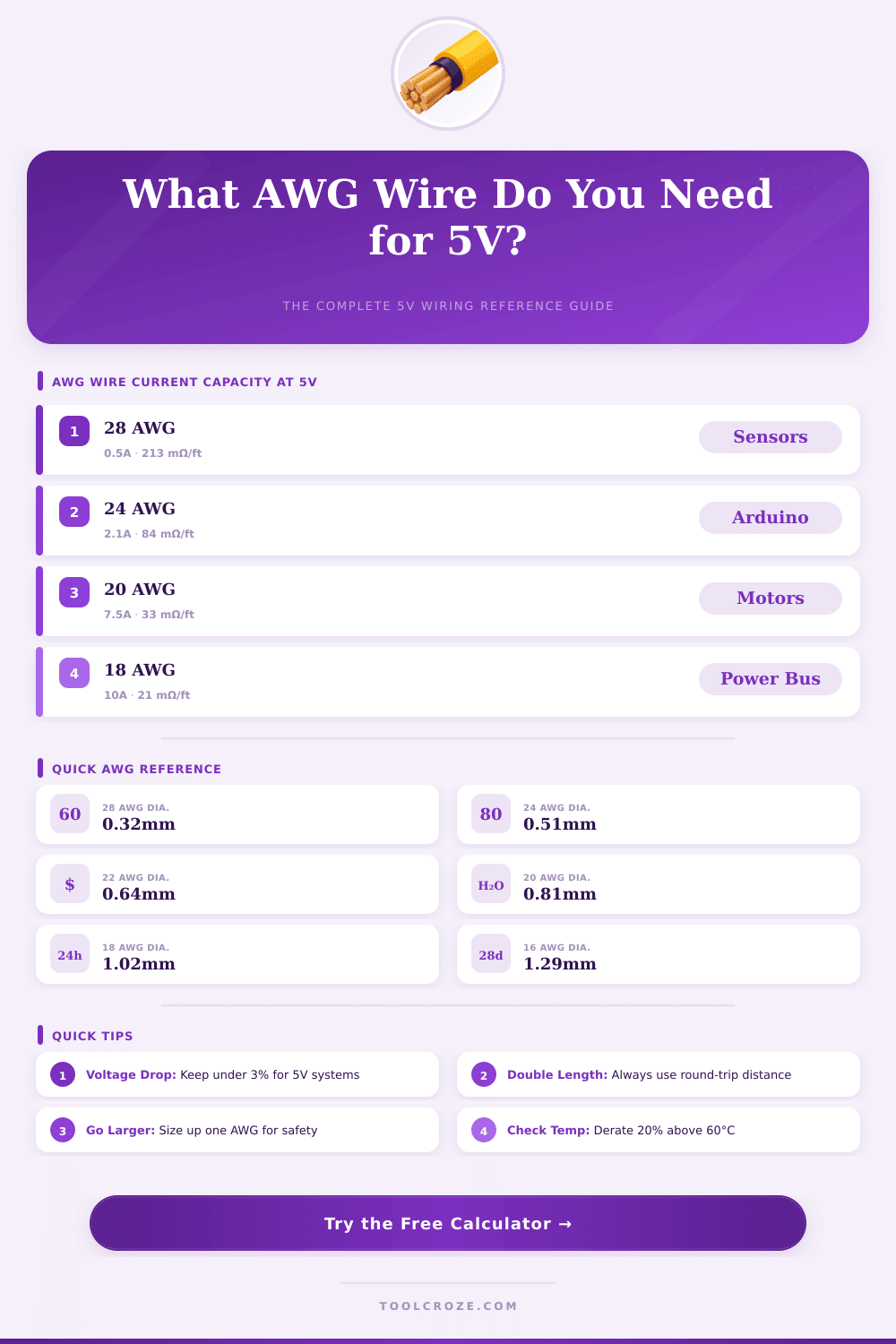
| AWG | Diameter (mm) | Area (mm²) | Resistance (mΩ/ft) | Resistance (mΩ/m) | Max Current (A) | Typical Use |
|---|---|---|---|---|---|---|
| 30 AWG | 0.255 | 0.051 | 103.2 | 338.6 | 0.14 | PCB traces, signals |
| 28 AWG | 0.321 | 0.081 | 64.9 | 213.0 | 0.50 | Sensors, signal wires |
| 26 AWG | 0.405 | 0.129 | 40.8 | 133.8 | 1.0 | Low-power devices |
| 24 AWG | 0.511 | 0.205 | 25.7 | 84.2 | 2.1 | Arduino, GPIO, sensors |
| 22 AWG | 0.644 | 0.326 | 16.2 | 53.1 | 3.0 | Servo motors, Raspberry Pi |
| 20 AWG | 0.812 | 0.518 | 10.15 | 33.3 | 7.5 | LED strips, DC motors |
| 18 AWG | 1.024 | 0.823 | 6.39 | 20.95 | 10.0 | Power distribution, fans |
| 16 AWG | 1.291 | 1.307 | 4.02 | 13.18 | 13.0 | High-current 5V bus |
| 14 AWG | 1.628 | 2.081 | 2.53 | 8.30 | 17.0 | Main power feed |
| 12 AWG | 2.053 | 3.309 | 1.59 | 5.21 | 20.0 | Heavy-duty power |
| AWG | 1A / 10ft | 2A / 10ft | 3A / 10ft | 1A / 20ft | 2A / 20ft | Drop % @2A/10ft |
|---|---|---|---|---|---|---|
| 28 AWG | 1.30V | 2.60V | 3.89V | 2.60V | 5.19V | 52.0% ❌ |
| 26 AWG | 0.82V | 1.63V | 2.45V | 1.63V | 3.26V | 32.6% ❌ |
| 24 AWG | 0.51V | 1.03V | 1.54V | 1.03V | 2.05V | 20.5% ❌ |
| 22 AWG | 0.32V | 0.65V | 0.97V | 0.65V | 1.29V | 13.0% ❌ |
| 20 AWG | 0.20V | 0.41V | 0.61V | 0.41V | 0.81V | 8.2% ⚠ |
| 18 AWG | 0.13V | 0.26V | 0.38V | 0.26V | 0.51V | 5.1% ⚠ |
| 16 AWG | 0.080V | 0.16V | 0.24V | 0.16V | 0.32V | 3.2% ✔ |
| 14 AWG | 0.051V | 0.10V | 0.15V | 0.10V | 0.20V | 2.0% ✔ |
| Conductor | Resistivity (Ω·m ×10⁻⁸) | Relative Conductivity | Temp Coefficient (/°C) | Notes |
|---|---|---|---|---|
| Copper | 1.724 | 100% | 0.00393 | Standard reference material |
| Tinned Copper | 1.741 | 99% | 0.00393 | +1% resistance, corrosion resistant |
| Silver-Plated Cu | 1.730 | 99.7% | 0.00390 | Better high-freq performance |
| Aluminum | 2.830 | 61% | 0.00410 | 64% more resistance than copper |
| Project | Typical Current | Typical Run | Recommended AWG | Voltage at Load |
|---|---|---|---|---|
| Arduino Uno | 0.05–0.2A | 1–3 ft | 26–28 AWG | 4.9–5.0V |
| Raspberry Pi 4 | 0.6–3A | 2–6 ft | 20–22 AWG | 4.85–5.0V |
| LED Strip (1m) | 1–3A | 3–10 ft | 20–22 AWG | 4.75–5.0V |
| 5V Servo (x4) | 2–4A | 2–5 ft | 18–20 AWG | 4.8–5.0V |
| USB Hub (active) | 2.5A | 3 ft | 20 AWG | 4.85V |
| 5V Cooling Fan | 0.2–0.5A | 5–15 ft | 24–26 AWG | 4.9–5.0V |
| IoT Sensor Node | 0.02–0.1A | 10–30 ft | 24–26 AWG | 4.9–5.0V |
| Small DC Motor | 0.5–2A | 3–8 ft | 22–24 AWG | 4.8–5.0V |
Election of the right wire thickness for drafts in 5 V can be hard. Because the voltage is low even little voltage drop does real harm. When the electricity flows through the wire, part of the voltage is lost because of the resistance of the material.
For instance, if the device requires 1 A in 5 V and the wire is 1 metre long, the total way indeed reaches 2 metres. According to the law of Ohm, the device will receive only around 4.9 V instead of the whole 5 V, because about 0.1 V disappear in the thin wire. That maybe does not seem big, but it adds up quickly.
How to Choose Wire Size for 5 V Power and LED Strips
For USB-type uses, where 5 V and 1 A are used, the lowest allowed voltage usually is 4.75 V. This leaves little space for mistakes. In bigger distances the problme grow. A run of 10 metres from the power source can require surprisingly thick wire.
Various calculators for wire thickness give different results, from 4 AWG to 10 AWG, according to the allowed voltage drop.
When dealing with LED-strips, the situation becomes interesting. A strip with 155 white LEDs at maximum brightness can use around 7.75 A in 5 V. In smart mode one doubles that current value during choice of wire, so search four something that lasts around 15.5 A. One commonly used system applies a MeanWell power supply with output wire joined to the start and to the finish of the LED-strip by means of spade-connections. That delivers energy from both spots and lowers the voltage drop through the whole strip.
Many users like 18 AWG wire for 5 V LED-drafts. It is almost the thickest that one can easily attach to LED-strips, and it bears enough electricity without problems in short runs. For loads at 3 A, 22 AWG wire works well for distances up to around 10 feet.
Even so 24 AWG is widely too thin for power lines. It lacks also mechanical strength and breaks easily.
In longer power wire, one can go to 12 AWG instead of 14 AWG, which lowers the resistance and the voltage drop. For short ties between controller and connection, or for small jobs, the resistance in tiny length does not matter a lot. Use of PTFE-coated wire works when one requires thin wire or expects high heats, because it lasts up to 200 °C.
The data signal wire on LED-strips bears only very little electricity, so the thickness does not matter a lot here. Using the same thickness as for the power wire is a perfectly good idea. For drafts like connecting a power supply to a servo controller, the 22 AWG wire of basic type works for most ties, but it does notsuffice for the main 5 V and basic wire.