
When I hear steel on concrete I don’t think of the noise, rather I think about a perfect circle becoming less so. What you may not be able to see with your eye you can measure based off calipers. Collets bridge the gap between imperfect stock and precision.
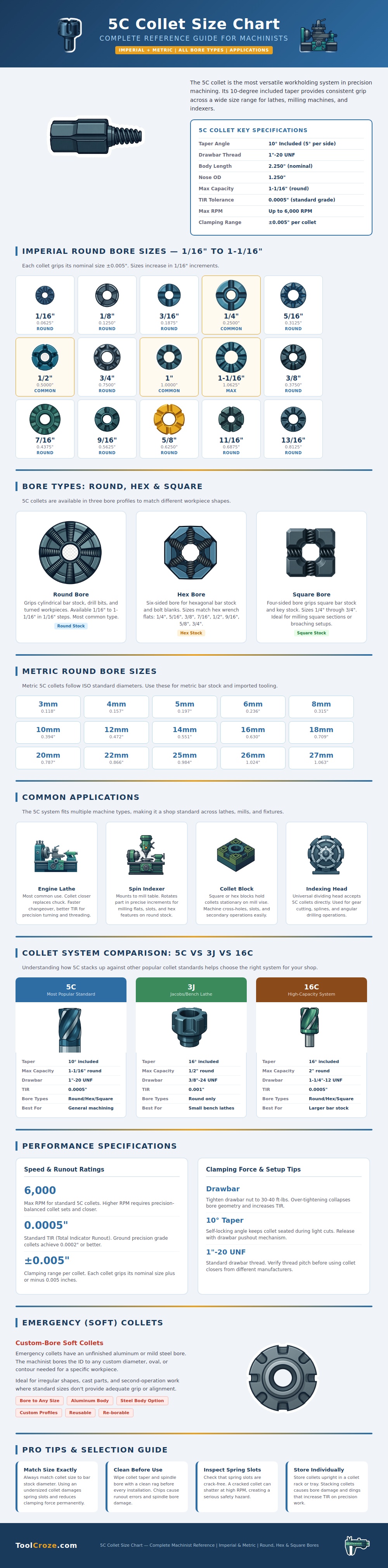
The 5C collet system do a good job of balancing accuracy with capacity. If you know the geometry you can use them for big bar stock or small pins. It’s shown in imperial standard sizes ranging from one-and-one-sixteenth inches down to a drill bit size of only sixteen-thousandths. Some sizes are marked as common. Why? Because some sizes tend to burn up quicker then others. They do so especially with quarter-inch and half-inch collets.
How Collets Help Make Parts Accurate
Keep in mind that these are ten degree included tapered collets. That ten degree taper provide an incredibly strong hold. No need to pull hard on the draw bar nut when cutting. Too much and you’ll actualy distort the bore rather than secure it tighter. A lot of folks does this thinking harder is better when gripping. But extra force ruins how the parts fits together.
For those wanting square or hex options, there are also ones available. These are particularly nice when drilling cross-holes or machining edges, as flat of wrench fits snugly into the hex collets to prevent your workpiece from rolling. Likewise, a square collet would be used if you need to hold something blocky like a piece of key stock.
Concentricity is really the winner here. Even if you have a three-jaw chuck that runs true on round stock, you may have an issue with squares, especially if you don’t own a soft jaw kit. When you use a square collet, all of the guesswork go away and you can count on immediate alignment. That makes things go a lot faster, which helps when making small batches.
For those who use metric, there’s a section of the chart where diameters increases by millimeters from three to twenty-seven. They adhere to the ISO standard, which is important when dealing with metric-based designs or tooling imports. Because the same external 5C interface stays the same, it’s easy to jump from imperial to metric; that’s why we see indexing heads, milling machines, and even engine lathes uses the same components.
With a six-millimeter collet being as easily swapped for a quarter-inch one on the same spindle, all you have to change is your fixture. And that’s what a spin indexer use in its ability to turn the part around exactly for multi sided machining jobs. Being able to reuse the hardware from machine-to-machine saves you money on spare parts since you don’t require separate systems for each one.
Runout is where theory meets reality. Where does vibration become a factor? It’s safe up to around six thousand RPM if you’re using a standard 5C collet with a balanced part. Beyond that, even if the collet grips the part perfectly, it will vibrate. Runout.
A grade for optical parts needs to have a total indicator runout tolerance lower than point-zero-zero-zero-five inches, which is very tight indeed for just plain old general machining. For these critical applications, you want one of more precise grades, ones that are made with lower tolerances.
Before installing make sure the spring slots aren’t cracked. Sometimes that can be a fine line you won’t see until you run it at high speed and watch the steel shatter. Keep them stored upright on a rack so you don’t ding up those fragil noses.
Another flexibility comes from emergency collets. With these, you have a body made of soft aluminum or mild steel with an unbored hole (unfinished) that you can machine to accommodate any irregular profile or odd-shaped casting. Create your own customized work holding solution on demand by boring it out, pressing the piece in for a tight fit, and going from there. It’s cost effective as opposed to having to special order fixtures and would of been reusable.
To select the correct size, choose collet size based off the stock and the tool being used. Stay within the limits of the hardware. Clean the taper between each operation. Do this properly and that dropped bar of steel becomes a precision part. So we’ve gone from chaos to order through proper workholding.
