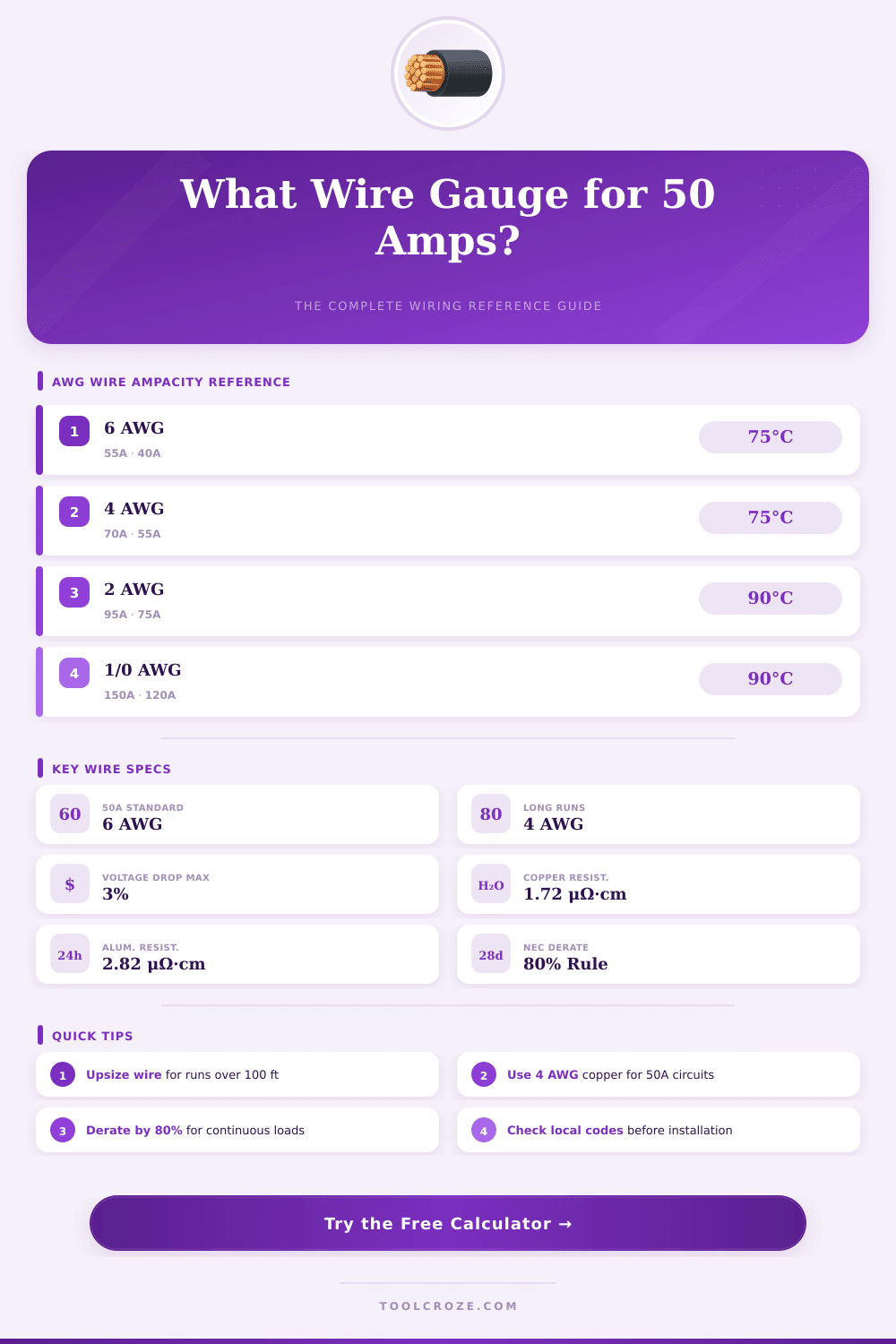
⚡ 50 Amp Wire Gauge Calculator
Find the correct AWG wire size for 50A circuits — accounts for run length, voltage drop, material & conduit fill
| AWG / kcmil | Copper 60°C (A) | Copper 75°C (A) | Copper 90°C (A) | Alum 75°C (A) | Resistance (Ω/1000ft) |
|---|---|---|---|---|---|
| 14 AWG | 15 | 20 | 25 | — | 3.14 |
| 12 AWG | 20 | 25 | 30 | 20 | 1.98 |
| 10 AWG | 30 | 35 | 40 | 30 | 1.24 |
| 8 AWG | 40 | 50 | 55 | 40 | 0.778 |
| 6 AWG | 55 | 65 | 75 | 50 | 0.491 |
| 4 AWG | 70 | 85 | 95 | 65 | 0.308 |
| 3 AWG | 85 | 100 | 115 | 75 | 0.245 |
| 2 AWG | 95 | 115 | 130 | 90 | 0.194 |
| 1 AWG | 110 | 130 | 145 | 100 | 0.154 |
| 1/0 AWG | 125 | 150 | 170 | 120 | 0.122 |
| 2/0 AWG | 145 | 175 | 195 | 135 | 0.0967 |
| 3/0 AWG | 165 | 200 | 225 | 155 | 0.0766 |
| 4/0 AWG | 195 | 230 | 260 | 180 | 0.0608 |
| 250 kcmil | 215 | 255 | 290 | 205 | 0.0515 |
| AWG | Diameter (in) | Diameter (mm) | Area (mm²) | Weight (lb/1000ft) | Common Uses |
|---|---|---|---|---|---|
| 10 AWG | 0.1019 | 2.588 | 5.26 | 31.4 | 30A branch circuits |
| 8 AWG | 0.1285 | 3.264 | 8.37 | 49.8 | 40A circuits, A/C units |
| 6 AWG | 0.162 | 4.115 | 13.3 | 79.5 | 50A ranges, dryers, EV |
| 4 AWG | 0.2043 | 5.189 | 21.2 | 126 | 50-70A, sub-panels |
| 2 AWG | 0.2576 | 6.544 | 33.6 | 200 | 95-115A services |
| 1/0 AWG | 0.3249 | 8.252 | 53.5 | 318 | 125-150A services |
| 2/0 AWG | 0.3648 | 9.266 | 67.4 | 401 | 150-175A services |
| 3/0 AWG | 0.4096 | 10.40 | 85.0 | 508 | 175-200A services |
| 4/0 AWG | 0.4600 | 11.68 | 107 | 641 | 200A main services |
| Application | Voltage | Typical Amps | Rec. Wire (Cu) | Rec. Wire (Al) | Breaker Size |
|---|---|---|---|---|---|
| Electric Range / Stove | 240V | 40–50A | 6 AWG | 4 AWG | 50A |
| EV Charger Level 2 | 240V | 32–50A | 6 AWG | 4 AWG | 50A |
| Hot Tub / Spa | 240V | 40–60A | 6 AWG | 4 AWG | 50A |
| Clothes Dryer | 240V | 24–30A | 10 AWG | 8 AWG | 30A |
| Sub-Panel Feed | 240V | 60–100A | 4 AWG | 2 AWG | 60–100A |
| Arc Welder 50A | 240V | 50A | 6 AWG | 4 AWG | 50A |
| Air Compressor (5hp) | 240V | 28A | 10 AWG | 8 AWG | 30A |
| Central A/C (5 ton) | 240V | 28–45A | 8 AWG | 6 AWG | 45–50A |
| RV Hookup 50A | 120/240V | 50A | 6 AWG | 4 AWG | 50A |
| Generator Interlock | 240V | 50A | 6 AWG | 4 AWG | 50A |
| Ambient Temp | 60°C Insulation | 75°C Insulation | 90°C Insulation | Wires in Conduit | Derating Factor |
|---|---|---|---|---|---|
| Up to 30°C (86°F) | 1.00 | 1.00 | 1.00 | 1–3 wires | 1.00 (100%) |
| 31–35°C (87–95°F) | 0.91 | 0.94 | 0.96 | 4–6 wires | 0.80 (80%) |
| 36–40°C (96–104°F) | 0.82 | 0.88 | 0.91 | 7–9 wires | 0.70 (70%) |
| 41–45°C (105–113°F) | 0.71 | 0.82 | 0.87 | 10–20 wires | 0.50 (50%) |
| 46–50°C (114–122°F) | 0.58 | 0.75 | 0.82 | 21–30 wires | 0.45 (45%) |
| 51–60°C (123–140°F) | 0.33 | 0.58 | 0.71 | 31+ wires | 0.40 (40%) |
Drat rating is the usual way, as we describe the size of wire. This word relates to the diameter or to the shape of the cross-section of the wire. Here commonly happens that folks get confused: bigger wire gauge indeed points to thinner wire, while smaller wire gauge shows that it is thicker.
It seems backwards at the start, but when you understand how the cables are genuinely made, everything fits together.
What Is Wire Gauge and Why It Matters
The system of ratings came directly from the process of making wires. One draws metal rod through a plate for pulling many times, and each time it exits a bit smaller (from cold material in slow steps). Every time when the wire narrows, that is another step of pulling, and more such steps give higher wire gauge.
The idea is fully tied to the production itself.
In United States one applies the American system of wire gauge ratings, or AWG, that was standard already by 1857. It is in use in all North America for electrical wires and cables, and the specifications stay in the standard ASTM B 258. Instead of simply saying “this wire is a quarter inch” or “5 millimeters“, AWG gives to every thickness its own number name.
It is simply a number shortcut, that avoids the need to measure by hand every time.
Why does the rating matter? It shows how much electricity the wire can carry without danger. The amount of copper or aluminium hear describes the story, bigger wire has more metal, so bigger ability for electricity.
If you push too much energy through too small wire, you risk burning insulation or even starting fire.
In practice one checks the thickness of wires by means of physical gauges, that is plates with slots around the edges, whether round or oval. One fits the wire in a slot, and there is a printed number that points to the size. There are also special tools for quickly checking it.
Some simply take a gauge and measure the diameter directly. For stranded wires one can count the total cross area and later check a table to find the rating.
The common sizes in AWG relate to copper wires, and the resistance changes a bit based on cleaning and mix, though one usually considers around 20 degrees Celsius as base. Other systems exist, the British used the Standard system of wire gauge ratings (SWG) for years, and metric units simply go by square millimeters of the cross area.
The drop of voltage relates directly to the wire gauge, and is well worth noting. Wire of 12-gauge in 40 feet only drops about 0.2 volts. But if one goes to thinner, the values grow quickly, 18-gauge jumps to around 0.81 volts, and 20-gauge reaches 1.2 volts.
The very thin wires that you find in USB-cables, commonly 28 AWG, have bigger resistance each foot, especially if theyare from steel instead of copper.