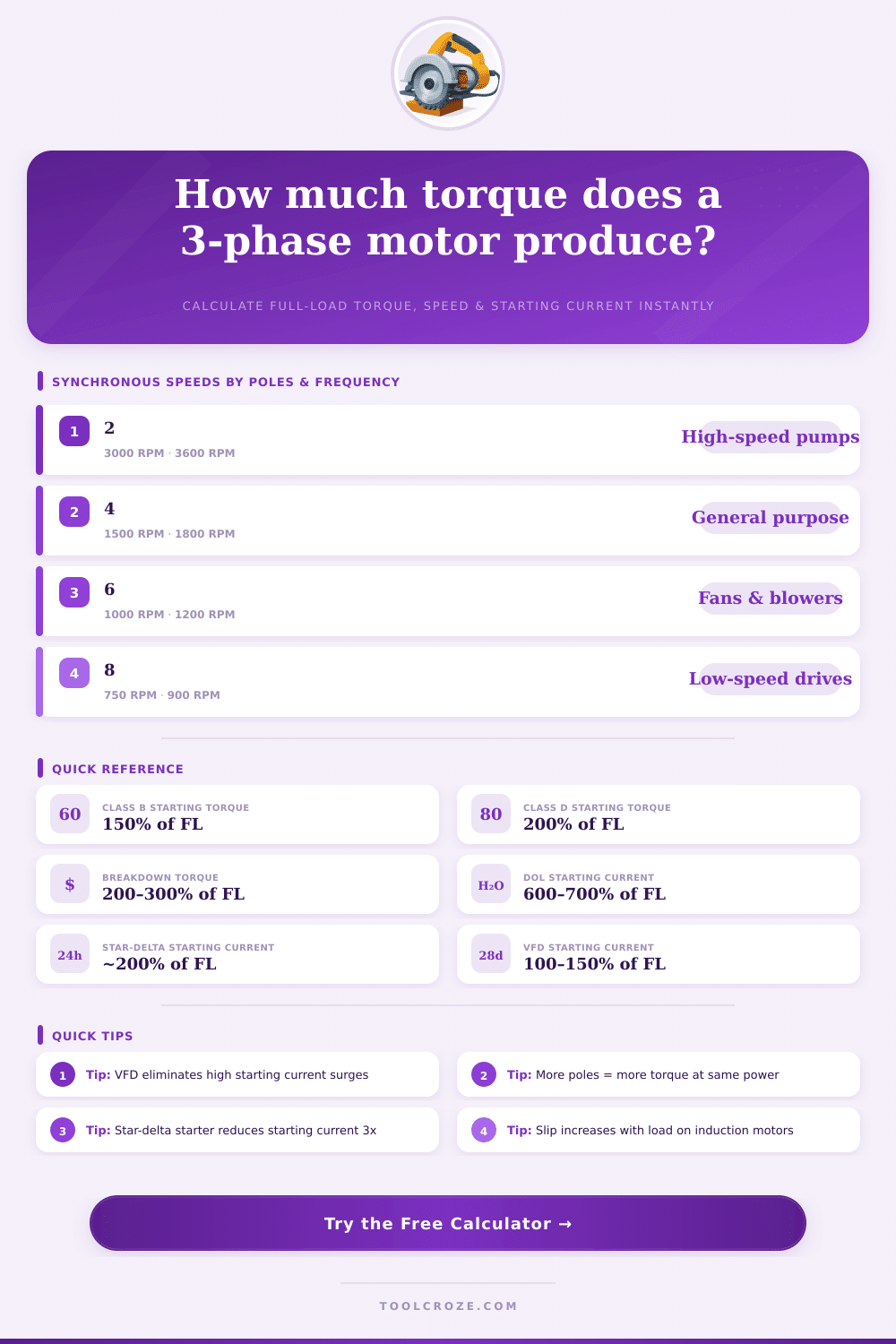
⚡ 3-Phase Motor Torque Calculator
Calculate full-load torque, speed, current & starting torque for 3-phase induction motors
| Poles | Sync Speed (50 Hz) | Sync Speed (60 Hz) | Typical Application |
|---|---|---|---|
| 2 | 3000 RPM | 3600 RPM | High-speed centrifugal pumps |
| 4 | 1500 RPM | 1800 RPM | General purpose, compressors |
| 6 | 1000 RPM | 1200 RPM | Fans, blowers, mixers |
| 8 | 750 RPM | 900 RPM | Conveyors, crushers |
| 10 | 600 RPM | 720 RPM | Low-speed applications |
| 12 | 500 RPM | 600 RPM | Gear drive replacements |
| Rating (hp) | Rating (kW) | Approx FL Current (A) | NEMA Frame Ref. |
|---|---|---|---|
| 1 hp | 0.75 kW | ~1.5 A | 143T |
| 5 hp | 3.7 kW | ~7.0 A | 184T |
| 10 hp | 7.5 kW | ~13 A | 213T |
| 25 hp | 18.6 kW | ~31 A | 256T |
| 50 hp | 37.3 kW | ~60 A | 326T |
| 100 hp | 74.6 kW | ~117 A | 405T |
| 200 hp | 149 kW | ~228 A | 447T |
| Starting Method | Starting Current | Starting Torque | Notes |
|---|---|---|---|
| Direct-On-Line (DOL) | 600–700% FL | 100–200% FL | Simple, high current surge |
| Star-Delta (Y-Δ) | ~200% FL | ~33% of DOL torque | Reduces current 3x; needs delta-rated motor |
| Variable Frequency Drive | 100–150% FL | 100–150% FL | Best control; adjustable frequency/voltage |
| Soft Starter | 200–400% FL | 40–80% FL | Smooth ramp-up; no speed control at run |
A 3 phase motor generates Torque by means of electromagnetic induction. When balanced three-phase currents flow through the coils that are spaced equally, they create a turning magnetic field. The rotor does not require electrical ties because it receives energy through induction from the stator magnetic field.
It can have wound or squirrel-cage type.
How a Three-Phase Motor Makes Torque and Starts
In these engines the Torque depends on three elements: the flow in stator poles, the rotor flow, and the power factor of the rotor. Torque is tied to the space between flows and to the rotor flow. An induction 3 phase motor reaches high Torque thanks to the strong flow that binds with rotor conductors, which causes bigger overall flows and more rugged forces.
The curve of Torque against speed has big meaning. It shows the tie between Torque and turning speed. During low speeds, for instance at starting form rest, the Torque grows together with the speed.
Between no load and full load the curve forms an almost straight line. Here is the knee, where the Torque sharply drops. When the Torque of the engine beats the load, it risks sudden stop.
3 phase motor engines usually beat single-phase ones by means of better starting Torque skill. Hence a 3 phase motor compressor commonly does not require helpful systems for starting, thanks to that strong starting Torque. Various NEMA designs offer different levels of starting Torque.
For instance, the general-purpose type has normal Torque and three percent of full-load slip. Design C reaches starting Torque between 140 and 195 percent. Design D goes until 275 percent.
Design E ranges from 75 until 190 percent. Some of those designs prepare the engine to receive until 600 percent of normal flow during the launch.
Star-delta starter is one way to control the start. The engine turns on in star linkup with low voltage, which limits the starting flow. After reaching a sure speed, it passes to delta for usual mode.
The star linkup delivers weaker starting Torque than the delta.
Variable frequency controls are an excellent method to alter the speed. VFD delivers wanted Torque through a broad speed range, commonly from around 100 until 1800 rpm for an 1800 rpm engine. VFD also strengthens the starting Torque, while it keeps the motor flow under normal, rather than straight starting, which gives less Torque and six until ten times bigger flow.
Running in lower voltage weakens the Torque in proportion, and the peak Torque falls according to the square of the voltage change. Also, one must consider motor cooling at low speeds.
If an engine makes loud noise and has weak Torque, check the coils and capacitors as a first step in diagnosis. A bad capacitor can cause loss of Torque. Commonly a more efficient solution is to replace theengine by means of a double-voltage model and use VFD to escape problems.