⚡ 3-Phase Motor Efficiency Calculator
Calculate efficiency, IE class, losses & annual energy for 3-phase induction motors
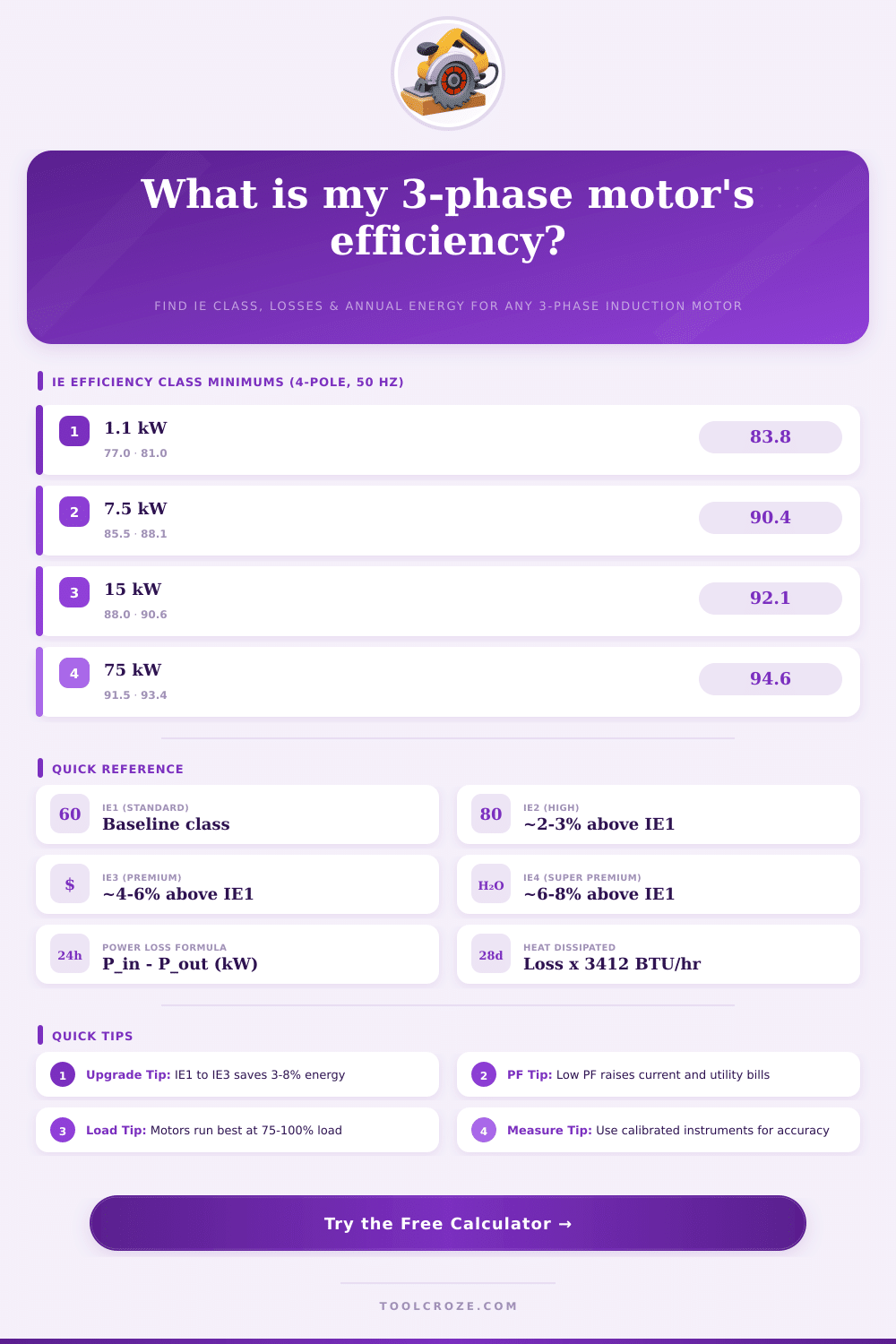
| Rated Power | IE1 Min % | IE2 Min % | IE3 Min % | IE4 Min % |
|---|---|---|---|---|
| 1.1 kW / 1.5 hp | 77.0 | 81.0 | 83.8 | 85.8 |
| 2.2 kW / 3 hp | 81.5 | 84.3 | 87.0 | 88.8 |
| 5.5 kW / 7.5 hp | 84.5 | 87.6 | 89.6 | 91.3 |
| 7.5 kW / 10 hp | 85.5 | 88.1 | 90.4 | 92.0 |
| 11 kW / 15 hp | 87.0 | 89.8 | 91.4 | 92.9 |
| 15 kW / 20 hp | 88.0 | 90.6 | 92.1 | 93.5 |
| 22 kW / 30 hp | 89.0 | 91.2 | 92.7 | 94.0 |
| 37 kW / 50 hp | 90.5 | 92.5 | 93.7 | 94.8 |
| 55 kW / 75 hp | 91.0 | 93.0 | 94.3 | 95.3 |
| 75 kW / 100 hp | 91.5 | 93.4 | 94.6 | 95.5 |
| Power Factor | Relative Current Draw | Reactive Power (kVAR) | Impact |
|---|---|---|---|
| 0.70 | +43% | Very High | Heavy utility penalty |
| 0.75 | +33% | High | Significant penalty |
| 0.80 | +25% | Moderate-High | Some penalty |
| 0.85 | +18% | Moderate | Typical old motors |
| 0.90 | +11% | Low-Moderate | Good efficiency |
| 0.95 | +5% | Low | Near optimal |
| 1.00 | Baseline | Zero | Unity (ideal) |
| Improvement | 10 hp Motor (8760 hr) | 50 hp Motor (8760 hr) | 100 hp Motor (8760 hr) |
|---|---|---|---|
| +1% efficiency | ~640 kWh/yr | ~3,200 kWh/yr | ~6,400 kWh/yr |
| +2% efficiency | ~1,280 kWh/yr | ~6,400 kWh/yr | ~12,800 kWh/yr |
| +4% efficiency | ~2,550 kWh/yr | ~12,750 kWh/yr | ~25,500 kWh/yr |
| +6% efficiency | ~3,820 kWh/yr | ~19,100 kWh/yr | ~38,200 kWh/yr |
Three-phase motors almost always beat the single-phase when talking about efficiency. Here the reason: the 3 phase motor energy never truly drops during its cycle unlike the single-phase, that has those big tops and bottoms. That flatter and stable energy flow results in less energy waste and the engine simply runs more well in every set of conditions.
Why do the numbers show such difference? At smaller engines the gap is truly clear. A single-phase engine of three horsepower can reach only around 30% efficiency.
Why Three-Phase Motors Are More Efficient Than Single-Phase Motors
If one swaps it for a 3 phase motor model, sharply the efficiency jumps to about 50%. Even so, as the engines grow, that gap shrinks. For instance, a single-phase engine of 10 horsepower has 64% efficiency, while its 3 phase motor match arrives to almots 67%.
Big 3 phase motor engines usually prove to be more efficient than their little relatives. Some motors even reach up to 97% efficiency, although many are planned with maximum around 92%. Where do those losses come from?
There are two main kinds: fixed ones as magnetic losses, and changing ones, for instance copper losses. The copper part depends on the load and grows according to square of the current values.
The conditions of load affect a lot. If you run a 10-horsepower engine at only quarter of its maximum, it works at around 80% efficiency. But if one brings it too full capacity, the efficiency hovers at almost 86%.
Actually, reaching the best working point of the engine truly creates a visible change.
Here something great: if one gives both engines same voltage, flow, efficiency and power factor, a 3 phase motor gives around 73% more horsepower than single-phase. That truly is a huge bonus. Also, 3 phase motor engines start without needing extra parts like capacitors or switches, things that single-phase engines can not skip.
Single-phase engines need a special starting coil to create magnetism, and that coil usually turns off after the engine reaches around 75% of its rated speed.
Variable frequency drives offer extra boost for efficiency. They adjust the speed and torque to the real needs of the system. Running an engine at high speed when slow would do simply burns energy for nothing.
On the other hand, VFDs themselves cost around 3% of energy during the conversion.
Engines of higher and even top efficiency use better materials and smart builds to cut energy losses. To figure the efficiency, one divides the output power by the input. At three-phase, the formula uses square root of three, multiplied by line voltage, line flow, power factor and efficiency itself.
For instance, a three-horsepower engine at 230 volts, drawing 6 amps on three phases, needs around 2.4 kilowatts of input, while typical modern engines reach around 90% efficiency.
3 phase motor engines also last and run more well under heavy loads. They are physically more compact and costless than single-phase with same power ratings. At heart, three-phase is simply the smarter way to move an engine, because all three phases stay active and the AC cycle naturally bears the main work.