🪨 3/4 Gravel Calculator
Calculate cubic yards, bags, and weight for your 3/4" gravel project instantly
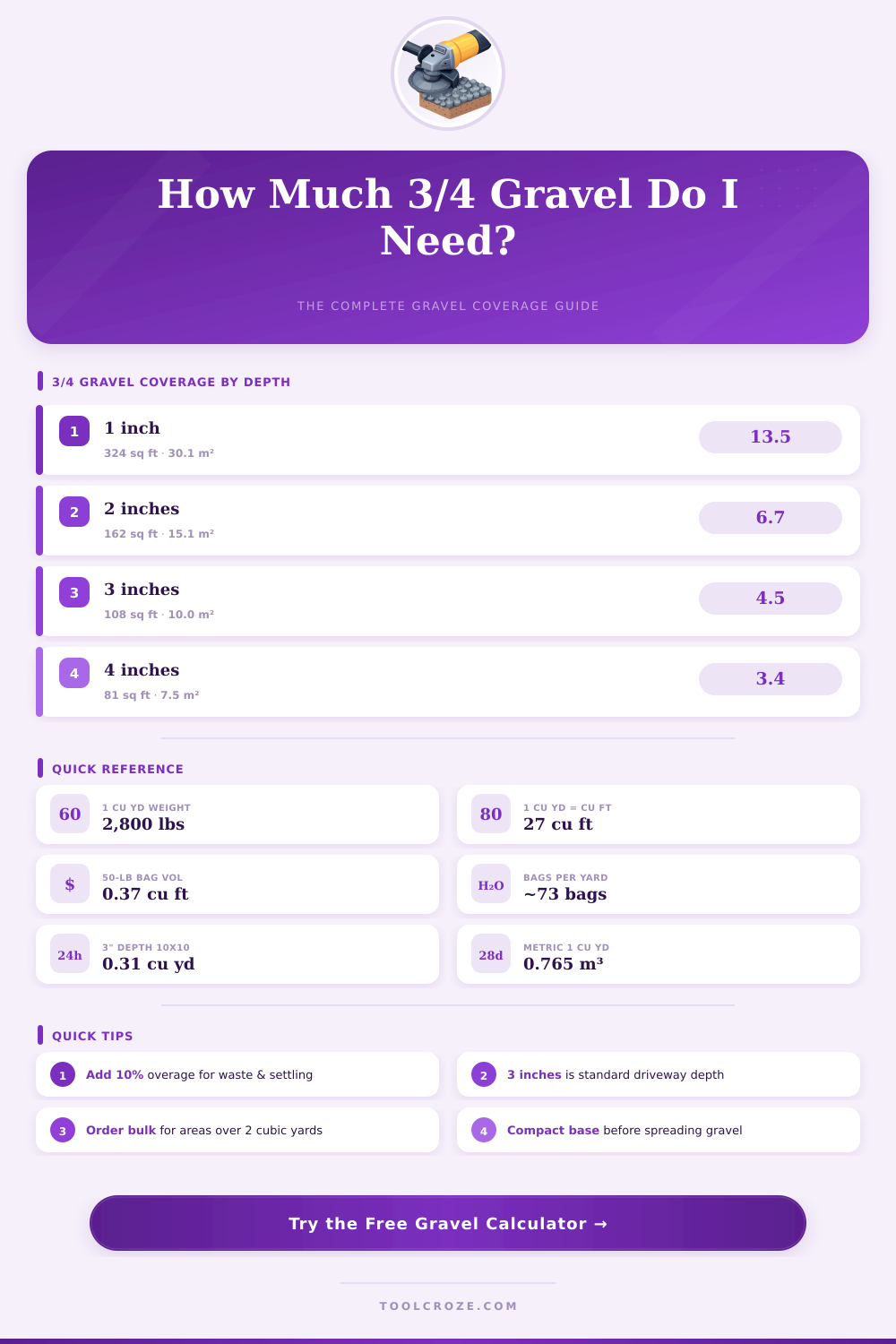
| Depth | Sq Ft per Cu Yd | Sq M per Cu Yd | Cu Yd per 1,000 Sq Ft |
|---|---|---|---|
| 1 inch | 324 sq ft | 30.1 m² | 3.09 cu yd |
| 2 inches | 162 sq ft | 15.1 m² | 6.17 cu yd |
| 3 inches | 108 sq ft | 10.0 m² | 9.26 cu yd |
| 4 inches | 81 sq ft | 7.5 m² | 12.35 cu yd |
| 6 inches | 54 sq ft | 5.0 m² | 18.52 cu yd |
| 8 inches | 40.5 sq ft | 3.8 m² | 24.69 cu yd |
| 12 inches | 27 sq ft | 2.5 m² | 37.04 cu yd |
| Bag Size | Volume per Bag | Bags per Cu Yd | Coverage at 3" |
|---|---|---|---|
| 50 lb bag | ~0.37 cu ft | ~73 bags | ~4 sq ft |
| 2 cu ft bag | 2 cu ft | 13.5 bags | ~8 sq ft |
| 3 cu ft bag | 3 cu ft | 9 bags | ~12 sq ft |
| 0.5 cu yd bulk | 13.5 cu ft | 0.5 yd | ~54 sq ft |
| 1 cu yd bulk | 27 cu ft | 1 yd | ~108 sq ft |
| Project | Area | Cu Yd at 3" | 2 Cu Ft Bags |
|---|---|---|---|
| Small Patio 10x10 | 100 sq ft | 0.93 cu yd | 13 bags |
| Medium Driveway 20x10 | 200 sq ft | 1.85 cu yd | 25 bags |
| Garden Path 20x4 | 80 sq ft | 0.74 cu yd | 10 bags |
| Large Driveway 50x20 | 1,000 sq ft | 9.26 cu yd | 125 bags |
| Parking Pad 20x20 | 400 sq ft | 3.70 cu yd | 50 bags |
| Drainage Trench 30x2 | 60 sq ft | 1.11 cu yd | 15 bags |
| Backyard Area 30x30 | 900 sq ft | 8.33 cu yd | 113 bags |
Gravel jobs are where your gut feel is no good. You might start with an idea of what you need, but end up with a pile too big to use or too small for the job. You might even end up with a pile that doesn’t fit on your driveway. Measure twice, order once… Otherwise you’ll be making multiple trips to quarry.
You can eyeball a space until you are cross-eyed, but stone do not compress into neat mental images, which is why intuition fails you spectacularly and you actualy need math to define its bounds. Let the calculator do the math for you so you don’t need to guess at coefficients and conversions.
Why You Need to Measure Gravel Correctly
It’s not all about area. It’s mostly about volume. Gravel isn’t like carpet; you don’t just measure in square feet. There’s thickness to consider, too. Before shopping around, establish your desired depth (in inches) and use that number in your calculations. For example, a driveway can be as thin as three inches, which is stable underneath cars’ tires but not too pricey. A decorative edging could be two inches thick. However, a drainage trench need at least six inches to do its job. The calculator will translate this into cubic yards (how they’ll weigh and sell it to you).
What stone is used make all the difference in the outcome. A driveway requires material with teeth, like crushed stone. Its sharpness interlocks to hold up under tires and heels. Smooth pea gravel rolls around and works well as a walking path, but it will move onto your lawn and is not good for parking. Decorative river rock holds no strength against anything structural. Using the calculator, you can select from various type such as drainage stone or crushed limestone. The density affects weight estimate, but selecting the right material type is what prevents ordering the wrong kind of stone for the desired use: a functioning driveway.
When transporting material, weight counts. A cubic yard of regular gravel will weigh roughly two thousand seven hundred pounds. That’s plenty of weight to harm your suspension unless your vehicle are rated for it. Unless you have a tow vehicle capable of handling a full load, do not assume that multiple shopping trips with bags will work. One cubic yard will require several loads of bag. For large projects, buy in bulk by the ton. The table below references the conversion from bags to other sizes. However, don’t wait until you have too much to carry before deciding to get a delivery. For most projects, once you exceed two cubic yards, you’ll need either a trailer or a dump truck for delivery, multiple stores runs would of not sufficed.
Plan to buy more because things always shrink in reality so you need to include additional materials to cover lost volume. Some of the stone will settle on top when installed and some will roll up underneath the edges and dissapears into the ground beneath. Ten percent extra isn’t too many dollars and provides a healthy cushion against loss. But if you’ve got lots of corner and curve in your shape, consider adding an extra 15-20 percent. It is better to have slightly more then to wait for another load to arrive while the project sits idle.
When you’re done, a good base ensures a solid feel. There’s no time spent fretting over supply, and more time spent using the space. In the end, it look exactly how you planned and handles weight well.