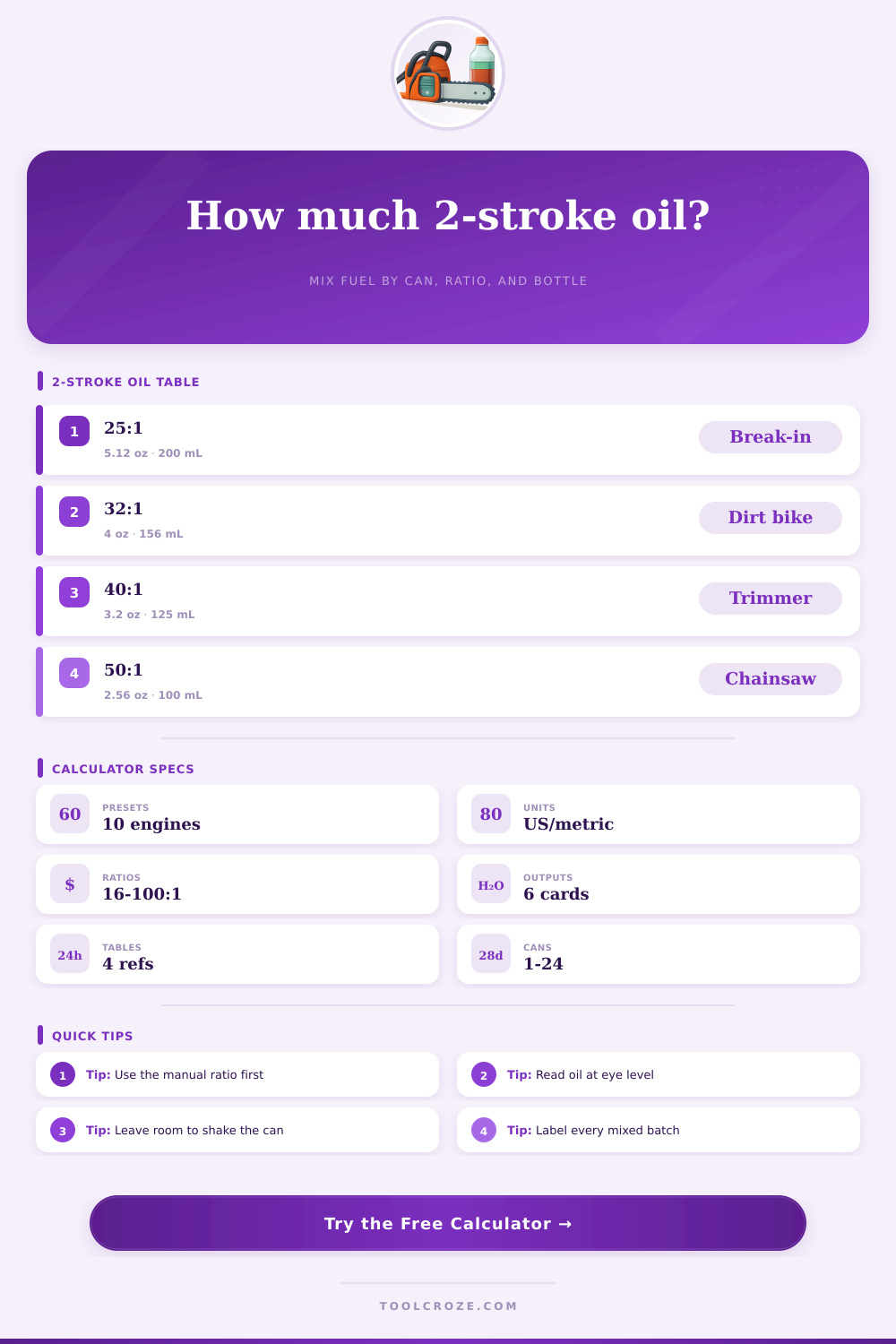
2-Stroke Fuel Mix Calculator
Calculate two-stroke oil by fuel can, ratio, engine class, measuring bottle graduation, number of cans, and allowed measuring error.
Start with a common two-stroke batch, then adjust the ratio and bottle marks to match the engine manual and oil container you actually use.
These rows update from your selected ratio and display unit, so the table can be used as a quick shop label.
| Fuel amount | Exact oil | Nearest bottle mark | Mark error |
|---|---|---|---|
| 1 gal | - | - | - |
| Engine class | Common ratio range | Typical batch | Oil note |
|---|---|---|---|
| Chainsaw or cut-off saw | 40:1 to 50:1 | 1 gal or 5 L | High-speed air-cooled engines need accurate measuring. |
| String trimmer or blower | 40:1 to 50:1 | 1 gal or 2.5 gal | Use one batch per can so the label stays simple. |
| Dirt bike or mini bike | 24:1 to 40:1 | 2.5 gal or 10 L | Race and break-in settings vary widely by engine. |
| Outboard two-stroke | 50:1 common | 10 L or 6 gal | Use the specified marine-rated oil type. |
| Older utility engine | 16:1 to 32:1 | 1 gal | Do not lean out an old engine without the manual. |
| Bottle or cup | Useful marks | Best for | Practical note |
|---|---|---|---|
| 100 mL pocket bottle | 5 or 10 mL | 1 L to 5 L cans | Good for metric saw and trimmer batches. |
| 250 mL mixing bottle | 0.25 fl oz or 10 mL | 1 gal and 2.5 gal cans | Common size for home shop premix. |
| 500 mL shop bottle | 25 or 50 mL | 10 L and multi-can runs | Less refilling when several cans are mixed. |
| 1 quart oil bottle | 1 fl oz | Large race or outboard batches | Coarse marks can create noticeable ratio drift. |
| Plan | Fuel layout | 50:1 oil guide | Why it matters |
|---|---|---|---|
| Single handheld can | 1 x 1 gal | 2.56 fl oz | Easy to label and finish before fuel gets old. |
| Weekend yard batch | 2 x 1 gal | 5.12 fl oz total | Two small cans avoid overfilling one container. |
| Trail or race day | 2 x 2.5 gal | 12.8 fl oz total | Mix each can the same to keep jetting predictable. |
| Metric shop run | 3 x 5 L | 300 mL total | Metric marks are often easier for repeat batches. |
A two-stroke engine require a spesific ratio of oil to gasoline. This is due to the fact that a two-stroke engine dont have a separate oil sump that provides lubrication to the engine. Instead, the ratio of oil to gasoline will provide the engine with the lubrication that it requires for even function, as well as to cool the engine and to seal within the engine.
If there is too little oil provided to the engine, the engine will overheat and wear its self down rapid. If there is too much oil provided to the engine, the engine will produce smoke, wear itself down, and lose power. Due to the effect that the oil to gasoline ratio has upon the engine, it is important to determine the correct ratio for that specific engine, oil, and conditions in which it will be running.
How to Mix Oil and Gasoline for Two-Stroke Engines
One of the first place that many individuals will look for the oil-to-gasoline ratio is the engine manual. The manufacturer can change the ratio that is specified based off the type of engine that is being used. For instance, engines that is air-cooled and tend to reach high temperatures may require a higher ratio of oil to gasoline than water-cooled outboards that dont need to reach as high of a throttle as the air-cooled engines.
The engine class that is entered into the calculator is used to account for these different type of engines so that the ratio that is provided is more accurate to that specific make and model of engine. In order to properly create the oil to gasoline mixture, the amount of oil must be measured accurately to ensure that the ratio is correct. Because it is difficult to measure the oil to the exact milliliter, the person should set the mark on the measuring bottle to the amount of oil that is to be used, and the reading should be taken to the smallest graduation mark on the measuring bottle.
Errors in measuring the oil can have a significant impact upon the performance of the engine. For instance, a three percent error on the amount of oil that is measured into the gasoline can impact the oil-to-gasoline ratio in a manner that can impact the performance of a high-revving engine. While this might not matter for garden tools, such error can have an impact upon two-stroke engines that is used for bikes and race karts.
The size of the batch of fuel that is created can impact the errors that is created within the fuel. For instance, if one batch of fuel is created at a time, there is no need to worry about the accuracy of the oil and gasoline mixture. However, if several batch of fuel are created at once, any error in measuring the oil will be reflected in each batch of fuel that is created.
Additionally, there must be some headspace provided for the fuel container after the oil is added to the container. Without this headspace, it wont be possible to shake the container to ensure that the oil is mixed with the gasoline. Most of the time, people make errors in the preparation of the oil and gasoline mixture for two-stroke engines due to certain habit.
For instance, individuals often reuse old fuel that has lost some of it’s volatility. Additionally, people often pour oil into an empty fuel container and shake the container in the attempt to mix the two substance. Finally, people often treat all engine the same, regardless of the manufacturer or model of the engine, because the previous engine model worked with a specific ratio of oil to gasoline.
Checking the spark plug of the engine can reveal whether or not the oil and gasoline mixture is correct; if the spark plug is tan in color rather than black or white, it is recommended to check the type and quality of the oil that is being used in the engine. Finally, it is important to label each fuel container with the date that the fuel was made, the ratio of oil to gasoline that went into the container, and the make and model of the engine for which it will be used. Fuel made for two-stroke engine does not improve with age.
The ratio of oil to gasoline that was correct for a trimmer in the yard in the month of May might not be correct for a bike in the yard in the month of January due to the change in temperatures. Thus, the fuel must be labeled so that the oil-to-gasoline ratio that was calculated with the calculator remains attached to the engine for which the fuel was created. Actualy, you should of checked teh labels carefully.
Useing the right mixture is more important then any other step.