🔧 Tap & Drill Size Calculator
Find the correct tap drill size for any thread — imperial UNC/UNF or metric coarse/fine
| Tap Size | TPI | Tap Drill (75%) | Drill Decimal (in) | Pitch (in) | Min Drill (50%) |
|---|---|---|---|---|---|
| #4-40 | 40 | #43 | 0.0890 | 0.0250 | #42 |
| #6-32 | 32 | #36 | 0.1065 | 0.0313 | #33 |
| #8-32 | 32 | #29 | 0.1360 | 0.0313 | #28 |
| #10-24 | 24 | #25 | 0.1495 | 0.0417 | #26 |
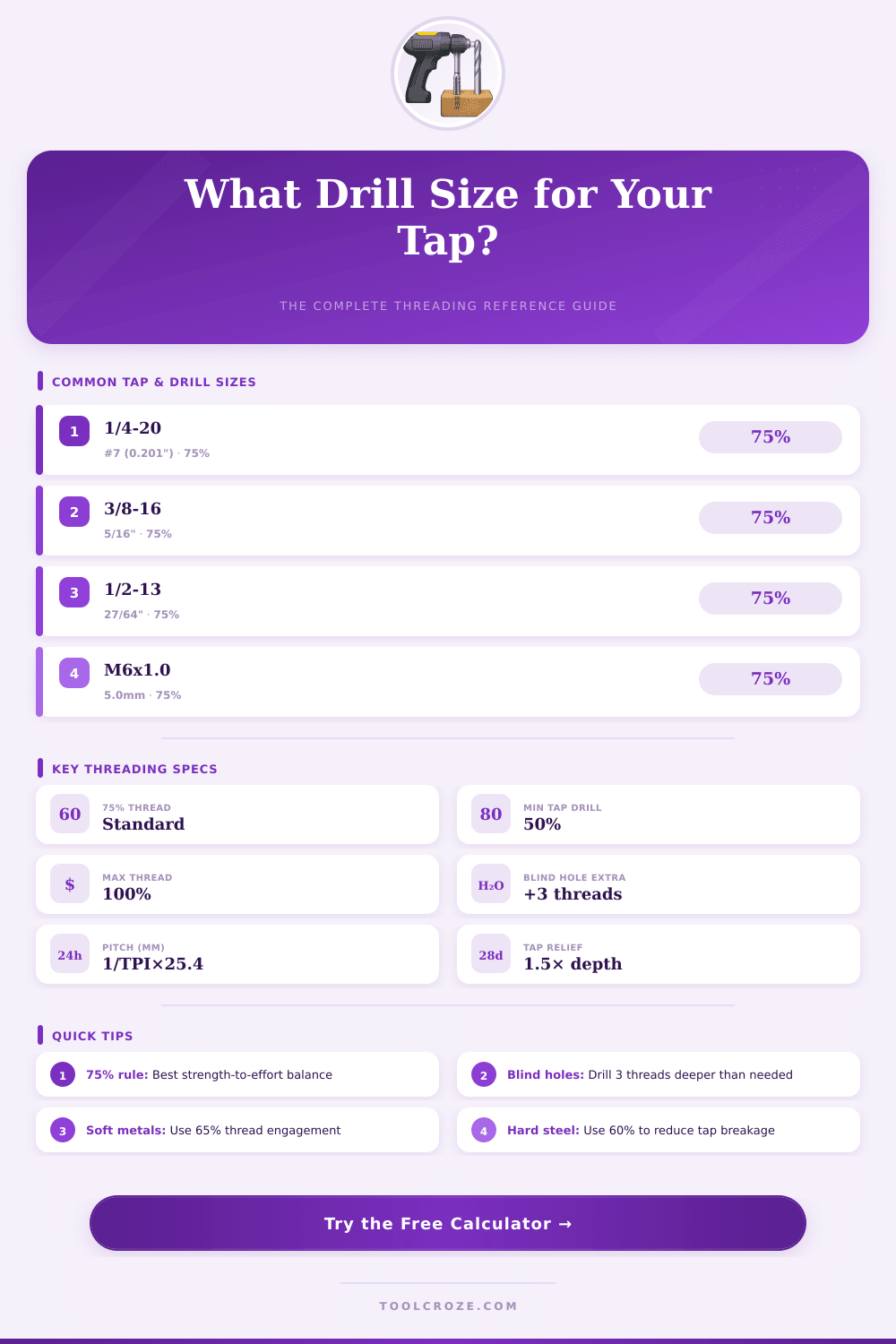
| 1/4-20 | 20 | #7 | 0.2010 | 0.0500 | #3 |
| 5/16-18 | 18 | F | 0.2570 | 0.0556 | G |
| 3/8-16 | 16 | 5/16 | 0.3125 | 0.0625 | 21/64 |
| 7/16-14 | 14 | U | 0.3680 | 0.0714 | 25/64 |
| 1/2-13 | 13 | 27/64 | 0.4219 | 0.0769 | 29/64 |
| 5/8-11 | 11 | 17/32 | 0.5313 | 0.0909 | 35/64 |
| 3/4-10 | 10 | 21/32 | 0.6563 | 0.1000 | 43/64 |
| Tap Size | Pitch (mm) | Drill (75%) | Drill Decimal (mm) | Min Drill (50%) | Thread Depth Formula |
|---|---|---|---|---|---|
| M3x0.5 | 0.50 | 2.5mm | 2.500 | 2.6mm | D – 0.5 |
| M4x0.7 | 0.70 | 3.3mm | 3.300 | 3.5mm | D – 0.7 |
| M5x0.8 | 0.80 | 4.2mm | 4.200 | 4.4mm | D – 0.8 |
| M6x1.0 | 1.00 | 5.0mm | 5.000 | 5.3mm | D – 1.0 |
| M8x1.25 | 1.25 | 6.8mm | 6.800 | 7.0mm | D – 1.25 |
| M10x1.5 | 1.50 | 8.5mm | 8.500 | 8.8mm | D – 1.5 |
| M12x1.75 | 1.75 | 10.2mm | 10.200 | 10.5mm | D – 1.75 |
| M14x2.0 | 2.00 | 12.0mm | 12.000 | 12.4mm | D – 2.0 |
| M16x2.0 | 2.00 | 14.0mm | 14.000 | 14.4mm | D – 2.0 |
| M20x2.5 | 2.50 | 17.5mm | 17.500 | 18.0mm | D – 2.5 |
| Material | SFM Range | RPM (1/4" Tap) | RPM (M6 Tap) | Cutting Fluid | Flutes |
|---|---|---|---|---|---|
| Aluminum | 50–100 SFM | 764–1528 | 838–1676 | WD-40 / Kerosene | 2 (spiral) |
| Mild Steel | 20–40 SFM | 305–611 | 335–671 | Cutting oil | 3–4 |
| Stainless Steel | 10–25 SFM | 153–382 | 168–419 | Sulfurized oil | 3 (spiral) |
| Cast Iron | 20–35 SFM | 305–534 | 335–586 | Dry / light oil | 3 |
| Brass / Bronze | 50–100 SFM | 764–1528 | 838–1676 | Light oil | 3 |
| Titanium | 8–15 SFM | 122–229 | 134–252 | TiCN coated tap | 3 (spiral) |
| Hardwood | 80–120 SFM | 1222–1833 | 1341–2011 | Dry | 2 |
| Plastic / Acrylic | 100–150 SFM | 1528–2292 | 1676–2514 | Dry / air blast | 2 |
| Bit Type | Best For | Point Angle | Max RPM (1/4") | Flutes | Notes |
|---|---|---|---|---|---|
| HSS Twist Bit | Steel, aluminum, wood | 118° | 3000 RPM | 2 | General purpose |
| Cobalt (HSCo) | Stainless, titanium | 135° | 2500 RPM | 2 | Heat resistant |
| TiN Coated HSS | Most metals | 118° | 3500 RPM | 2 | Extended life |
| Carbide Tipped | Cast iron, abrasives | 130° | 4000 RPM | 2 | Hard/abrasive materials |
| Brad Point | Wood, plastic | 90° | 3500 RPM | 2 | Clean entry holes |
| Spiral Flute | Deep blind holes | 118° | 2500 RPM | 3 | Chip evacuation |
| Project / Application | Tap Size | Drill Bit | Material | Thread Depth | Engagement |
|---|---|---|---|---|---|
| Electronics / PCB standoff | #4-40 UNC | #43 (0.089") | Aluminum | 0.25" | 75% |
| Machine frame bolts | 1/4-20 UNC | #7 (0.201") | Mild steel | 0.50" | 75% |
| Hydraulic fittings | 3/8-16 UNC | 5/16" (0.3125") | Steel | 0.75" | 75% |
| Engine bolt holes | M10x1.5 | 8.5mm | Cast iron | 20mm | 75% |
| Furniture hardware | M6x1.0 | 5.0mm | Hardwood | 12mm | 75% |
| Structural steel | 1/2-13 UNC | 27/64" (0.422") | Mild steel | 1.0" | 75% |
| Plastic enclosures | M4x0.7 | 3.3mm | ABS Plastic | 8mm | 65% |
| Aerospace brackets | 1/4-28 UNF | #3 (0.213") | Titanium | 0.50" | 65% |
Choosing the right size of Drill before Tap threaded hole is big help. That helps to keep the threads strong and stop the Tap from splitting. Charts about Taps and Drill sizes simplify the whole process because they allow matching the right Drill to the thread type and size.
Such charts describe metric, NPT, screw and inch-sized Taps, and they commonly suggest Drills according to around 75 percent thread engagement.
How to Choose the Right Drill Size for Tapping Holes
Simple math works for all threads in 60 degrees. Just subtract the pitch from the diameter. For instance for 1/4-20 thread, the pitch matches 1/20 of inch, so 0.050 inches.
So 0.250 minus 0.050 gives 0.200 inches. The nearest standard Drill is number 7 with 0.201 inches. For metric threads it is even simpler, because the pitch already is stated.
Thread M5x0.8 requires 4.2 mm Drill for the Tap. For M8x1.25 one subtracts 1.25 from 8 what gives 6.75 mm. Usually one rounds to the next full 0.1 mm, so 6.8 mm is the standard Drill for Tap of that size.
Practical thumb-rule for inch screws is to use 85 percent of the thread diameter for coarse threads and 90 percent for fine threads.
The percent of thread is really important. Drill number 30 delivers around 80 percent thread level for M4-0.7, while number 29 reaches only about 60 percent. In most tasks 55 to 65 percent engagement of thread proves most efficient, because it unloads the Tap.
If one goes higher, for instance 90 percent, tapping becomes much harder and can brake the tool. In strong materials like stainless steel, dropping to 50 percent thread by means of different methods removes troubles.
The Tap 6-32 is known for its weakness. It has rough pitch with very small diameter, so the tools break quickly. In strong materials Drill that ensures 60 to 65 percent engagement helps a lot.
Sometimes one must test different Drills, until the breaks drop to a good level.
Materials like aluminium are more forgiving. A slightly too-small hole can work well, because the Tap itself will open it. In aluminium the exact Drill size matters less than good technique, and one must use cutting fluid, because aluminium likes to stick to Taps.
For 5/16 Tap 1/4-inch Drill works in most cases, being only a bit smaller than the suggested F-Drill.
For typical UNC coarse threads of 6-32 to 1/2-13, few Drill sizes are worth noting: number 36, number 29, number 25, number 7, letter F, 5/16 inch and 27/64. There are also combined Drill-Tap tools, where the Drill part follows the Tap on the same shaft. Many however likethe classic two-tool method, with Tap Drill first and later the Tap itself.