⚙️ SPZ Belt Length Calculator
Calculate exact V-belt length, speed ratio, belt velocity, and recommended SPZ belt code for any pulley setup
| Belt Code | Effective Length (mm) | Datum Length (mm) | Tolerance (mm) | Typical Application |
|---|---|---|---|---|
| SPZ 487 | 487 | 500 | ±8 | Small bench tools |
| SPZ 537 | 537 | 550 | ±8 | Compact pumps |
| SPZ 562 | 562 | 575 | ±8 | Small compressors |
| SPZ 587 | 587 | 600 | ±8 | Drill press drives |
| SPZ 637 | 637 | 650 | ±8 | Bench grinders |
| SPZ 687 | 687 | 700 | ±8 | Band saws |
| SPZ 737 | 737 | 750 | ±8 | Lathes, fans |
| SPZ 787 | 787 | 800 | ±9 | Machine tools |
| SPZ 837 | 837 | 850 | ±9 | General drives |
| SPZ 887 | 887 | 900 | ±9 | Compressors |
| SPZ 937 | 937 | 950 | ±9 | Pumps, fans |
| SPZ 987 | 987 | 1000 | ±10 | Industrial drives |
| SPZ 1037 | 1037 | 1060 | ±10 | Wood machines |
| SPZ 1087 | 1087 | 1120 | ±10 | Planers, joiners |
| SPZ 1137 | 1137 | 1180 | ±10 | Heavy machine tools |
| SPZ 1237 | 1237 | 1250 | ±11 | Conveyors |
| SPZ 1337 | 1337 | 1360 | ±11 | Large compressors |
| SPZ 1487 | 1487 | 1500 | ±12 | Industrial fans |
| SPZ 1587 | 1587 | 1600 | ±12 | Pump stations |
| SPZ 1987 | 1987 | 2000 | ±14 | Large drives |
| Profile | Top Width | Thickness | Min Pulley Ø | Max Speed | Power Range | Standard |
|---|---|---|---|---|---|---|
| SPZ | 9.7 mm | 8 mm | 63 mm | 25 m/s | 0.4–4 kW | ISO 4184 |
| SPA | 12.7 mm | 10 mm | 90 mm | 25 m/s | 1.5–11 kW | ISO 4184 |
| SPB | 16.3 mm | 13 mm | 125 mm | 25 m/s | 4–30 kW | ISO 4184 |
| SPC | 22 mm | 18 mm | 200 mm | 25 m/s | 15–90 kW | ISO 4184 |
| Z / 10 | 10 mm | 6 mm | 50 mm | 30 m/s | 0.2–2 kW | ISO 4183 |
| A / 13 | 13 mm | 8 mm | 75 mm | 30 m/s | 1–8 kW | ISO 4183 |
| B / 17 | 17 mm | 11 mm | 125 mm | 30 m/s | 3–20 kW | ISO 4183 |
| Application Type | Example Machines | Service Factor | Recommended Belt Count |
|---|---|---|---|
| Light Duty | Fans, blowers, centrifuges | 1.0 – 1.1 | 1–2 |
| Medium Duty | Lathes, drill presses, grinders | 1.1 – 1.2 | 1–3 |
| Heavy Duty | Compressors, pumps, planers | 1.2 – 1.4 | 2–4 |
| Shock Load | Conveyors, mixers, crushers | 1.4 – 1.6 | 3–6 |
| Continuous 24hr | Process plant, HVAC | 1.3 – 1.5 | 2–5 |
| Intermittent | Workshop tools, occasional use | 1.0 – 1.1 | 1–2 |
| Application | Driver Ø (mm) | Driven Ø (mm) | Center Dist (mm) | Approx Belt | Speed Ratio |
|---|---|---|---|---|---|
| Small Air Compressor | 100 | 200 | 350 | SPZ 987 | 2.0:1 |
| Bench Lathe | 75 | 150 | 300 | SPZ 787 | 2.0:1 |
| Band Saw | 63 | 175 | 400 | SPZ 1037 | 2.78:1 |
| Drill Press | 100 | 100 | 300 | SPZ 787 | 1.0:1 |
| Pedestal Grinder | 100 | 75 | 280 | SPZ 737 | 0.75:1 |
| Industrial Fan | 140 | 280 | 500 | SPZ 1337 | 2.0:1 |
| Centrifugal Pump | 120 | 180 | 450 | SPZ 1237 | 1.5:1 |
| Wood Planer | 100 | 250 | 450 | SPZ 1237 | 2.5:1 |
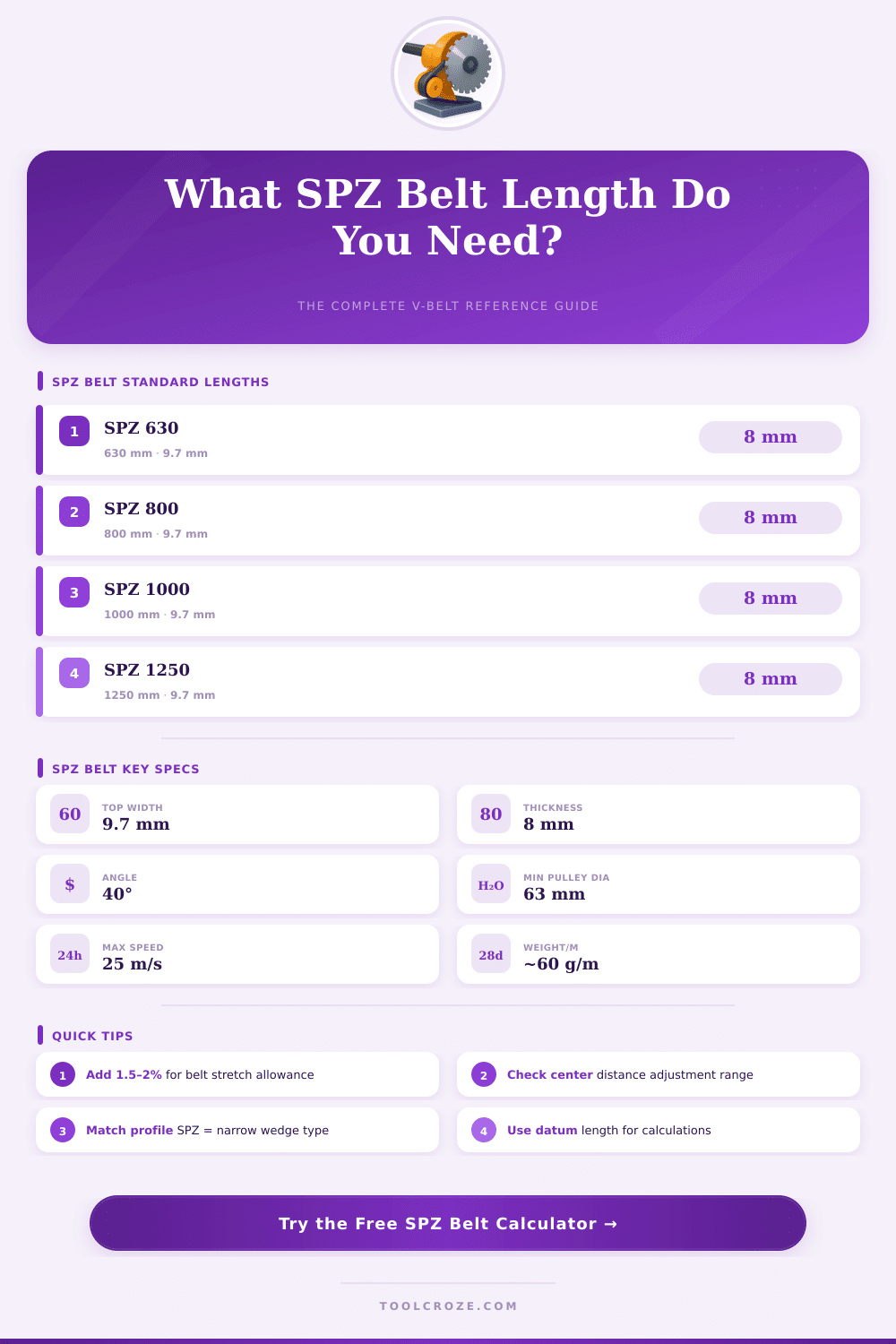
SPZ belts are a type of narrow V-belts for sending power. They have a low profile, we talk about 10 mm of width and 8 mm of height. Some specs mention it as 9.7 mm wide, but it is the same cross-section only measured a bit differently.
Those belts form a classic wedge shape, with a pair of upper parts with SPZ cross-section for V-pulleys.
SPZ V-Belts: How to Measure, Fit and Care
Choices of lengths for SPZ belts are many. One finds them in 700 mm, 710 mm, 1340 mm, 1937 mm and 2000 mm in pitch length. That gives quite a large range, which helps to choose exactly the right one.
Many of those belts use rubber cushion material strengthened by polyester cord that runs through them.
Here is where things get tricky for many folks. The real length code of a spz belt does not match what stands on the label. The measure one takes along the tension members in the belt, not along the surface, where one usually would measure.
So, if you take a tape measure and follow along the outside, your reading will not match the stamped value. It is effective length, sometimes called Lw, that is a theoritcal rating at a particular depth inside the V-cross-section of the belt. Because of that, outer measures stay only rough guesses.
To find the pitch length of a spz belt, add 13 mm to the inner circumference. Other kinds of belts need a different number (SPA takes 18 mm), SPB needs 22 mm and SPC needs 30 mm extra.
Types of V-belts are many everywhere. Standard sizes go threw Z, A, B, C, D and E. Then comes the narrow group with 3V, 5V and 8V options. Wedge belts cover SPZ, SPA, SPB and SPC among the options.
Double-sided belts appear as AA, BB and CC. Fractional horsepower belts widen the options with 2L, 3L, 4L and 5L sizes. The SPZ cross-section has 13 mm of width, same as SPA, while SPB comes in 17 mm and SPC reaches 22 mm.
Installing a spz belt needs pre-tension first. After it runs for 15 to 20 minutes, you must tighten it again. Surprisingly often one skips that step.
One more spot to recall: if the temperature stays above 60 degrees all the time, standard V-belts willnot last a long time.
Swapping old belts can get costly sometimes. A new belt with the same SPZ marking could be a bit longer than the replaced one. Such a difference can change the distance between pulleys.
Metric V-belts like SPZ happen often in industrial gear, textile mills, machine tools, food processing lines, and they can double the horsepower compared to traditional fractional belts.